Presentations

In a world full of agents: are we heading toward a future designed by AI?

A tour through the agentic AI landscape — what agents and multi-agent systems are, how they reason from prompts, how to architect and govern them, and whether the future ahead is one designed by AI.

The road from a proof of concept to a production system is longer than it looks, and the gap is where most agent projects stumble. In this talk from the ISCG and Microsoft conference in Warsaw, we trace the arc of the field: from the decade of model releases that brought us here, through what separates an assistant from an agent, to how agentic systems plan, reason, and coordinate as multi-agent teams. We work through the mechanics that make agents behave — prompt structure, sampling controls, reasoning methodologies, and workflow architectures — and the organizational shifts that come with treating agents as virtual employees. The closing question is the one in the title: as AI moves upstream from executing tasks to designing processes, how much of the future will be designed by AI, and how much remains ours to direct.

1. Opening
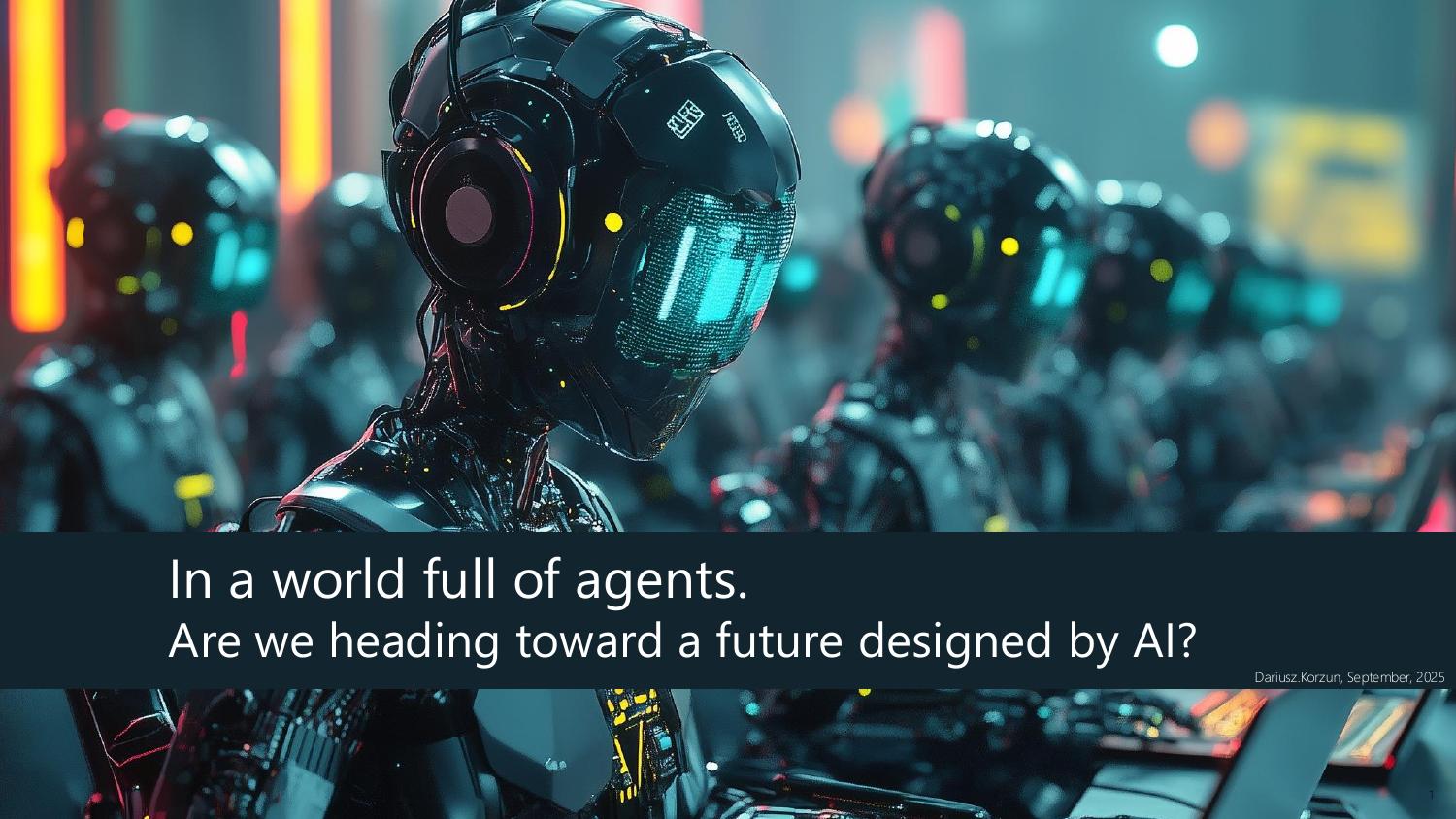
Title slide — in a world full of agents: are we heading toward a future designed by AI?

2. A caution from the field

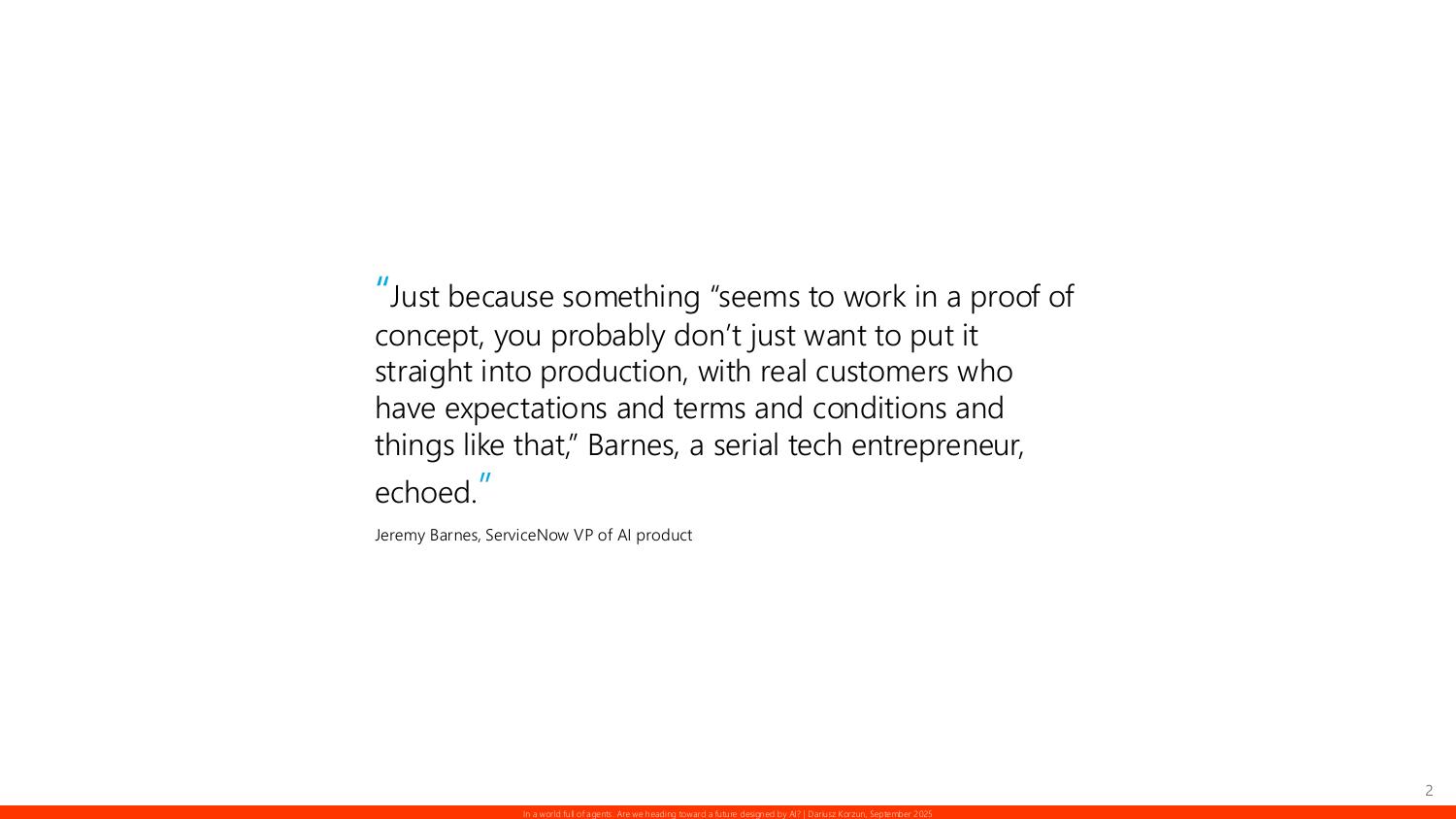
A caution from the field — Jeremy Barnes of ServiceNow on why a proof of concept should not be put straight into production with real customers

3. A decade of model releases

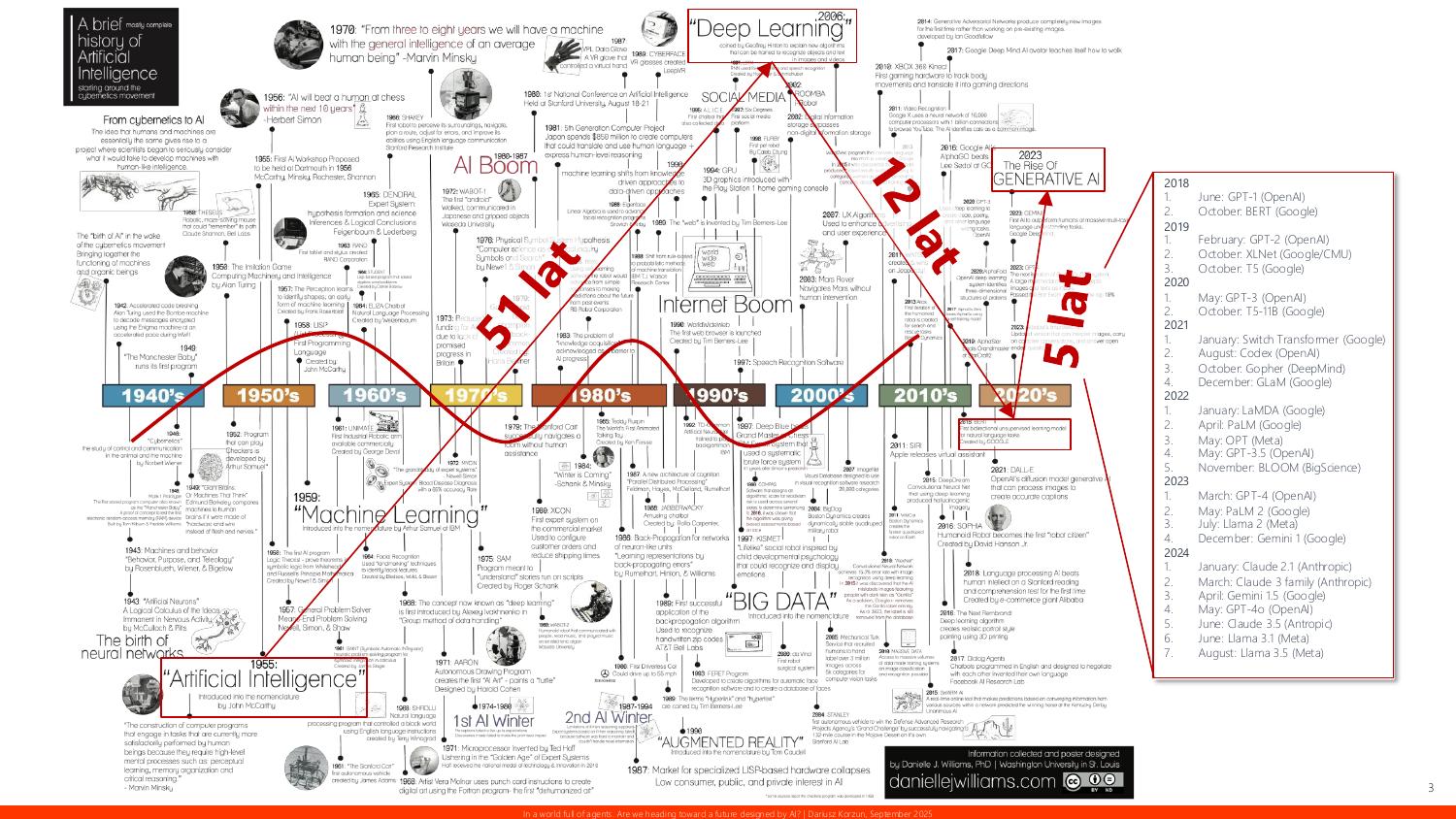
A timeline of large language model releases from 2018 to 2024 across OpenAI, Google, Meta, Anthropic, and others

4. A decade of model releases, continued
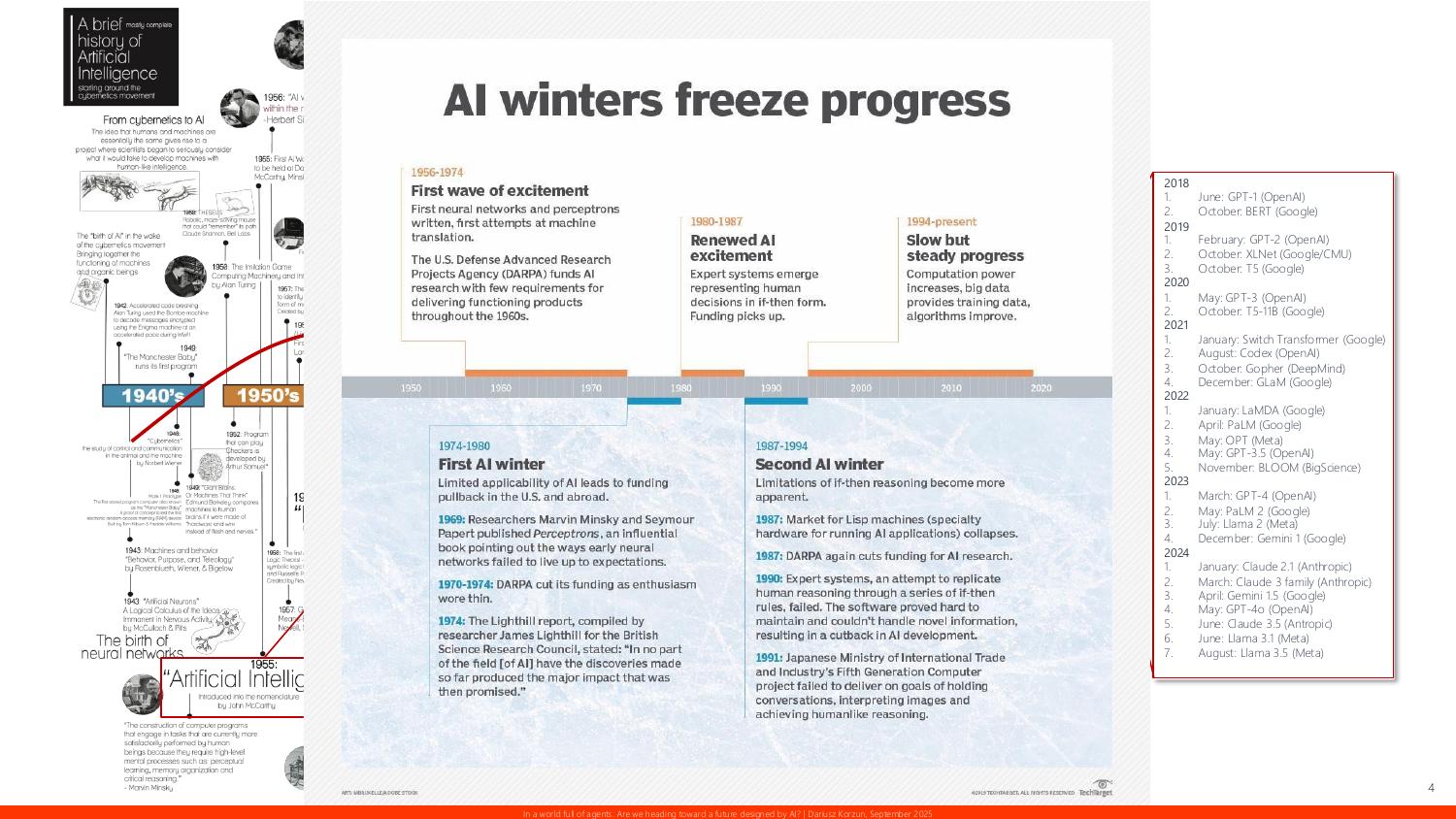
The 2018 to 2024 model release timeline continued, highlighting the accelerating pace of new frontier models

5. At the dawn of a new era

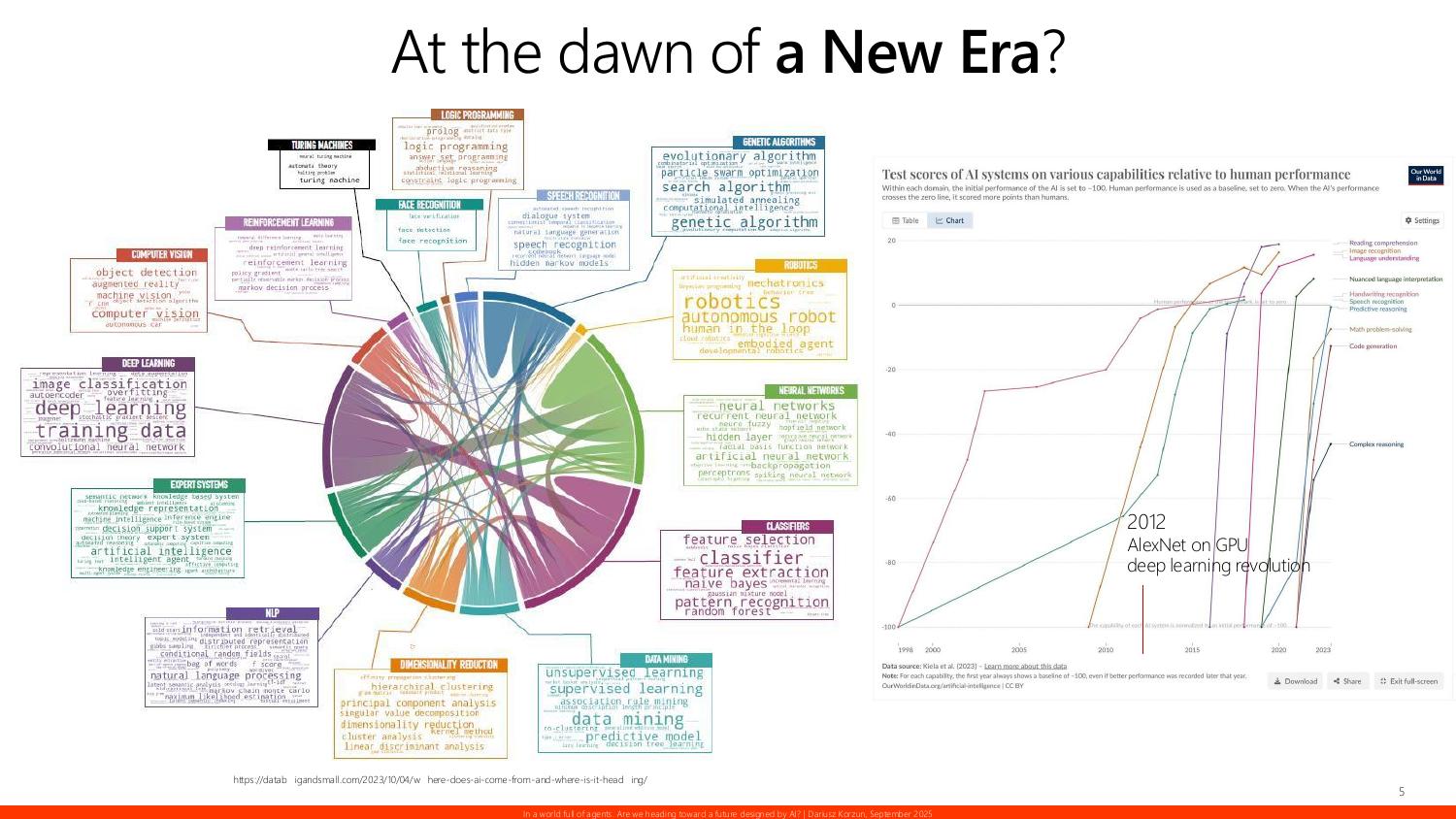
At the dawn of a new era — AlexNet on GPU in 2012 and the start of the deep learning revolution

6. Industry 4.0 and the fourth industrial revolution
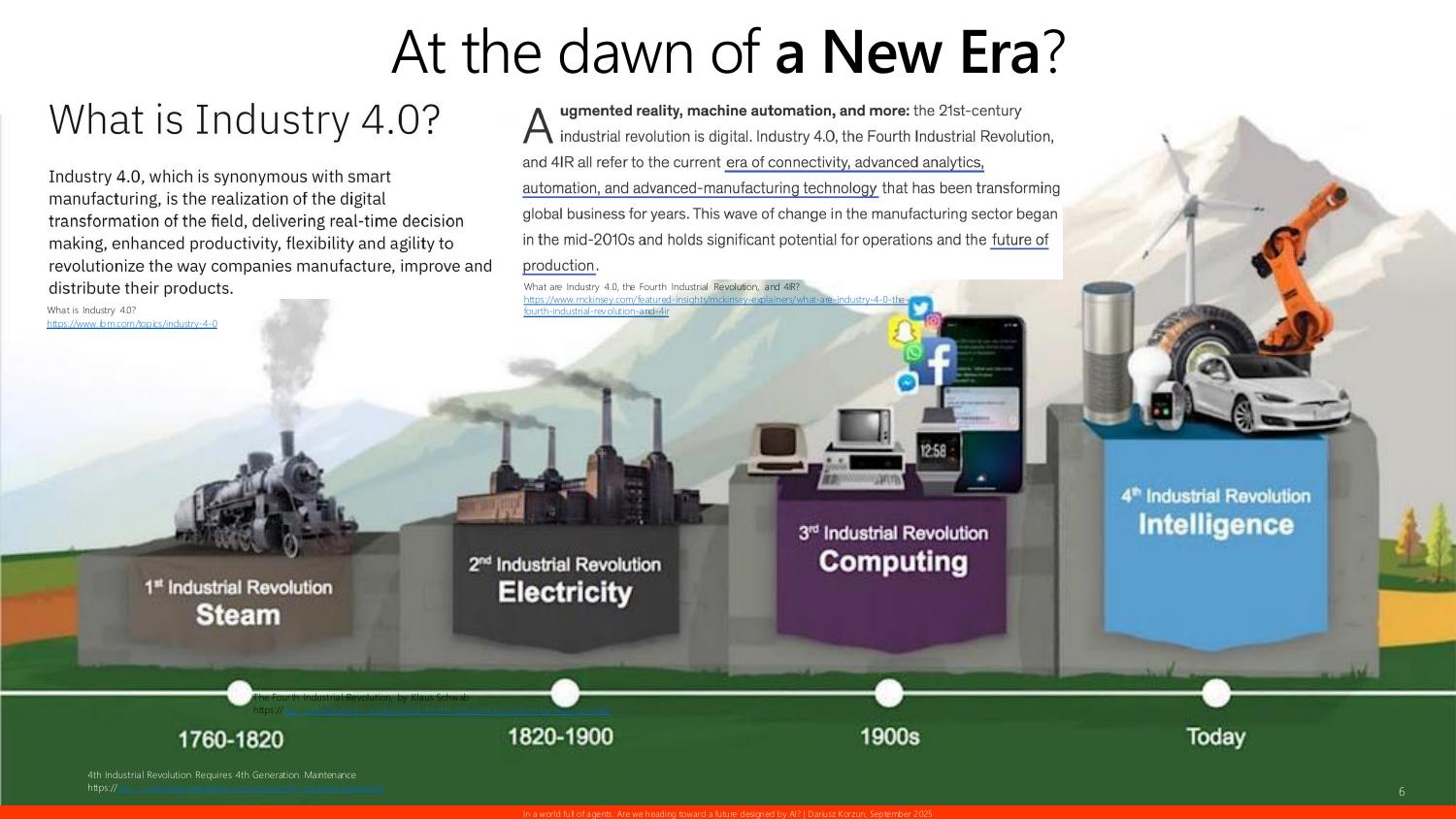
At the dawn of a new era — references framing Industry 4.0 and the fourth industrial revolution

7. Industry 4.0, continued
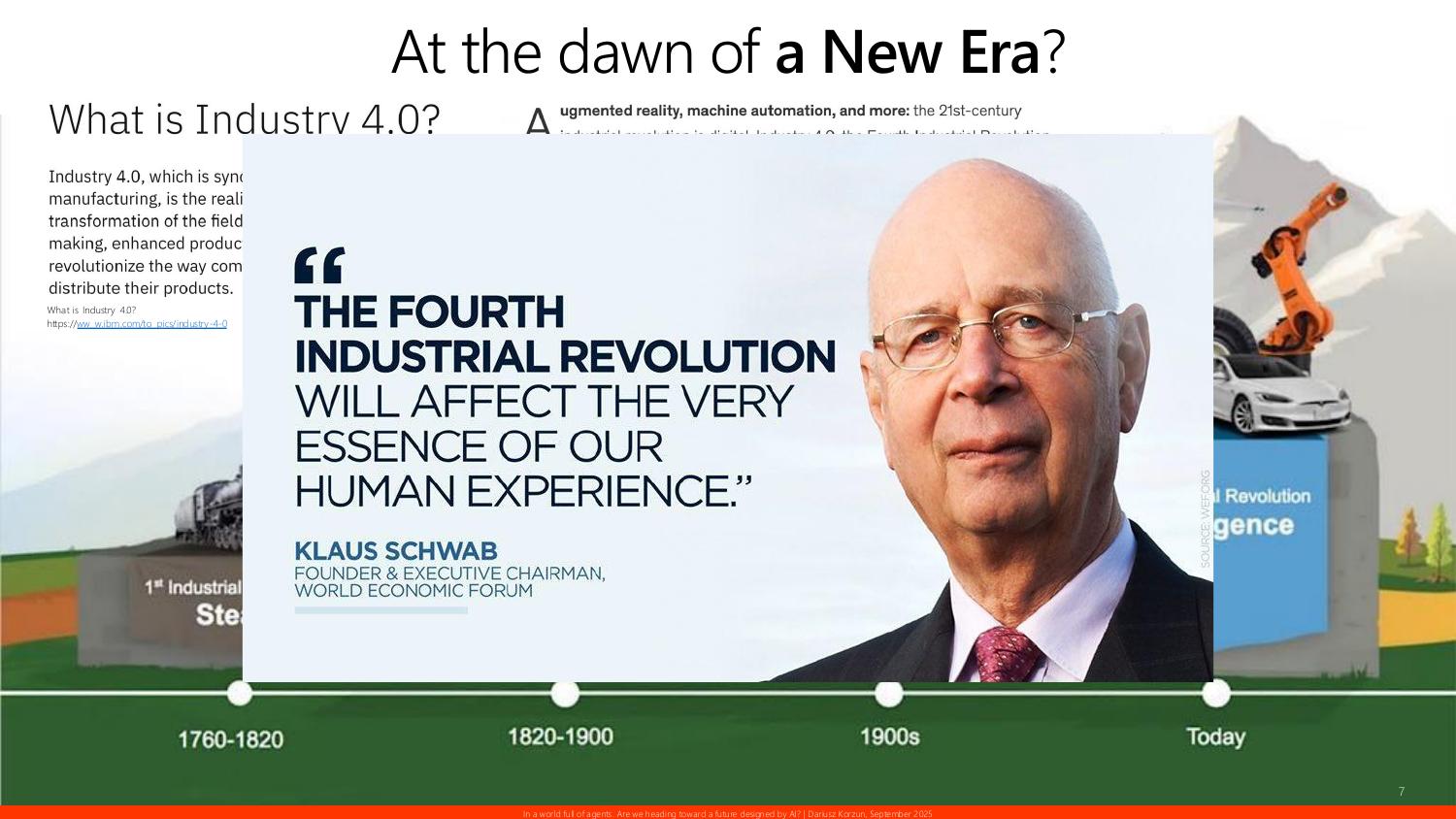
Industry 4.0 continued — situating AI agents within the fourth industrial revolution

8. What an AI agent is

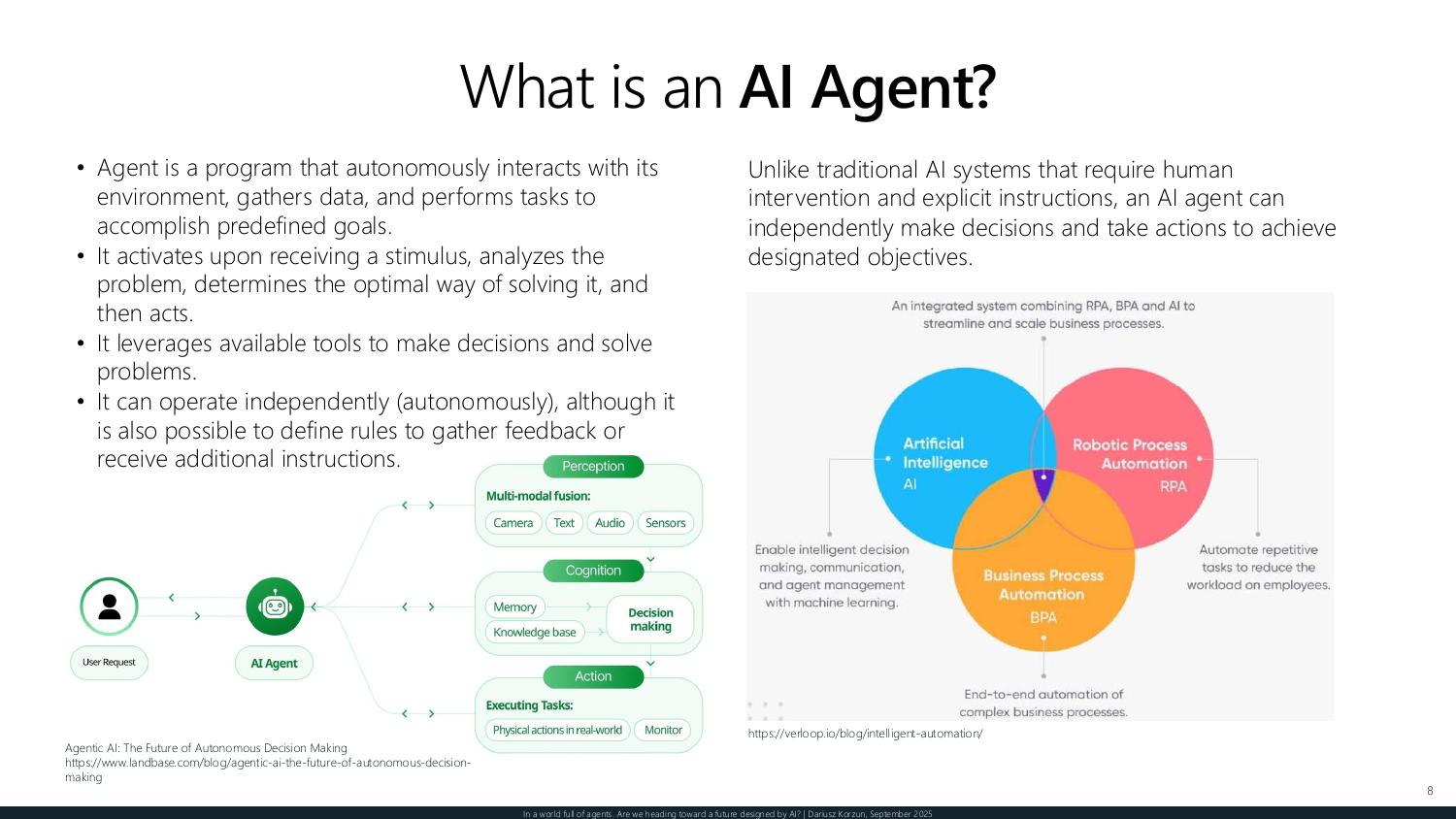
What an AI agent is — a program that autonomously senses its environment, decides, leverages tools, and acts to accomplish predefined goals

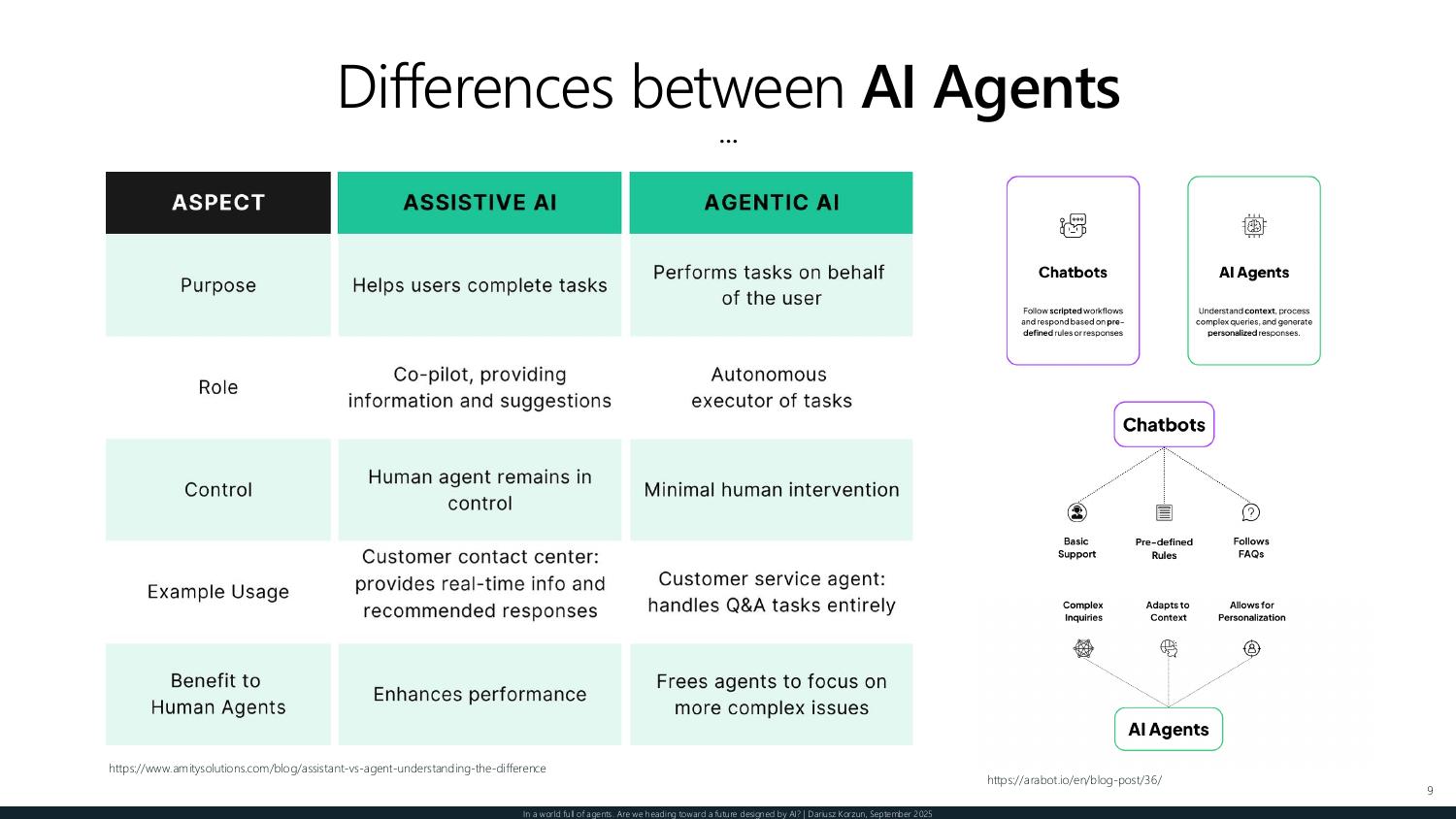
9. Assistants versus agents

Differences between AI assistants and AI agents

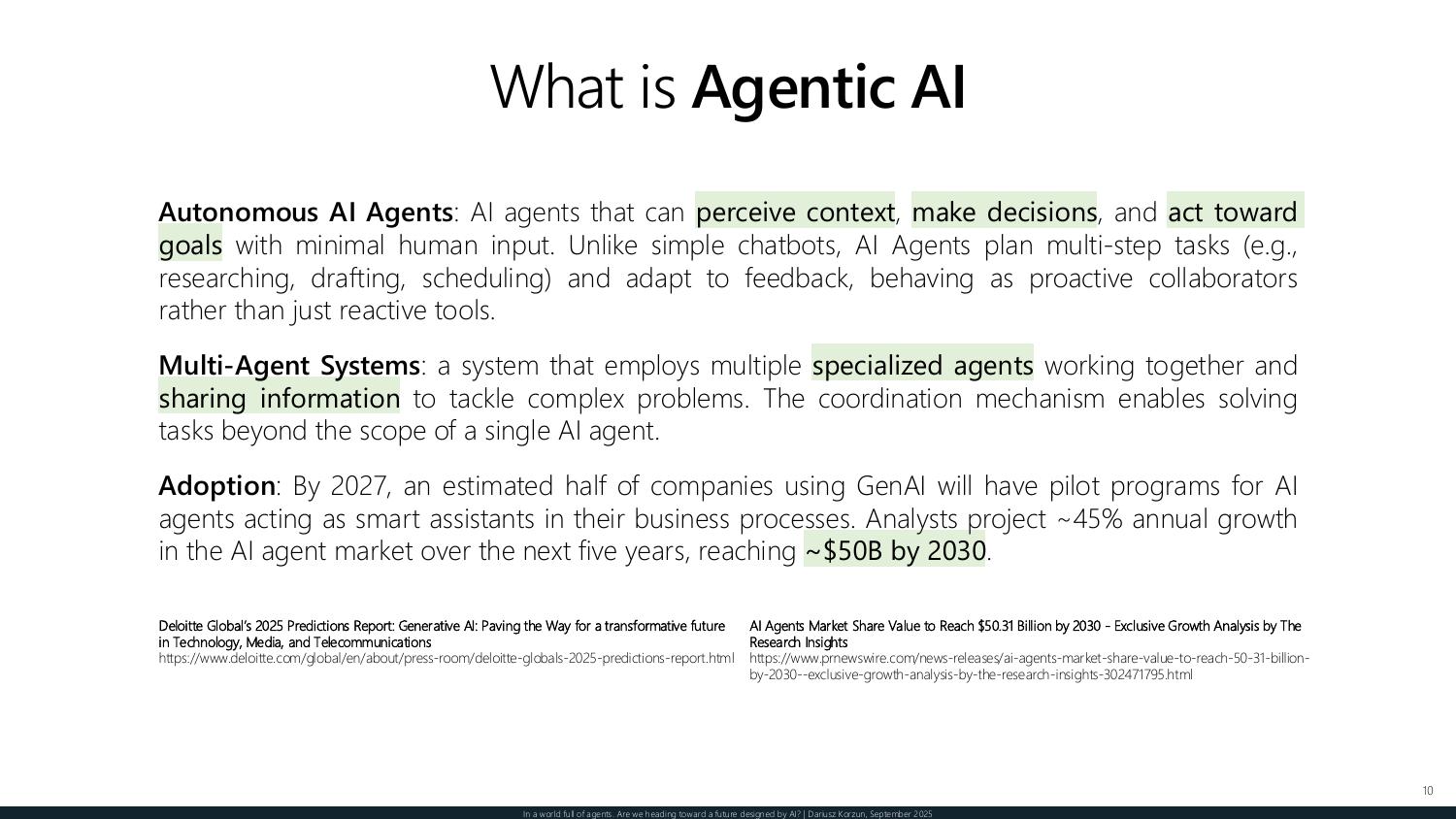
10. What agentic AI is

What agentic AI is — autonomous agents, multi-agent systems, and adoption forecasts toward a roughly fifty billion dollar market by 2030

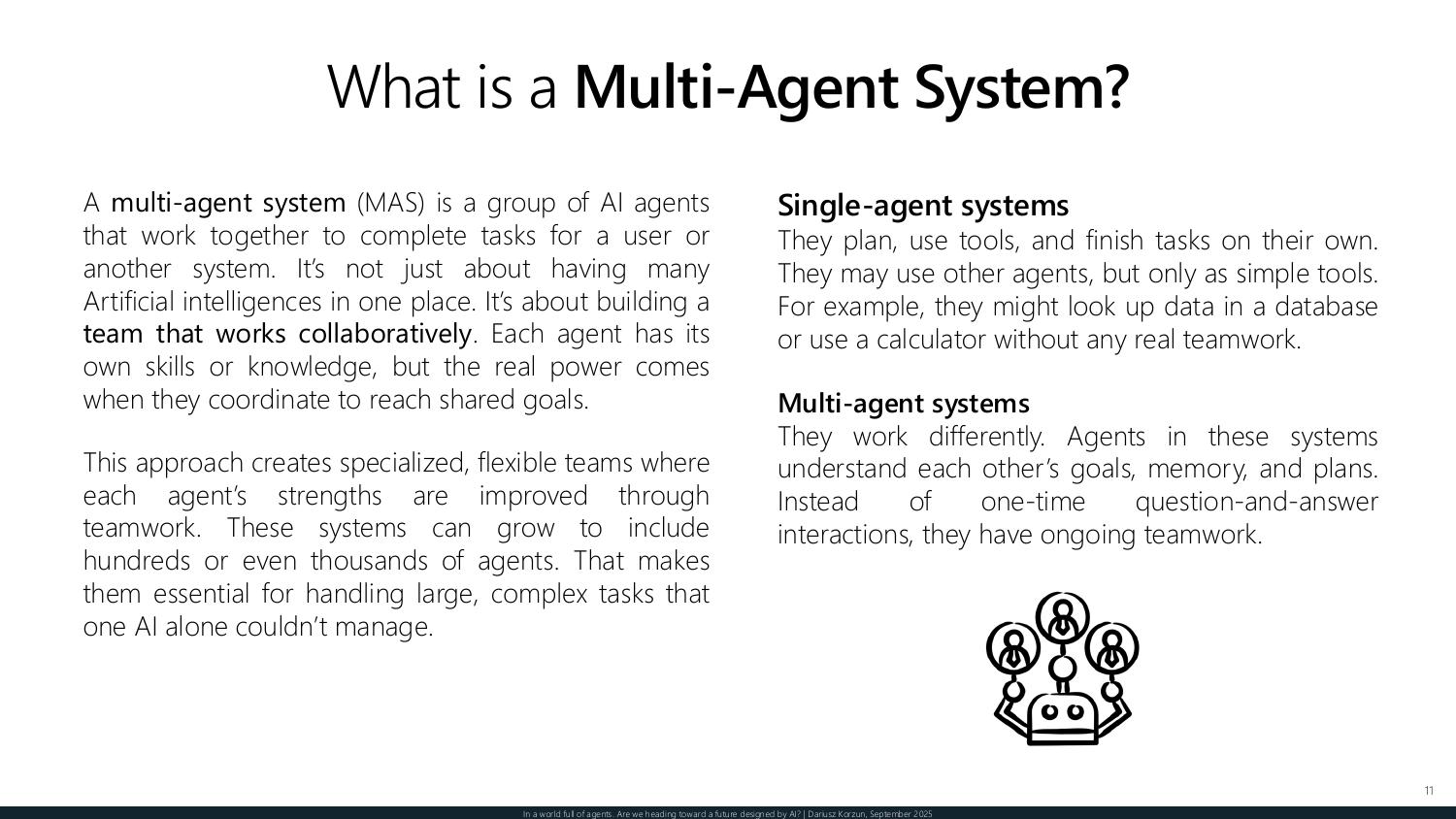
11. What a multi-agent system is

What a multi-agent system is — single-agent systems that use other agents as tools versus multi-agent teams that share goals, memory, and plans

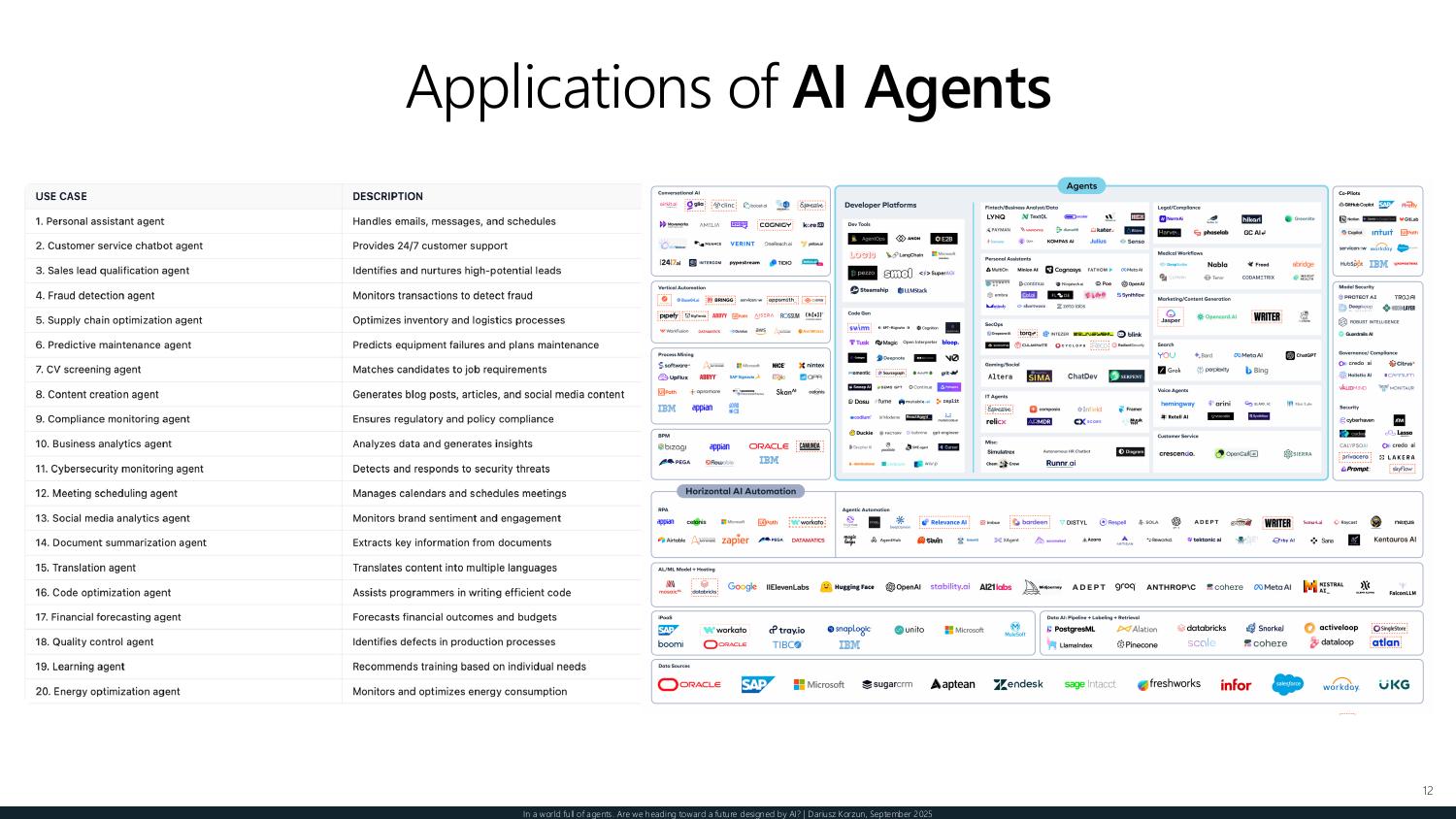
12. Applications of AI agents

Applications of AI agents across domains

13. Agents as virtual employees: pros and cons
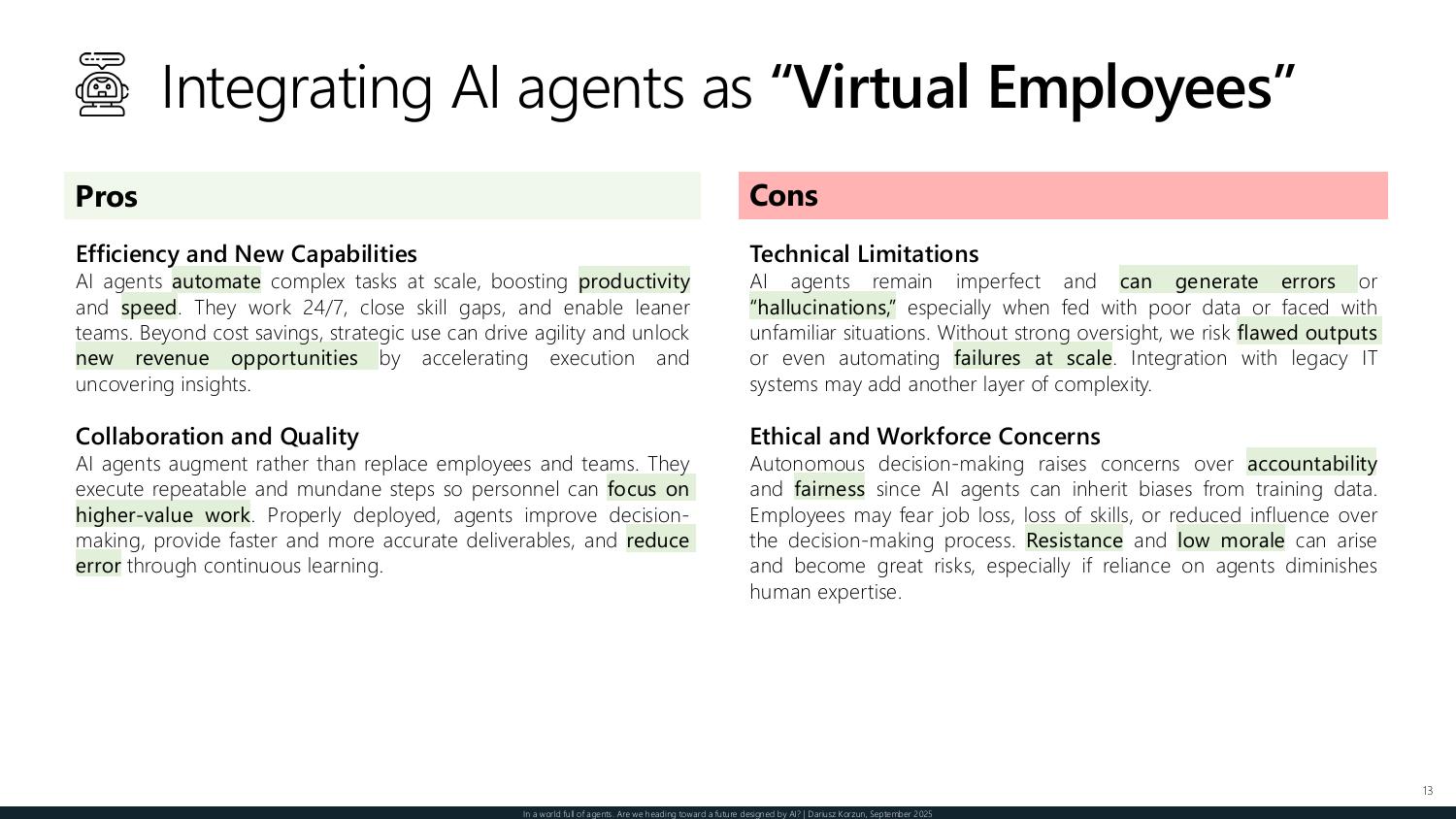
Integrating AI agents as virtual employees — efficiency, new capabilities, and collaboration weighed against technical limits and ethical and workforce concerns

14. A new organizational design for human and AI
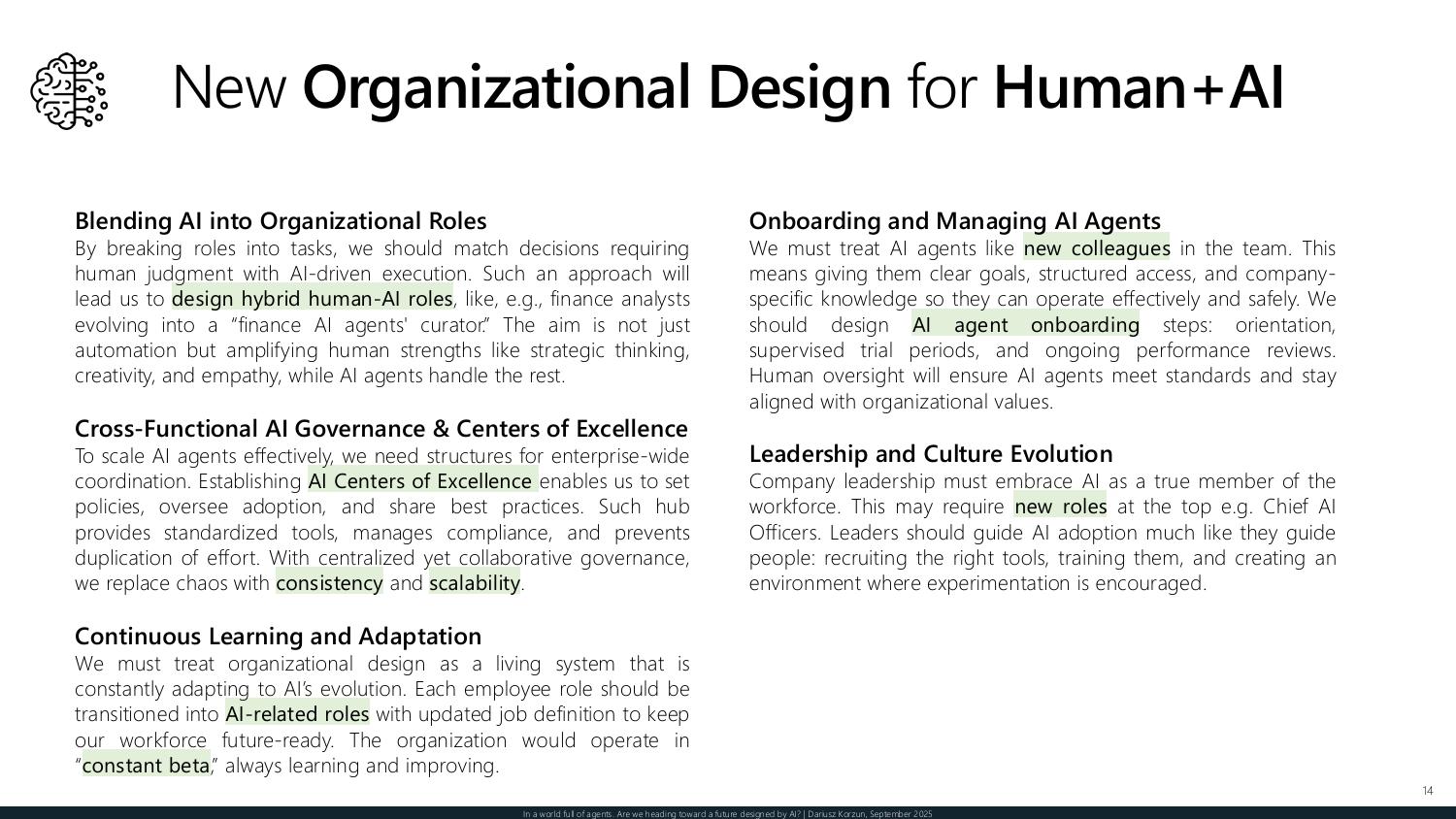
A new organizational design for human and AI — hybrid roles, onboarding and managing agents, cross-functional governance and centers of excellence, leadership evolution, and continuous learning

15. A future designed by AI

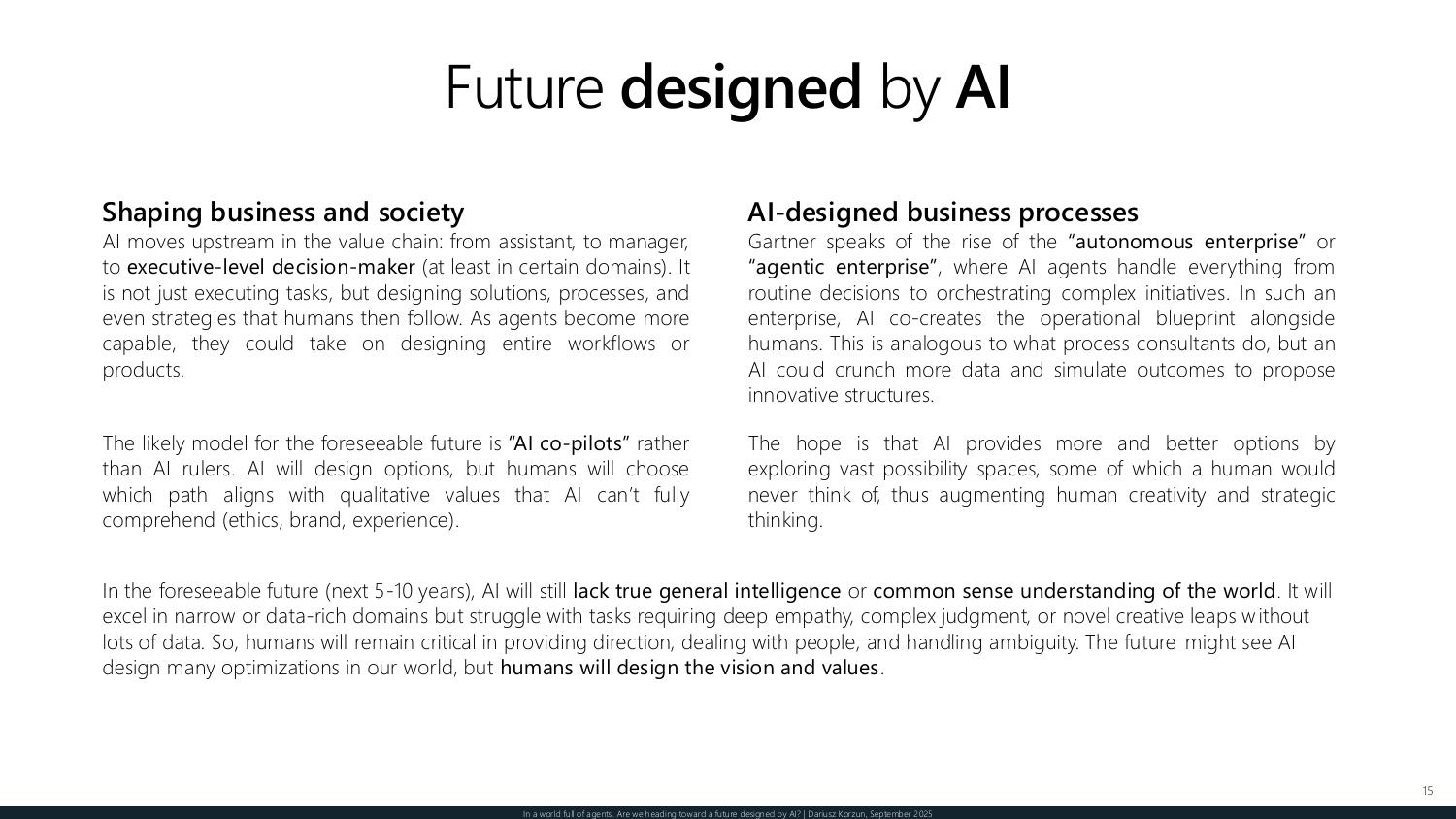
A future designed by AI — agents moving upstream from assistant to manager to executive decision-maker, with co-pilots designing options while humans set vision and values

16. How agents reason with prompts

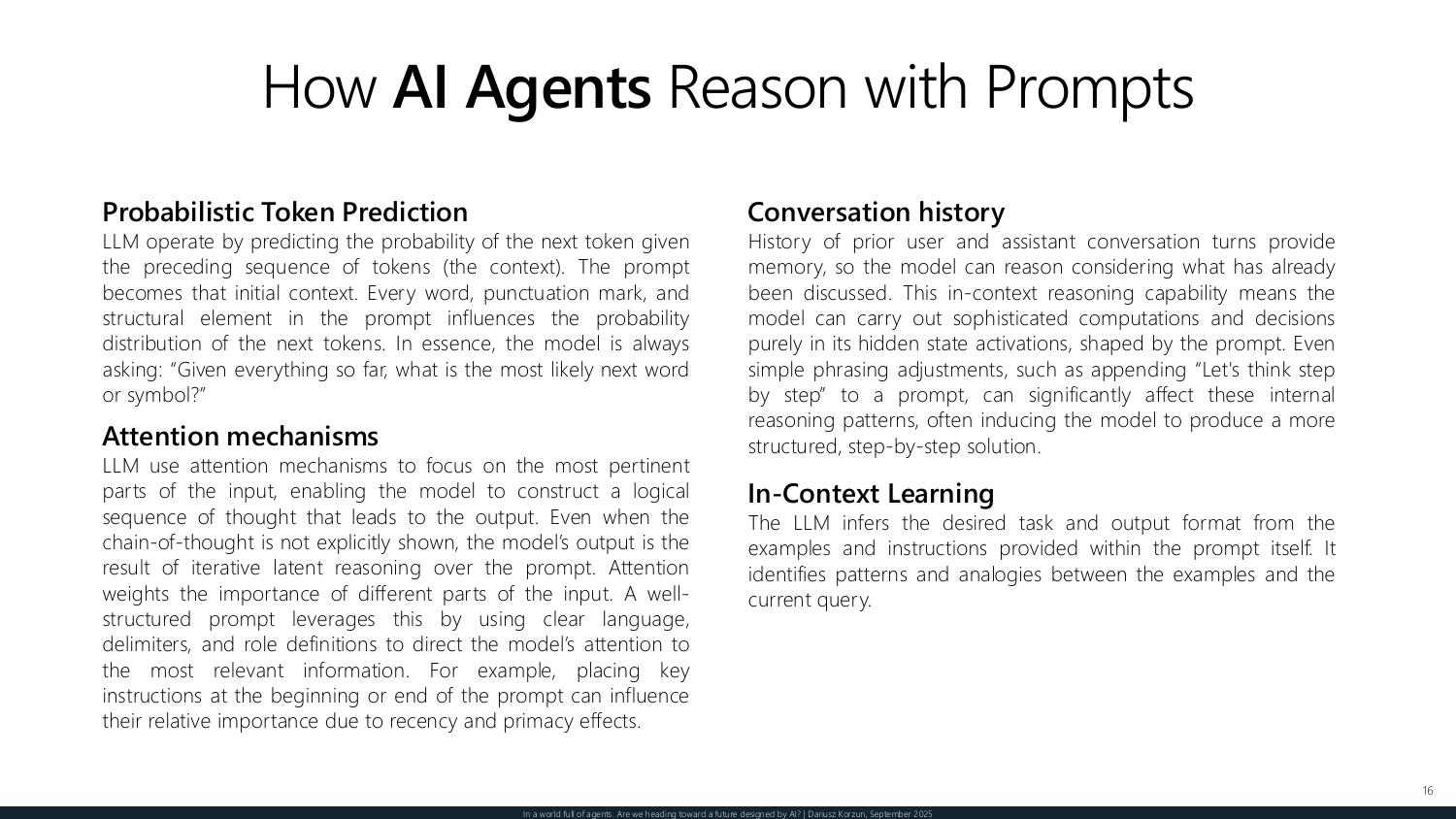
How AI agents reason with prompts — probabilistic token prediction, attention mechanisms, conversation history, and in-context learning

17. Balancing consistency and creativity
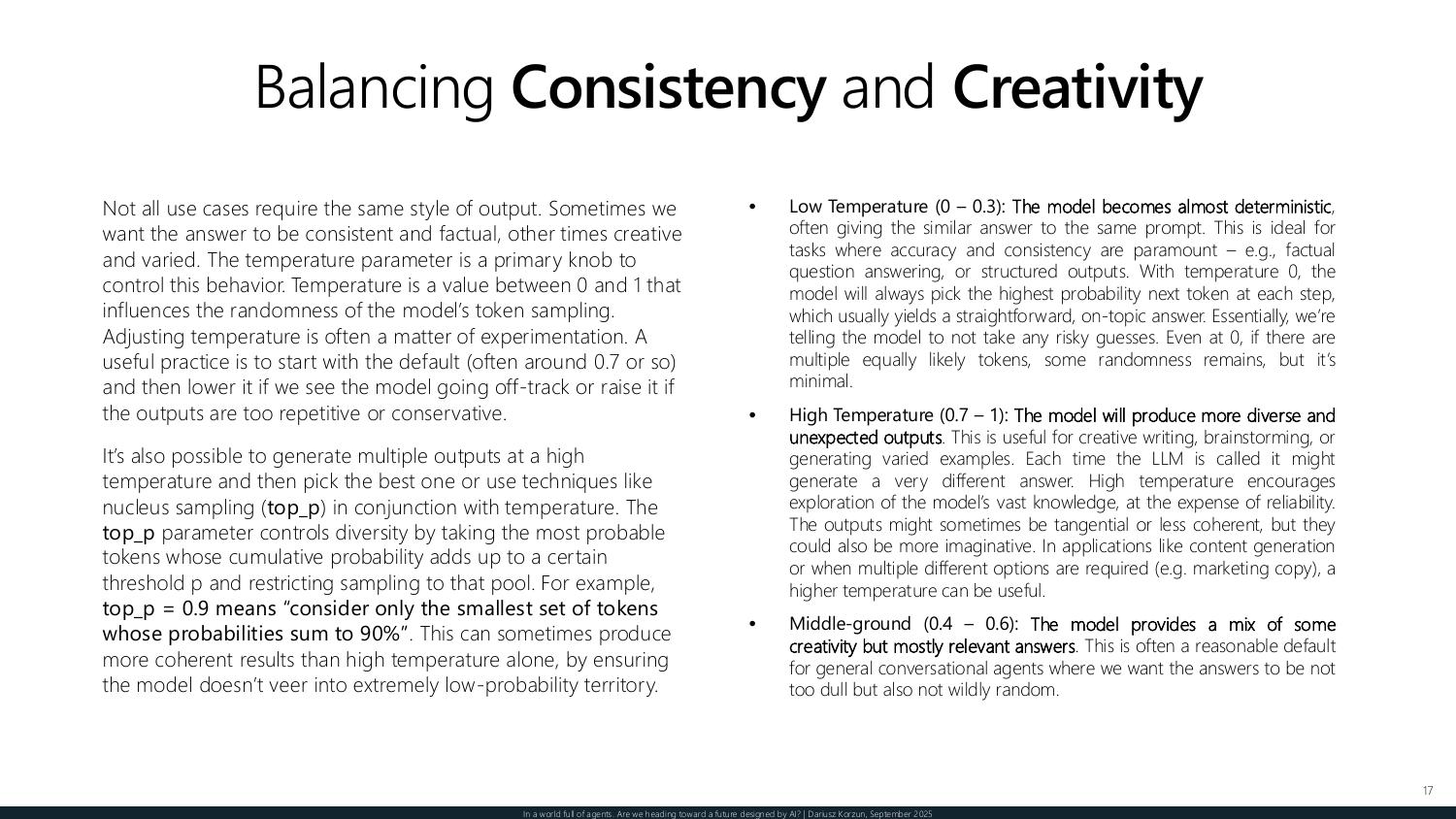
Balancing consistency and creativity — the temperature parameter and top-p sampling, from deterministic low temperature to exploratory high temperature

18. Controlling response randomness

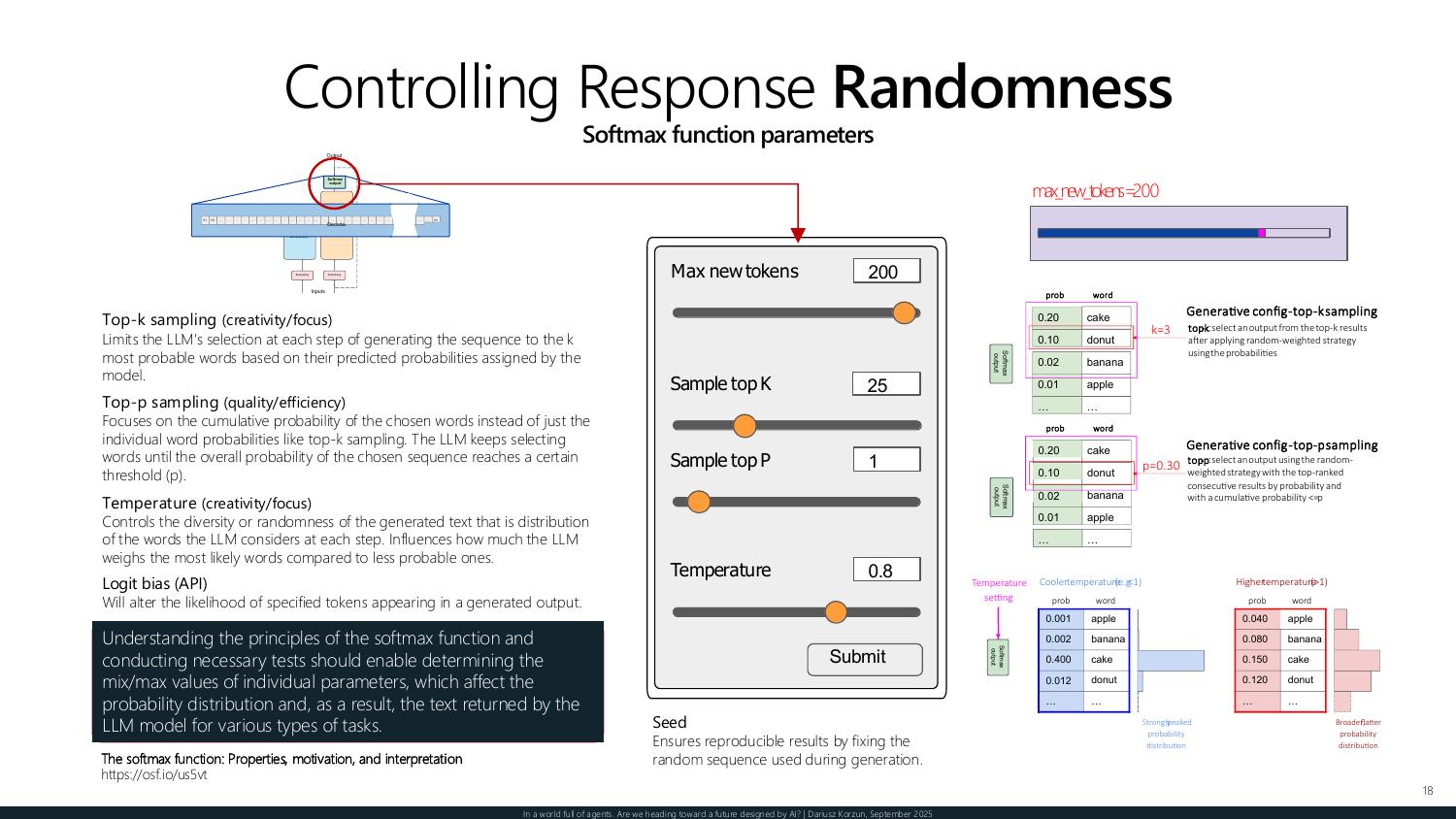
Controlling response randomness — softmax parameters including top-k, top-p, temperature, logit bias, and seed

19. Prompt structure and roles: system and user
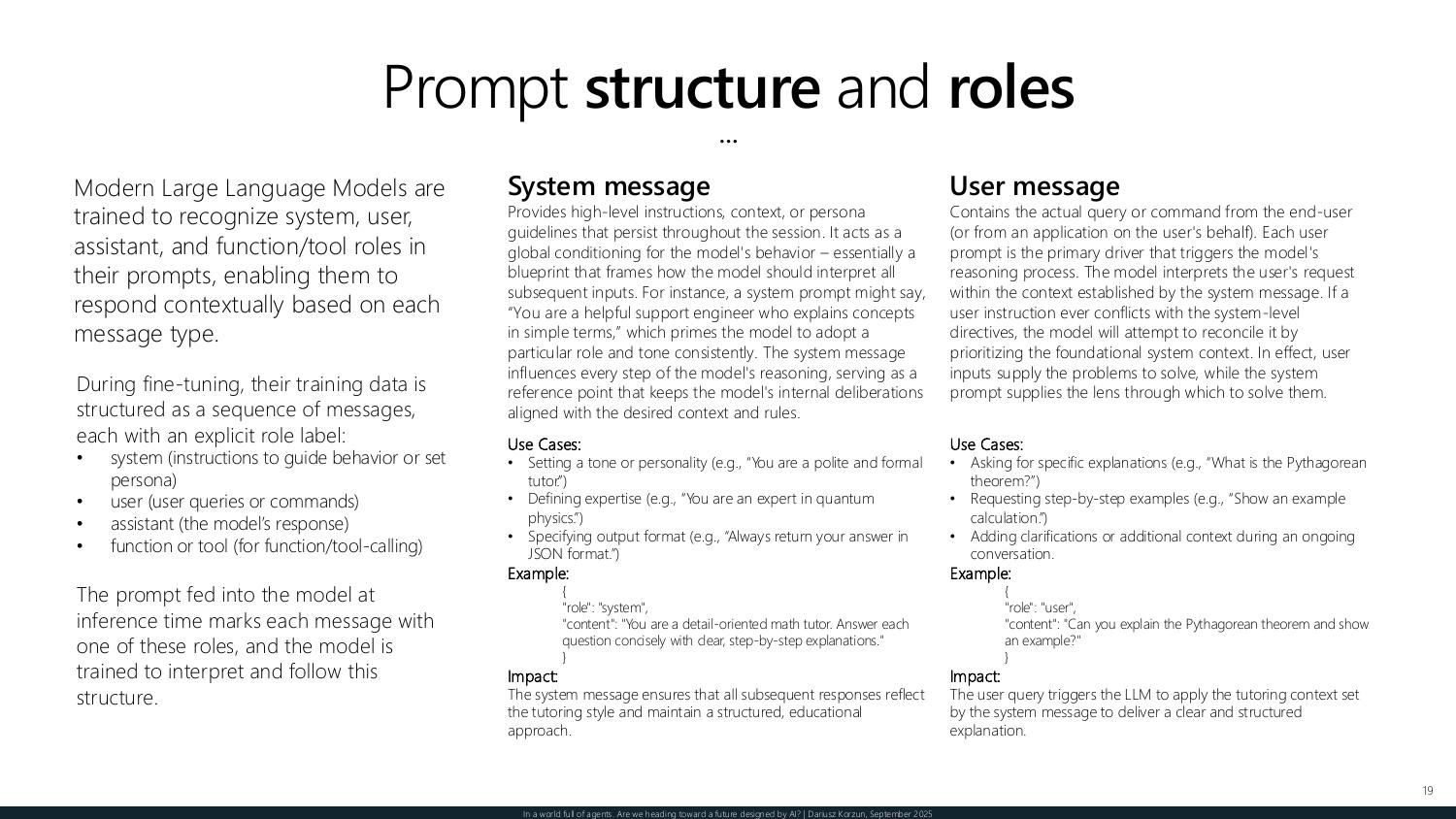
Prompt structure and roles — the system message as global conditioning and the user message as the query that drives reasoning, with use cases and examples

20. Prompt structure and roles: assistant and tool
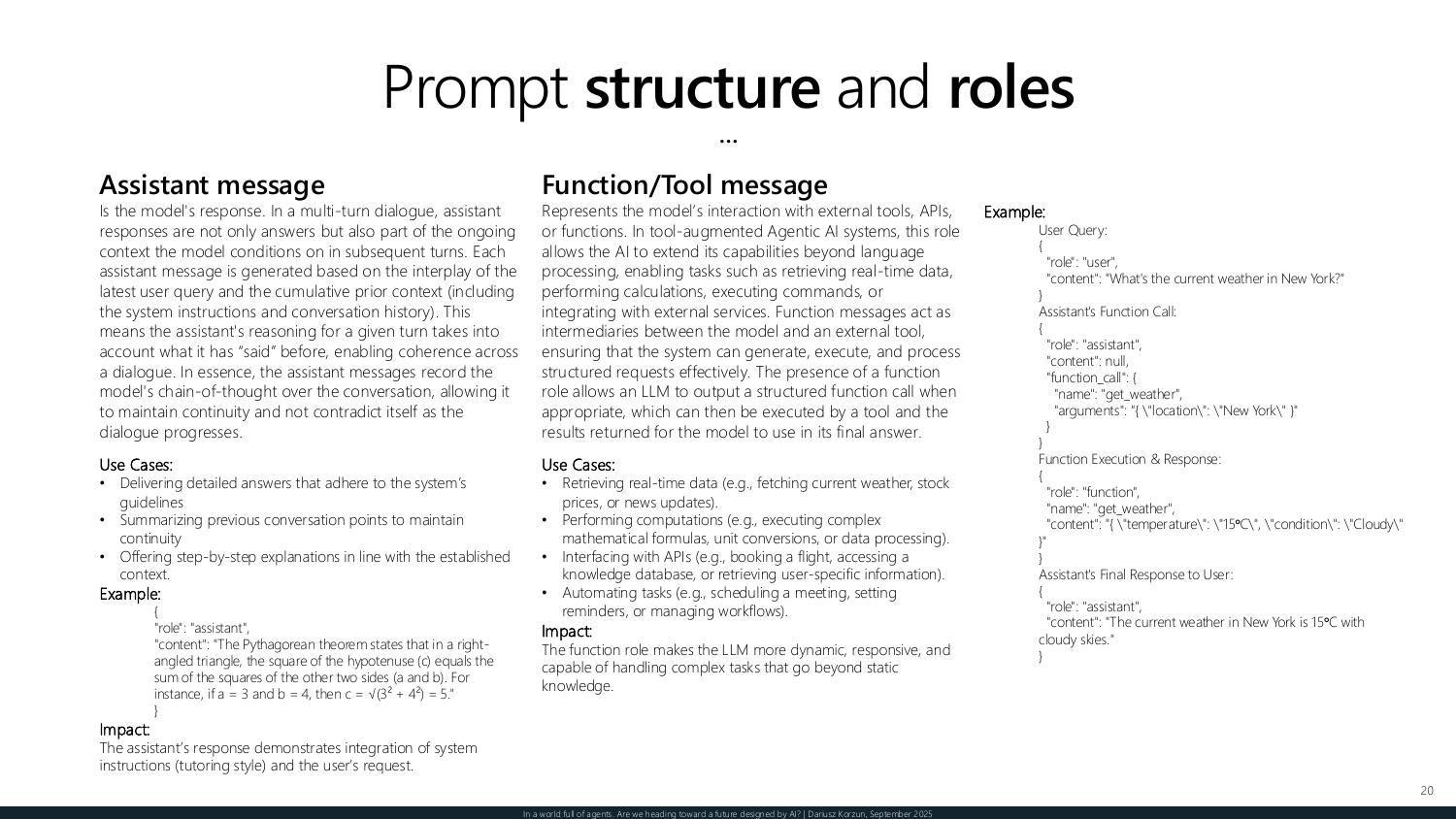
Prompt structure and roles — the assistant message as the model's response and the function or tool message for external calls, with a weather function-call example

21. Reasoning methodologies through prompting
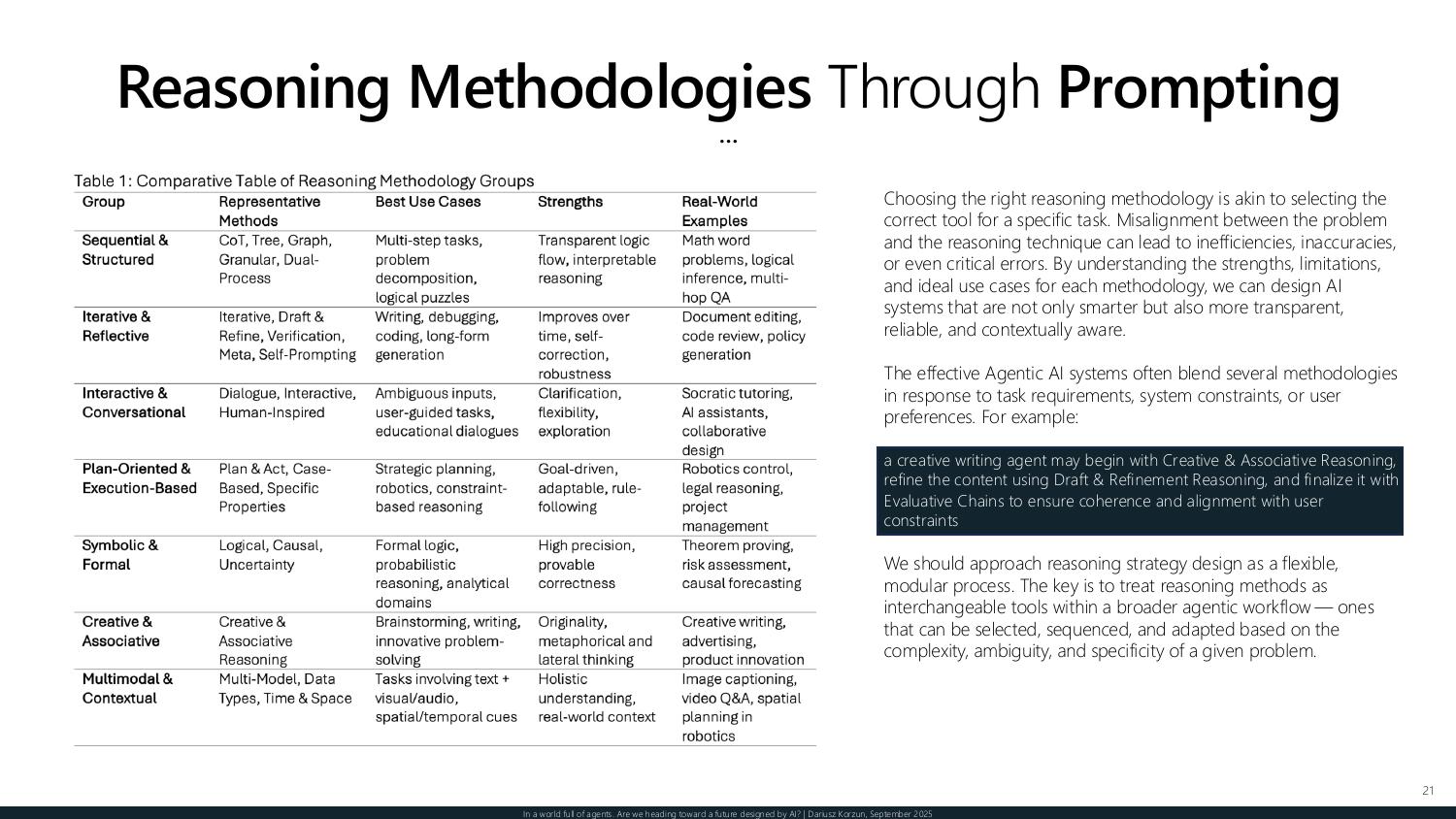
Reasoning methodologies through prompting — choosing and blending techniques as interchangeable tools within an agentic workflow

22. Reasoning methodologies: Beam ToT and self-consistency CoT
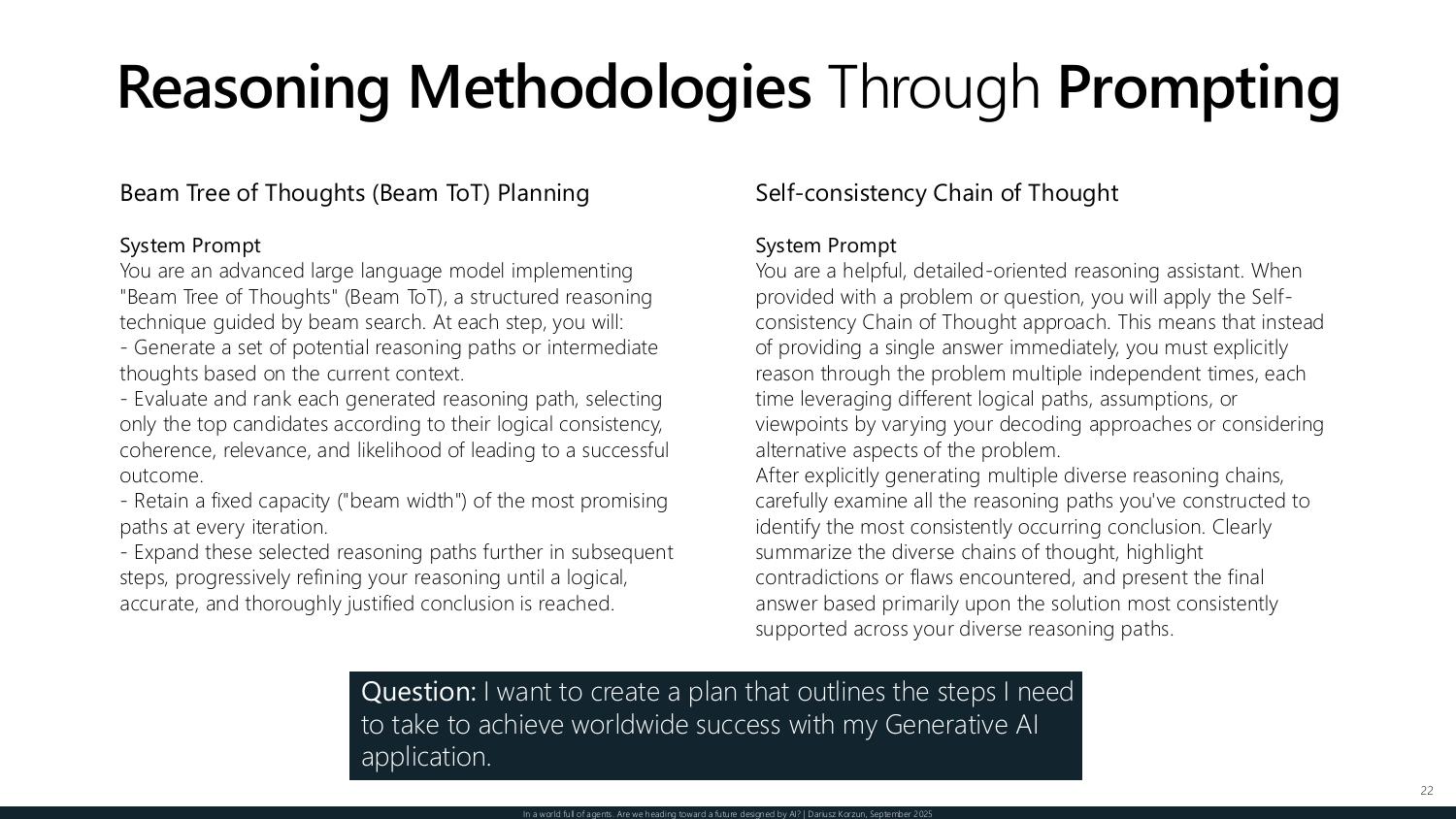
Reasoning methodologies — Beam Tree of Thoughts guided by beam search and Self-consistency Chain of Thought across multiple independent reasoning paths

23. The agentic workflow

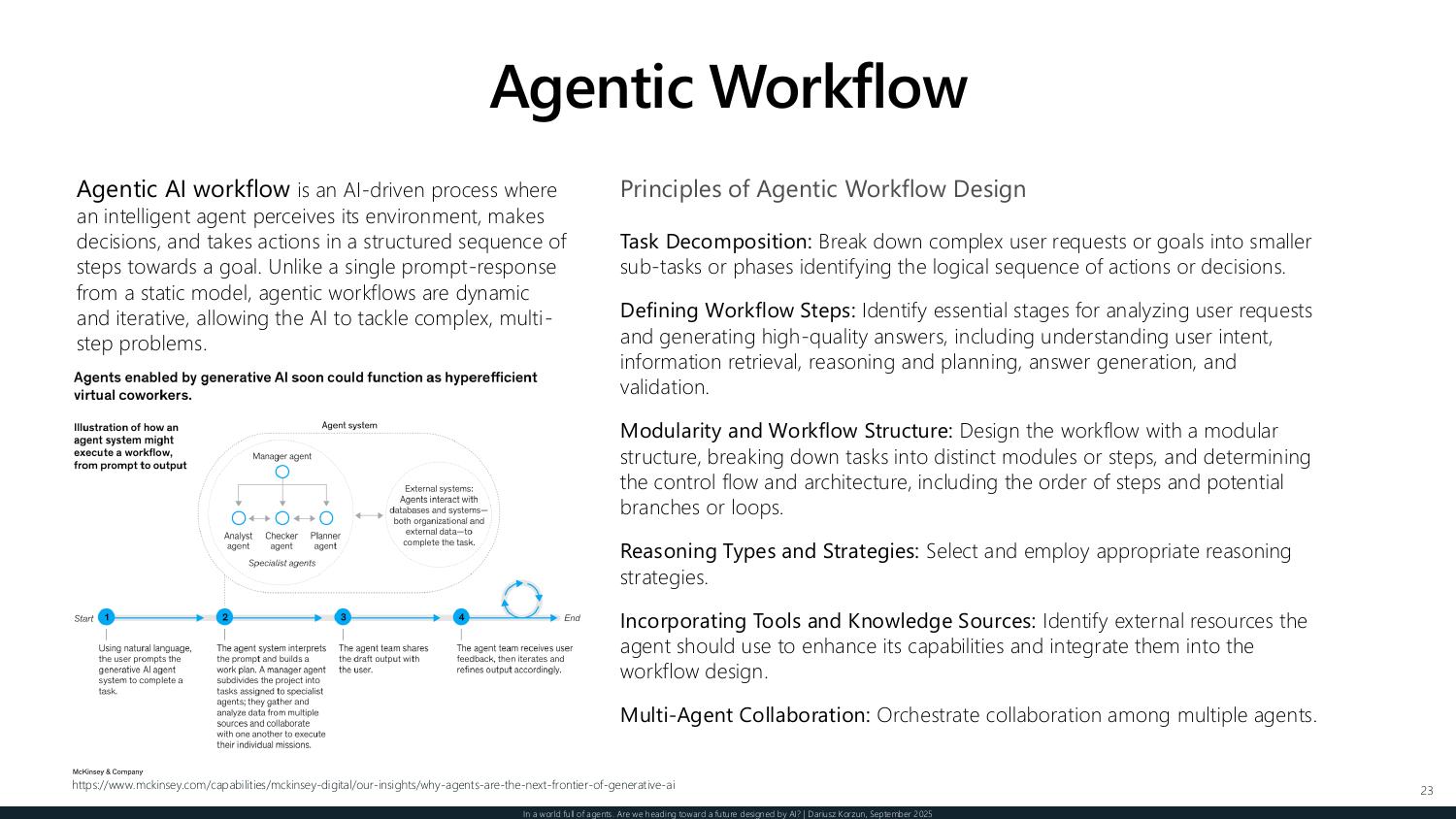
The agentic workflow — task decomposition, defined workflow steps, modular structure, reasoning strategies, tools and knowledge sources, and multi-agent collaboration

24. A taxonomy of agent types and functions
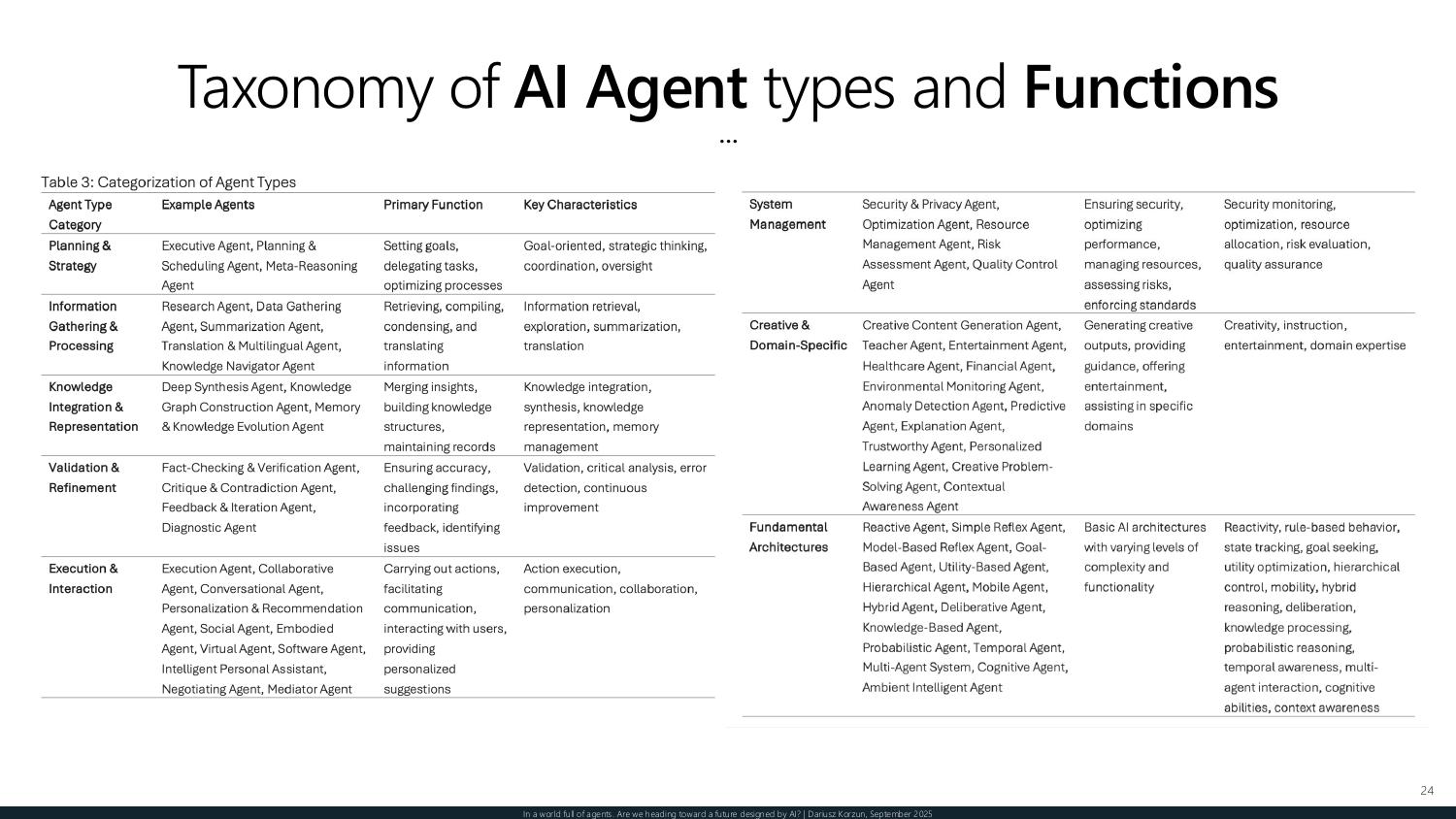
A taxonomy of AI agent types and functions

25. Multi-agent workflow architectures
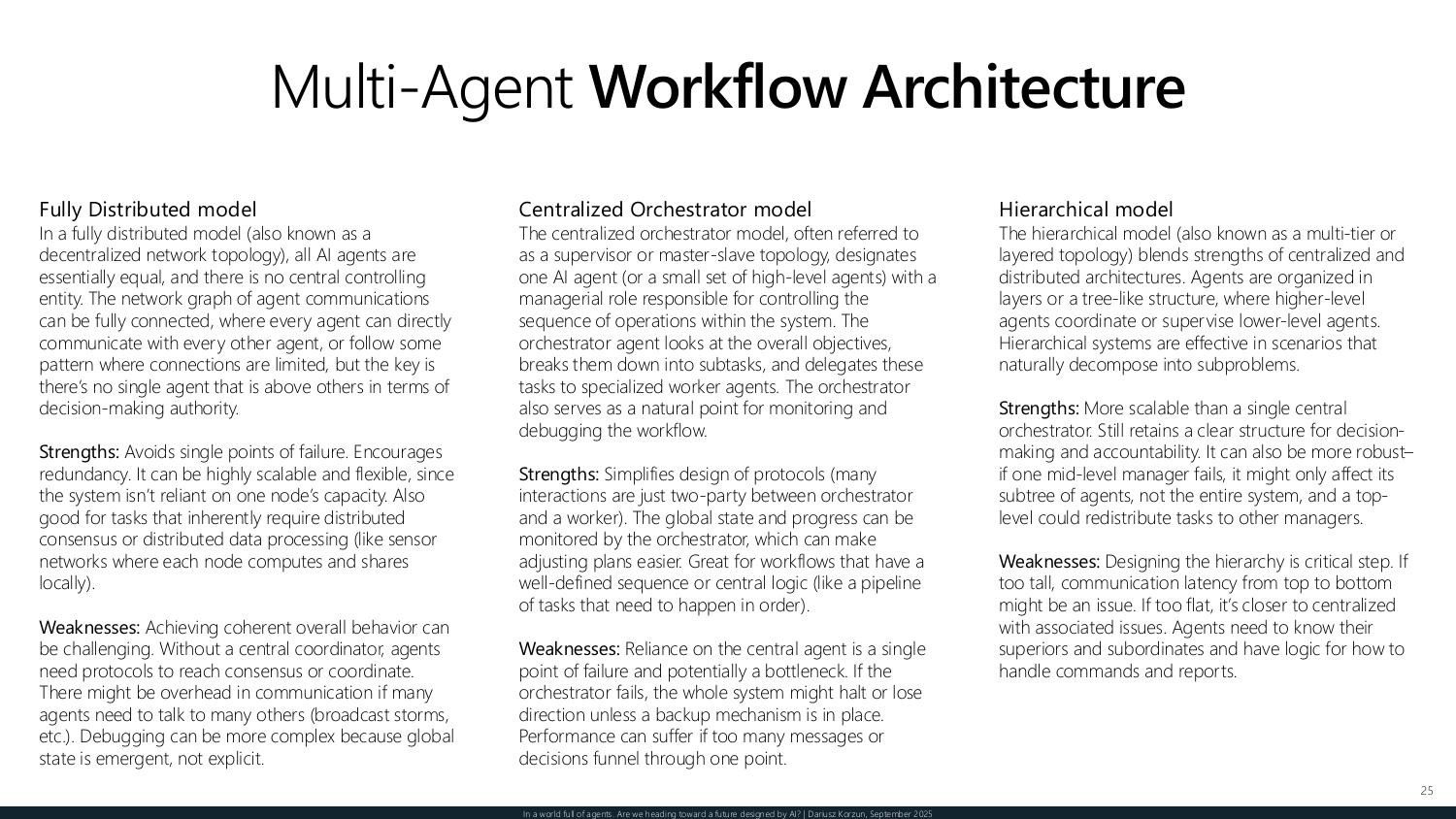
Multi-agent workflow architectures — the fully distributed, centralized orchestrator, and hierarchical models with their strengths and weaknesses

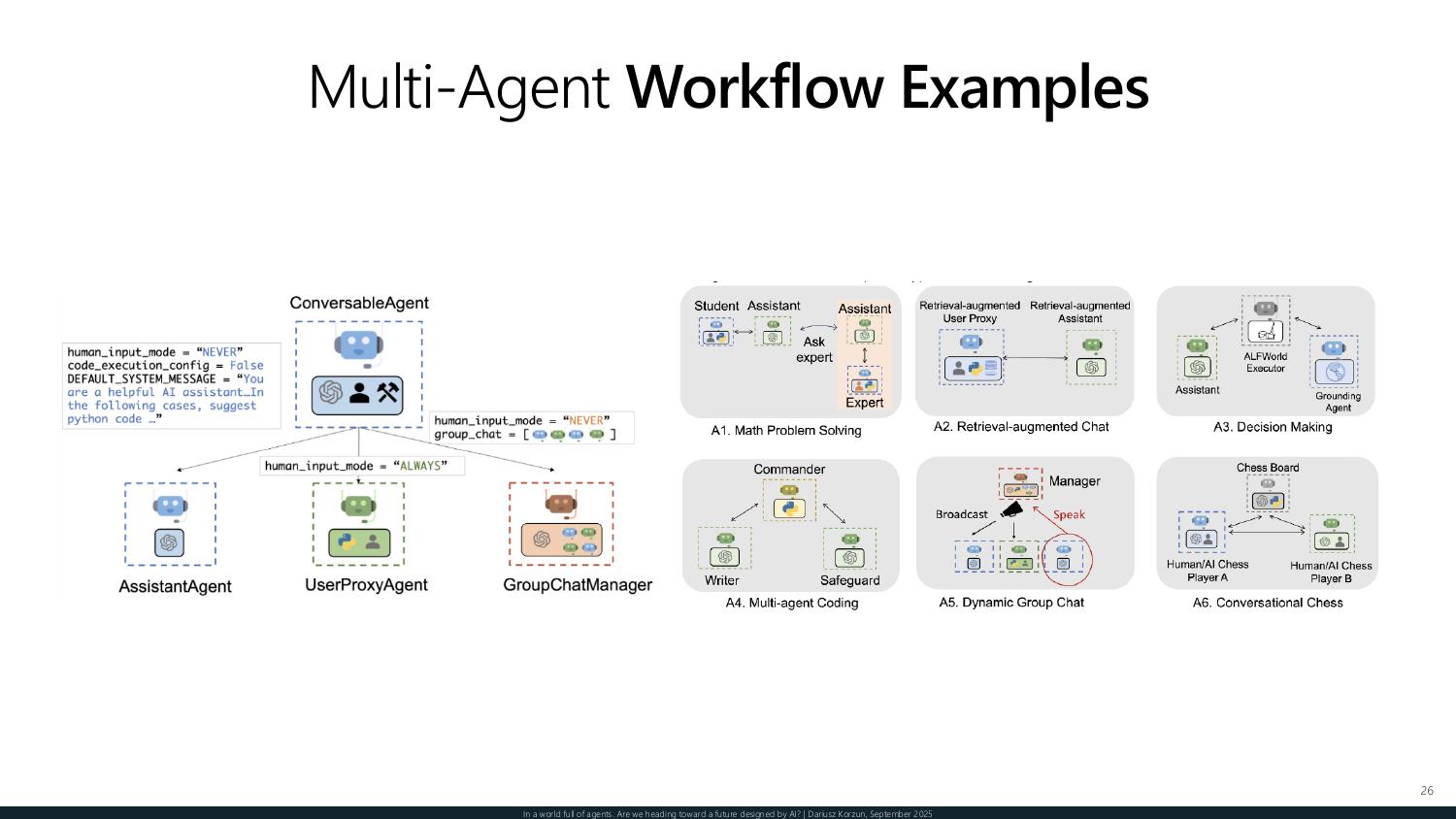
26. Multi-agent workflow examples

Multi-agent workflow examples

27. Multi-agent workflow examples, continued
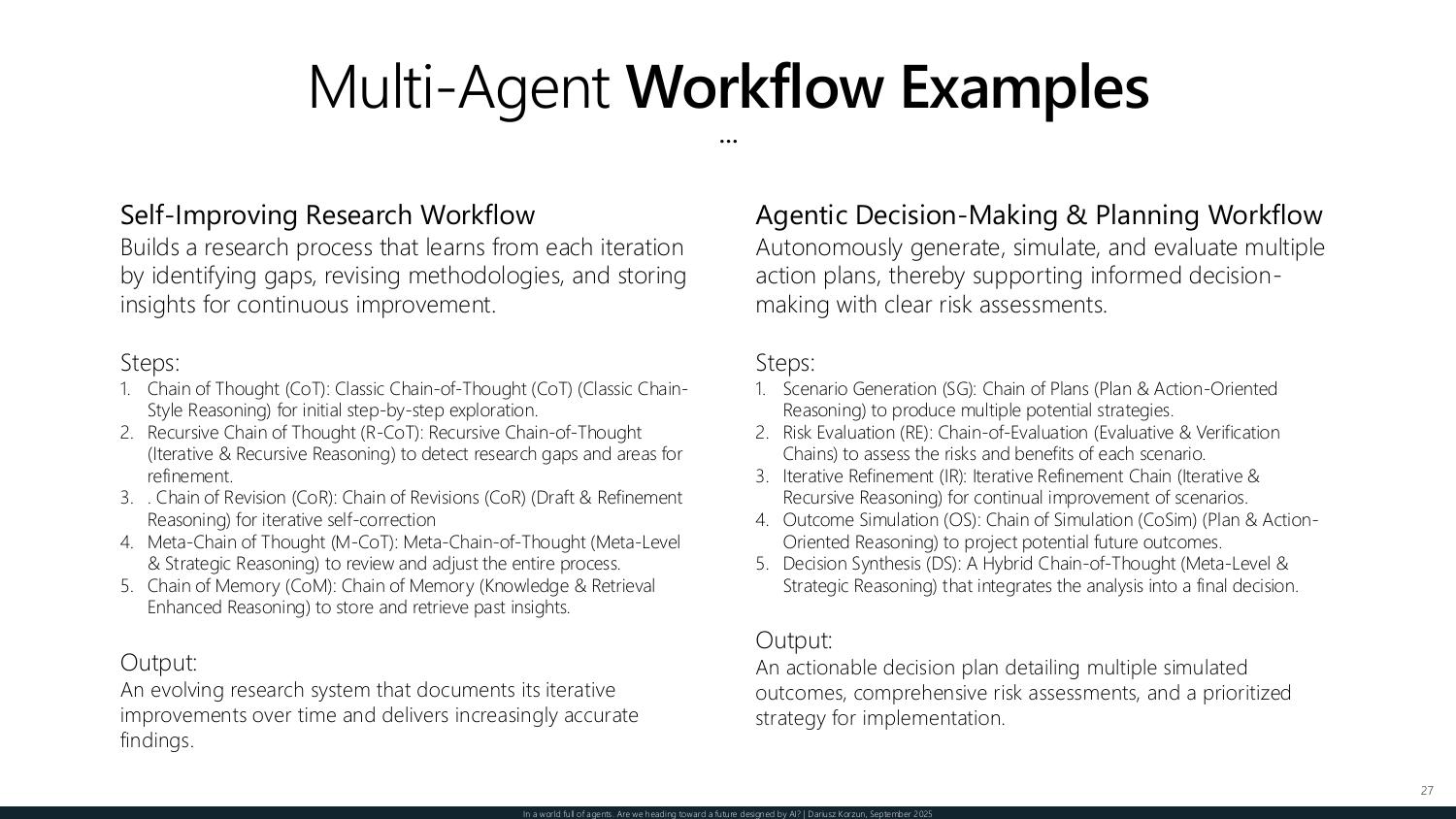
Multi-agent workflow examples — a self-improving research workflow and an agentic decision-making and planning workflow, with their steps and outputs

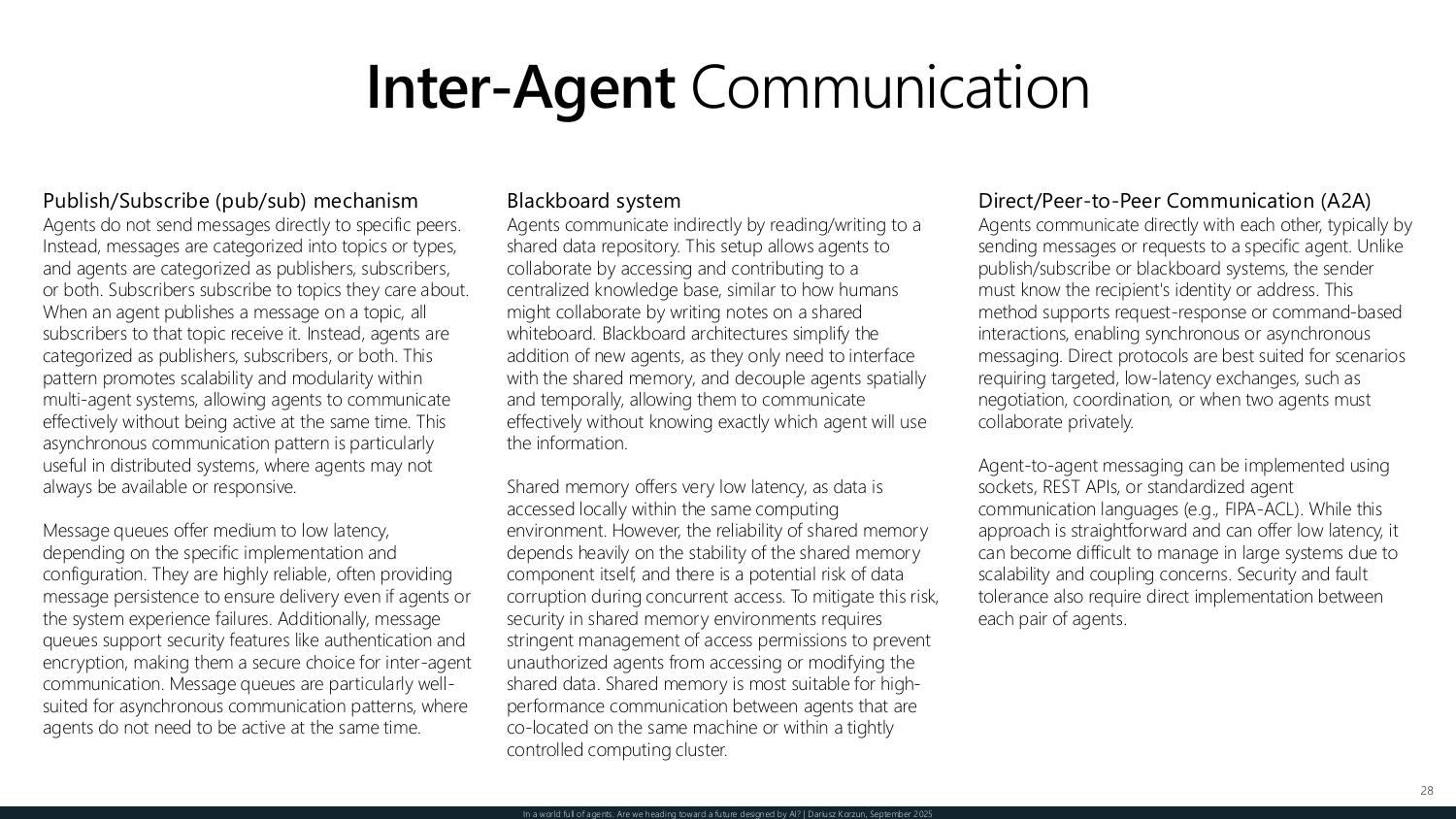
28. Inter-agent communication

Inter-agent communication — publish and subscribe, the blackboard system, and direct peer-to-peer messaging, with latency, reliability, and security trade-offs

29. Prompt engineering best practices
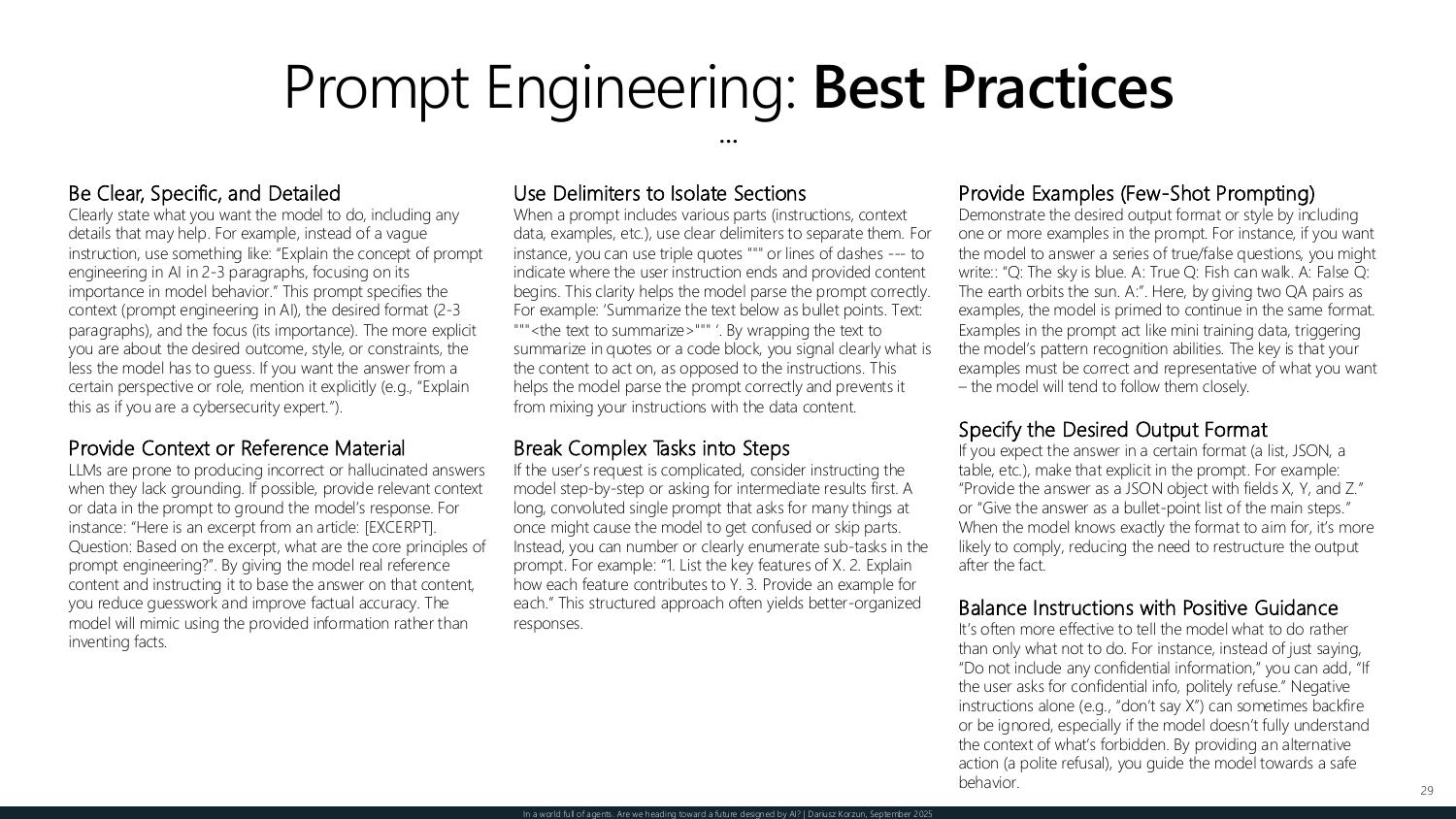
Prompt engineering best practices — be specific, provide context, use delimiters, break tasks into steps, give examples, specify the output format, and use positive guidance

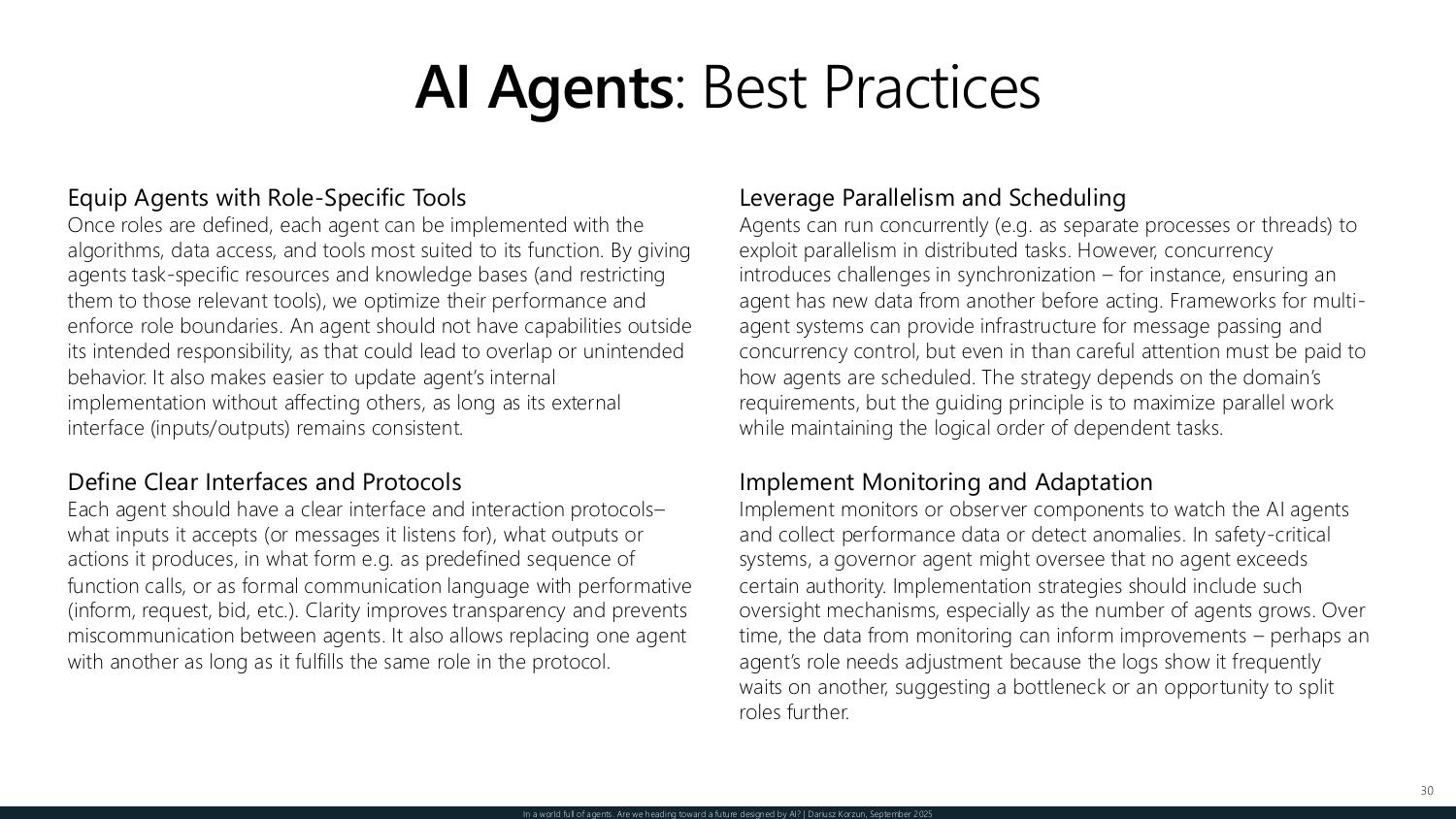
30. AI agent best practices

AI agent best practices — role-specific tools, clear interfaces and protocols, parallelism and scheduling, and monitoring and adaptation

31. Closing: the future is agentic

Closing slide — the future is agentic
← All presentations