Presentations

AI-Augmented Lean Enterprise

How Lean and autonomous AI agents reinforce each other — adaptive standardization, digital Kaizen, and just-in-time intelligence — plus the benefits, risks, and roadmap for an AI-augmented Lean enterprise.

Lean and agentic AI are usually discussed apart. We argue they multiply each other: Lean supplies the goals, guardrails, and process stability that keep AI honest, while autonomous agents bring the speed, data, and scale to run continuous improvement at machine speed. In this talk from the 25th “I love Lean” Conference Lean Management in Wrocław, we work through three pillars of integration — adaptive standardization, digital Kaizen, and just-in-time intelligence — then weigh the operational benefits against the real costs, risks, and change-management demands, and close with a staged roadmap for treating AI agents as virtual employees. The throughline is simple: agentic AI does not replace Lean, it elevates it.

1. Opening
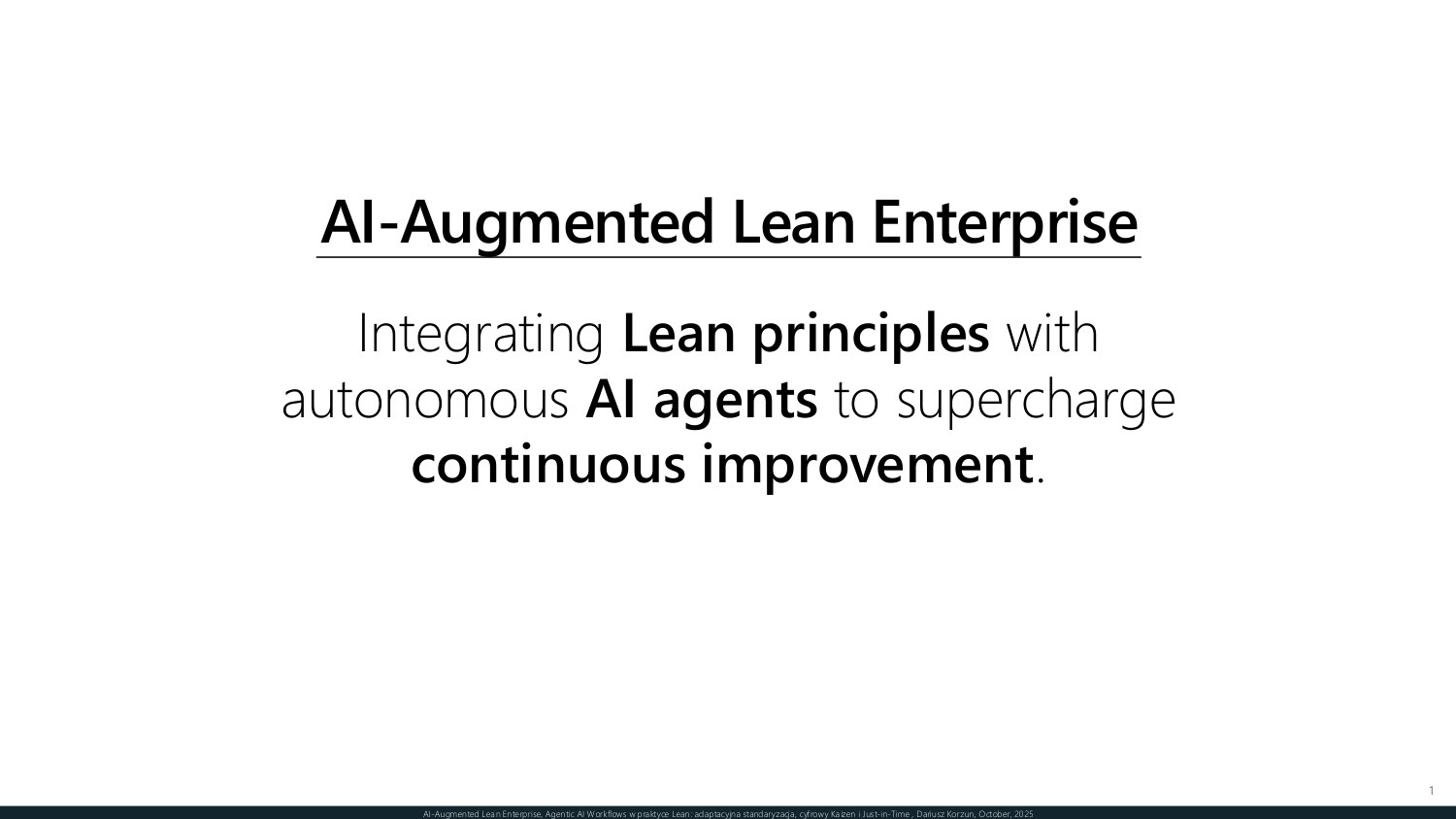
Title slide — AI-Augmented Lean Enterprise: integrating Lean principles with autonomous AI agents to supercharge continuous improvement

2. The paradigm shift: Lean plus agentic AI
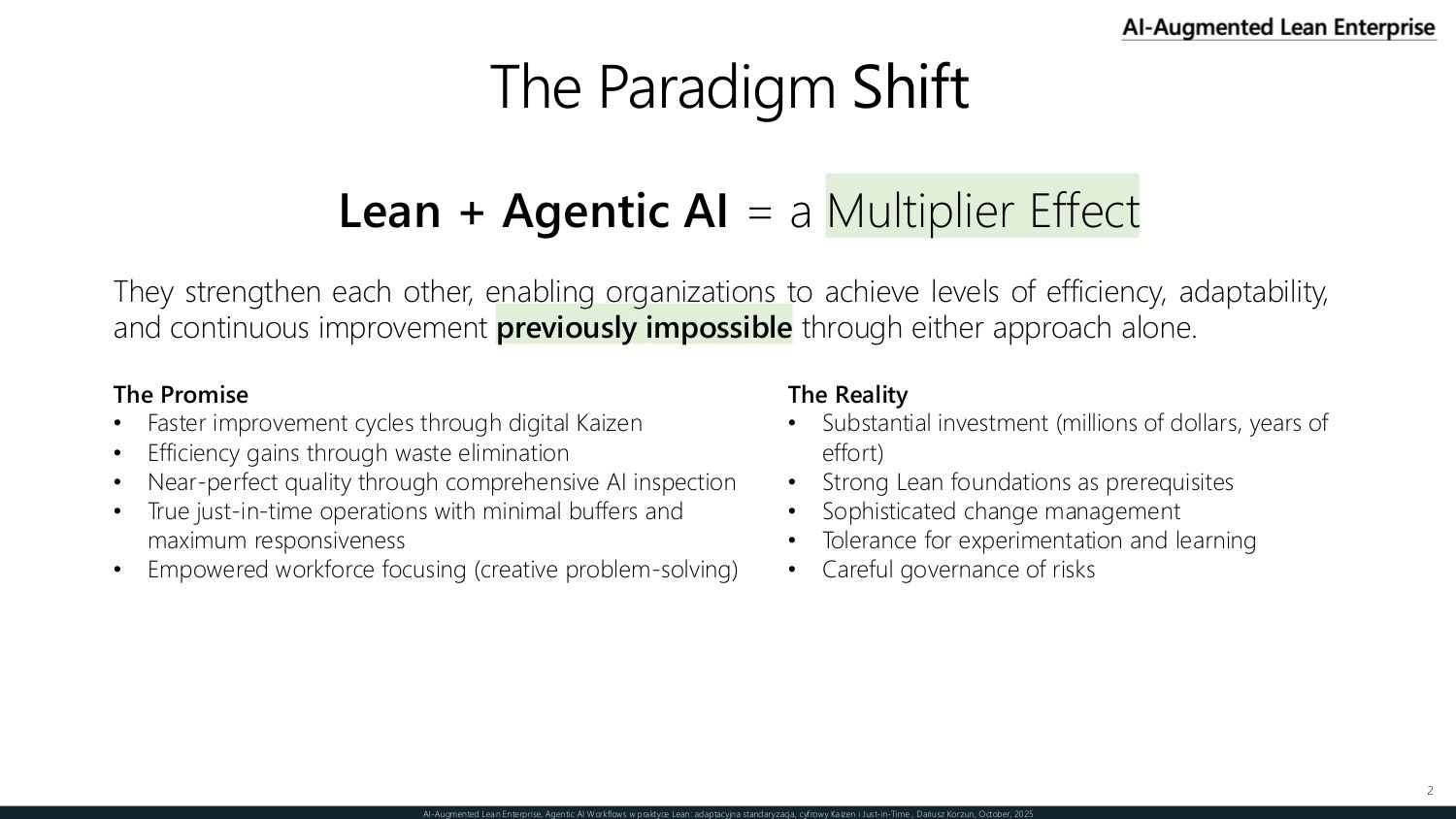
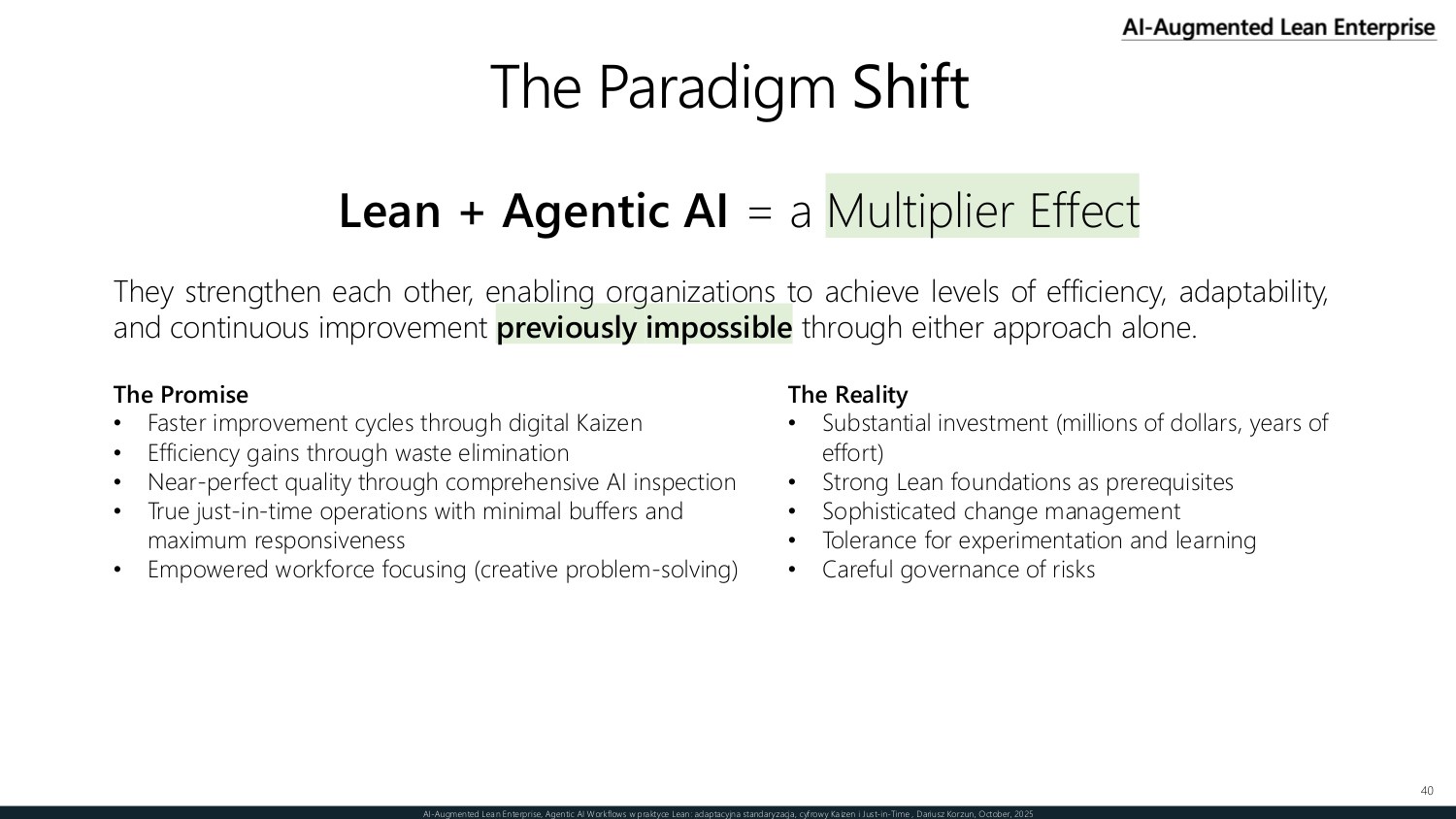
The paradigm shift — Lean plus agentic AI as a multiplier effect, weighing the promise against the reality of investment, strong Lean foundations, and careful governance

3. Understanding agentic AI and its convergence with Lean
Section divider — understanding agentic AI and its convergence with Lean

4. What agentic AI is
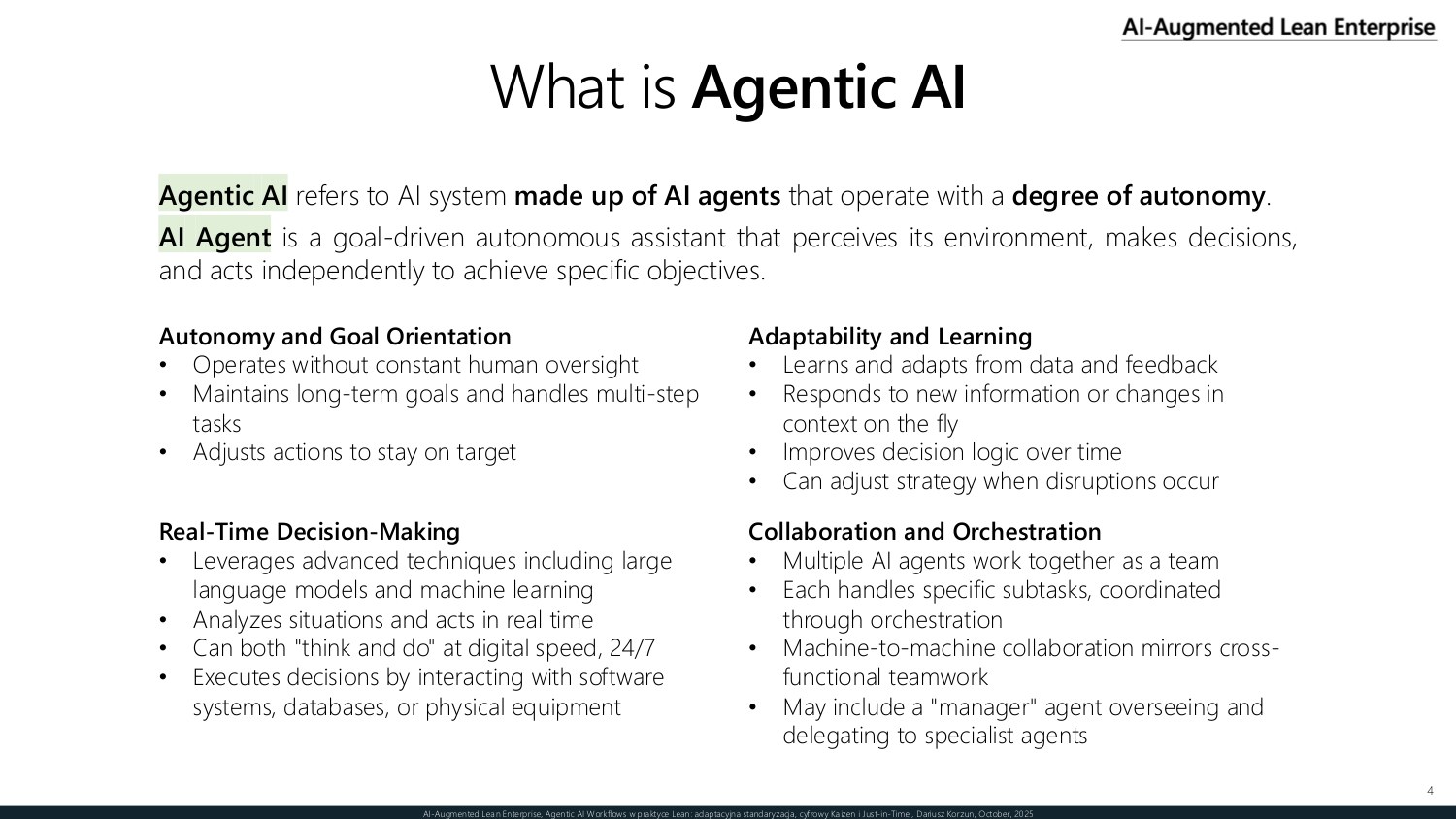
What agentic AI is — autonomy and goal orientation, adaptability and learning, real-time decision-making, and collaboration and orchestration across agents

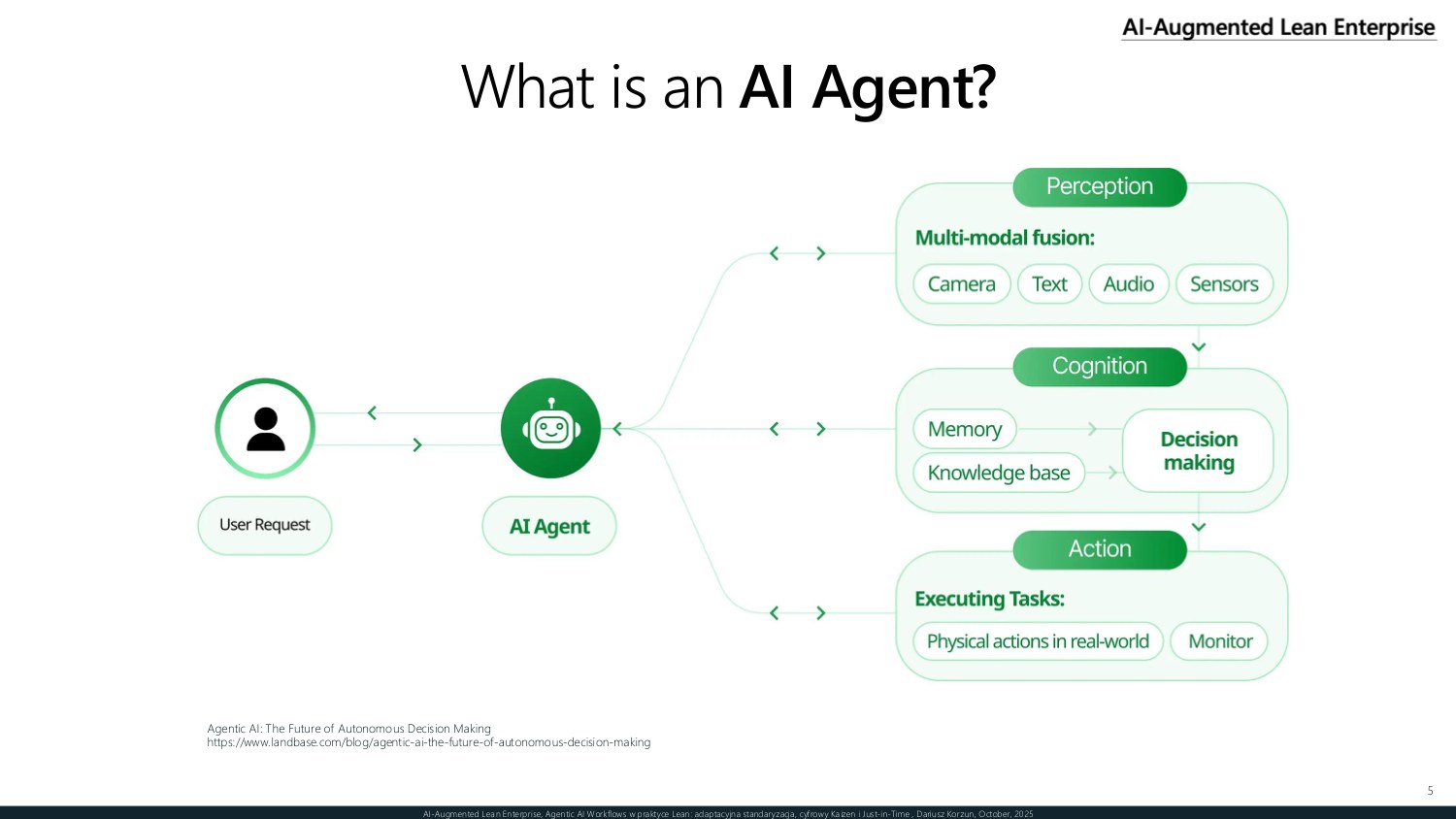
5. What an AI agent is

What an AI agent is — a diagram of a goal-driven autonomous agent that perceives its environment, makes decisions, and acts

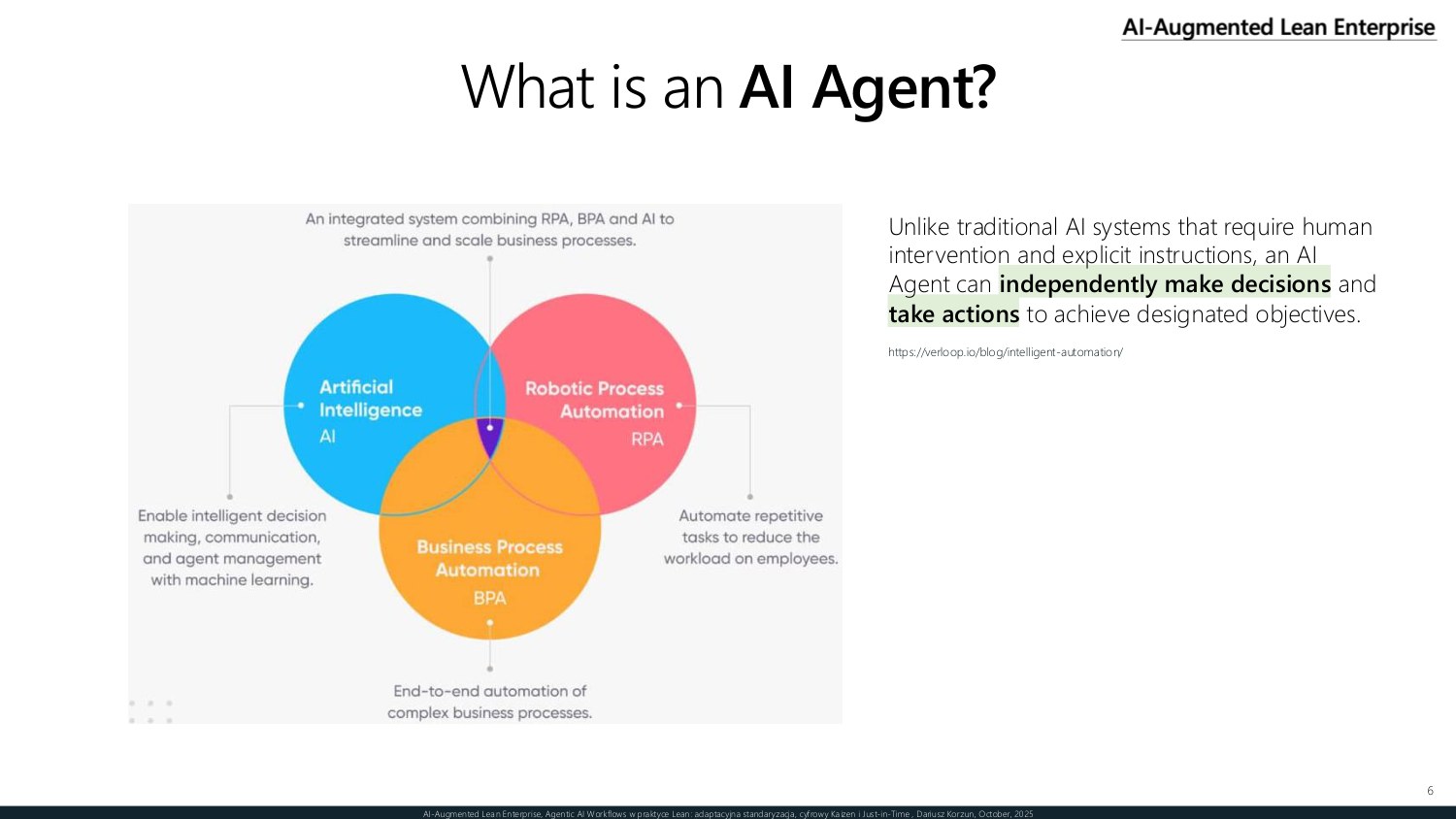
6. What an AI agent is, continued

What an AI agent is — an agent that independently makes decisions and takes action, unlike traditional systems that require explicit instructions

7. Lean and agentic AI: shared goals and synergy
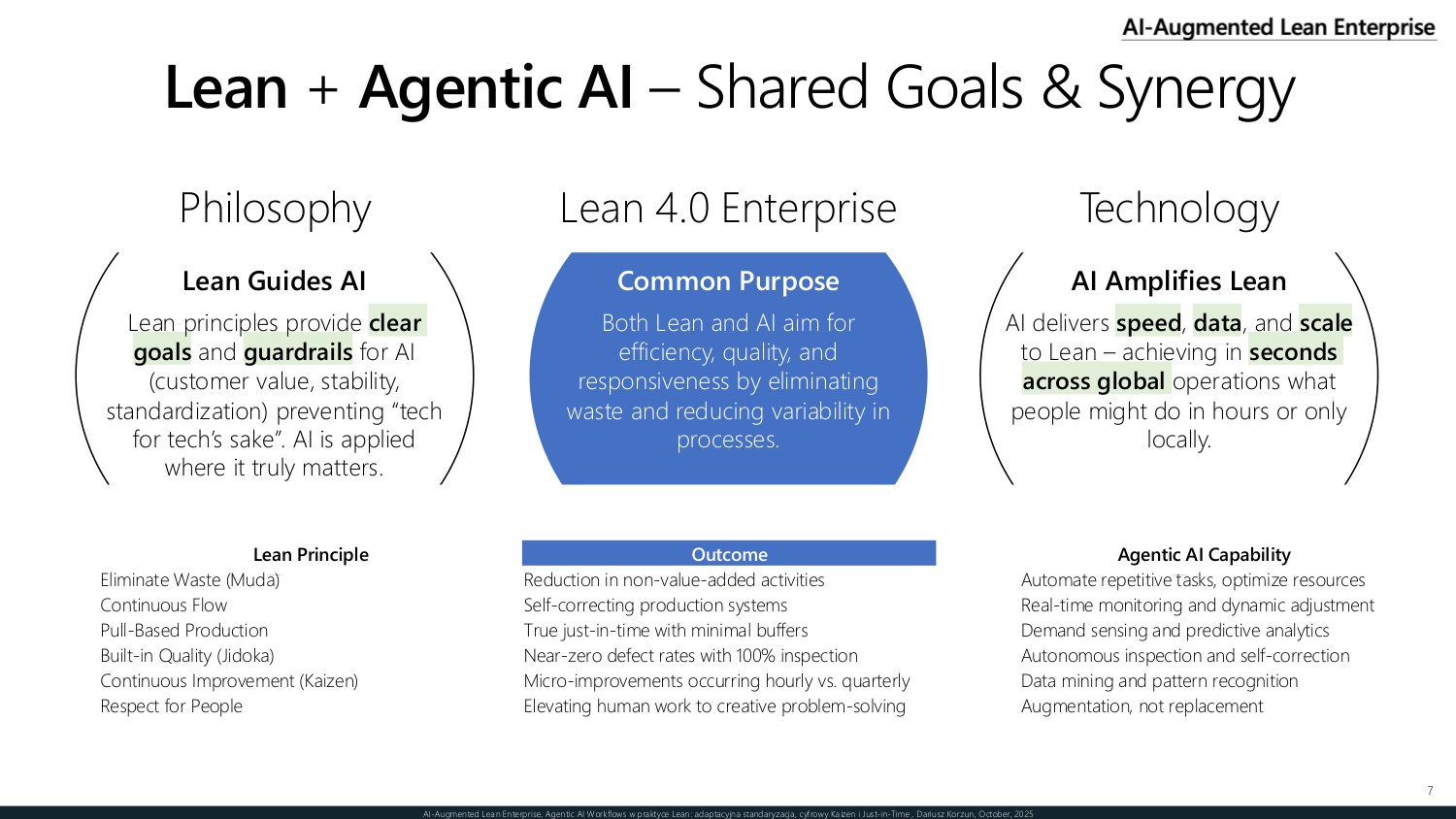
Lean and agentic AI shared goals and synergy — a table mapping Lean principles such as waste elimination, continuous flow, pull-based production, Jidoka, and Kaizen to agentic AI capabilities

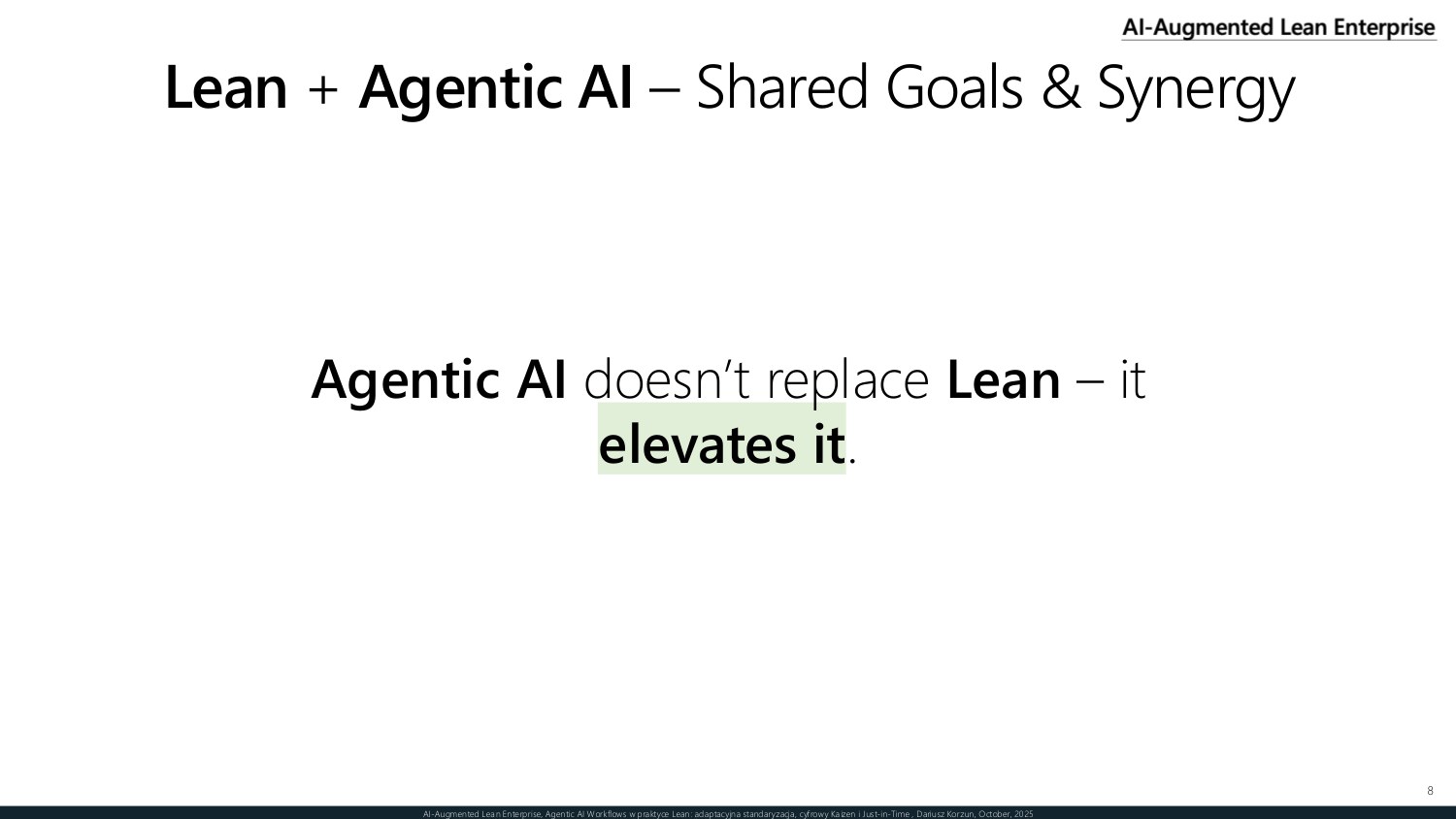
8. Agentic AI elevates Lean

Key message — agentic AI does not replace Lean, it elevates it

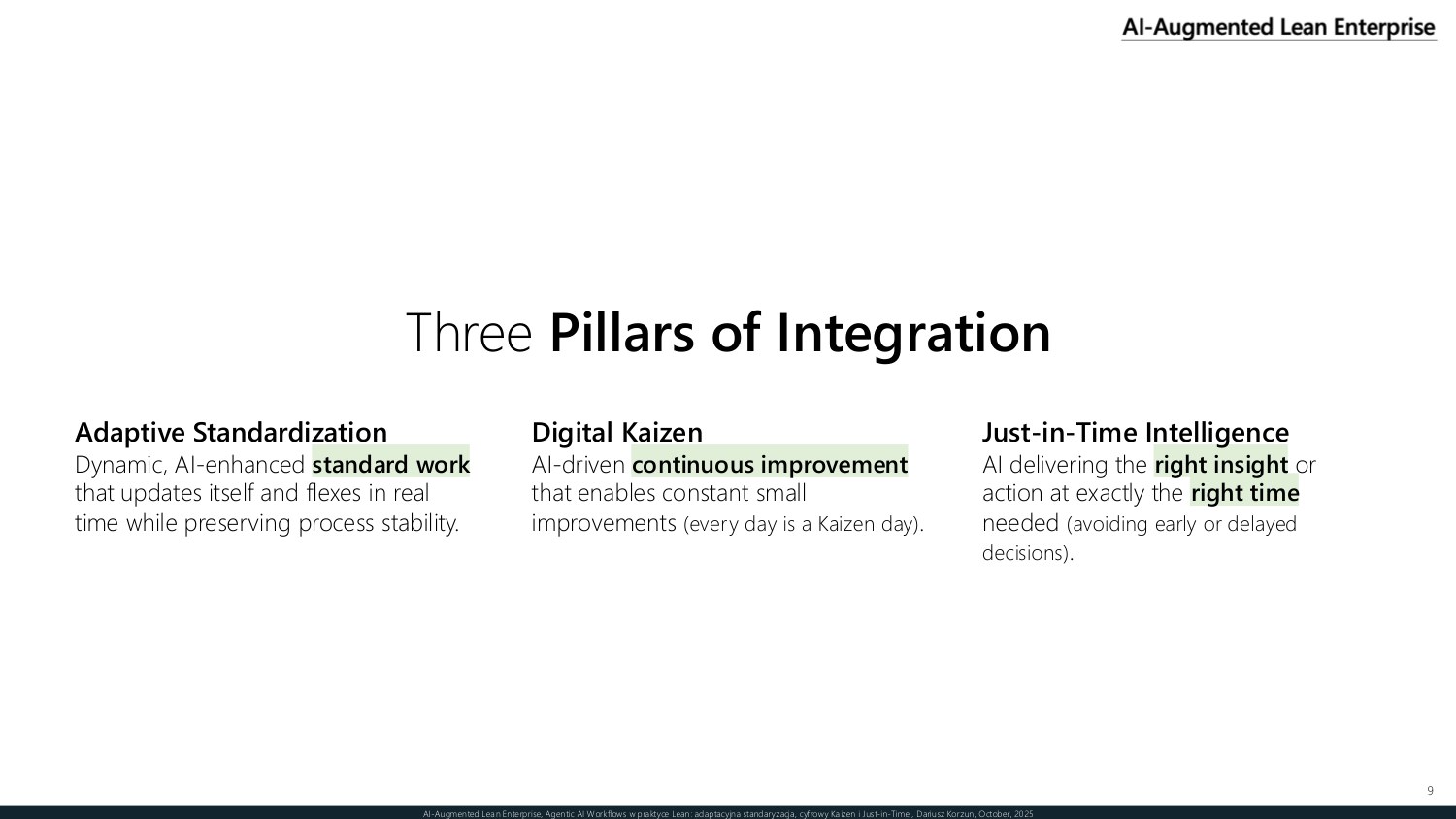
9. Three pillars of integration

Three pillars of integration — adaptive standardization, digital Kaizen, and just-in-time intelligence

10. Adaptive standardization: dynamic excellence
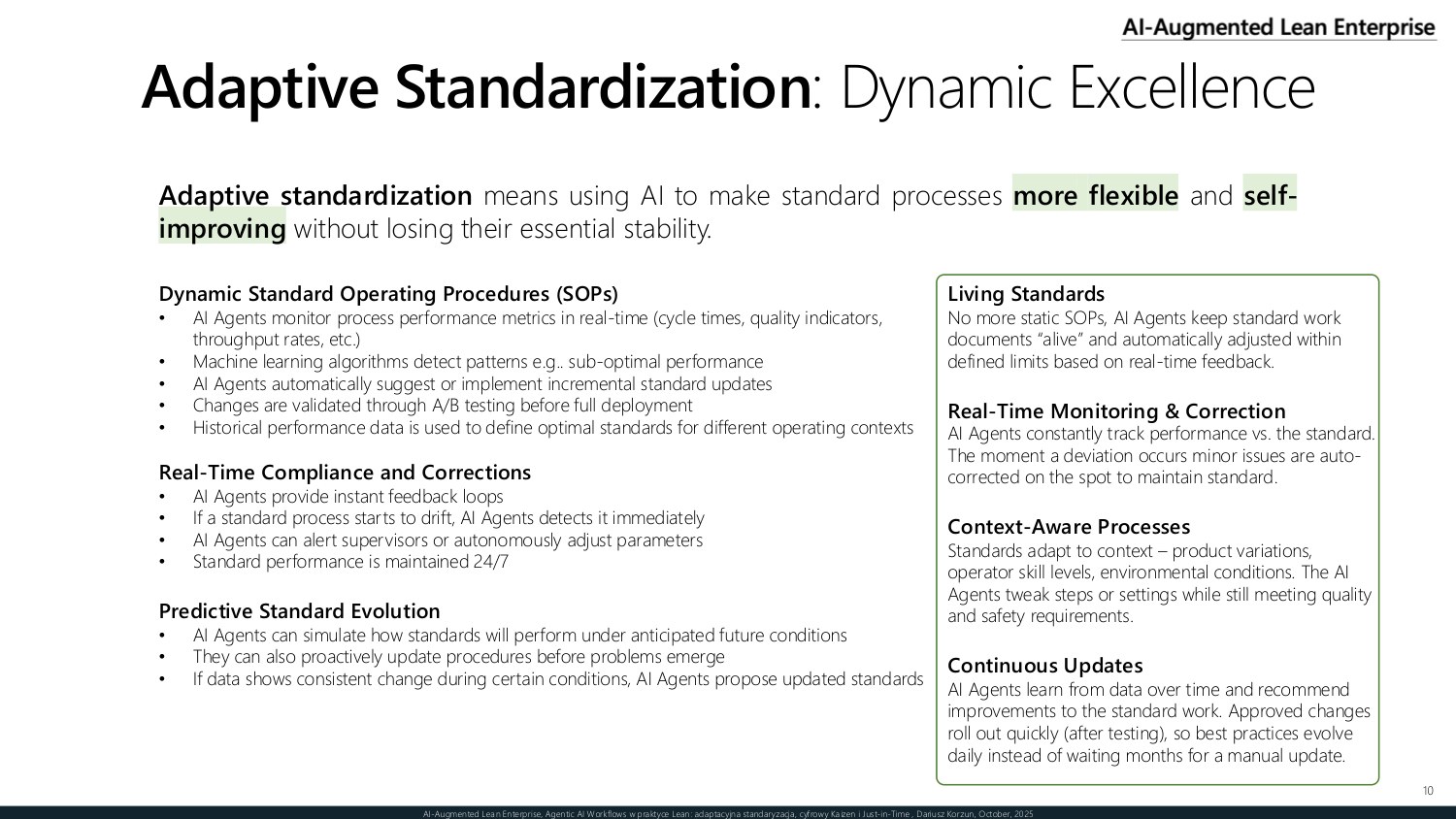
Adaptive standardization — dynamic standard operating procedures, living standards, and real-time monitoring and correction that keep standard work stable yet self-improving

11. Adaptive standardization: impact and implications
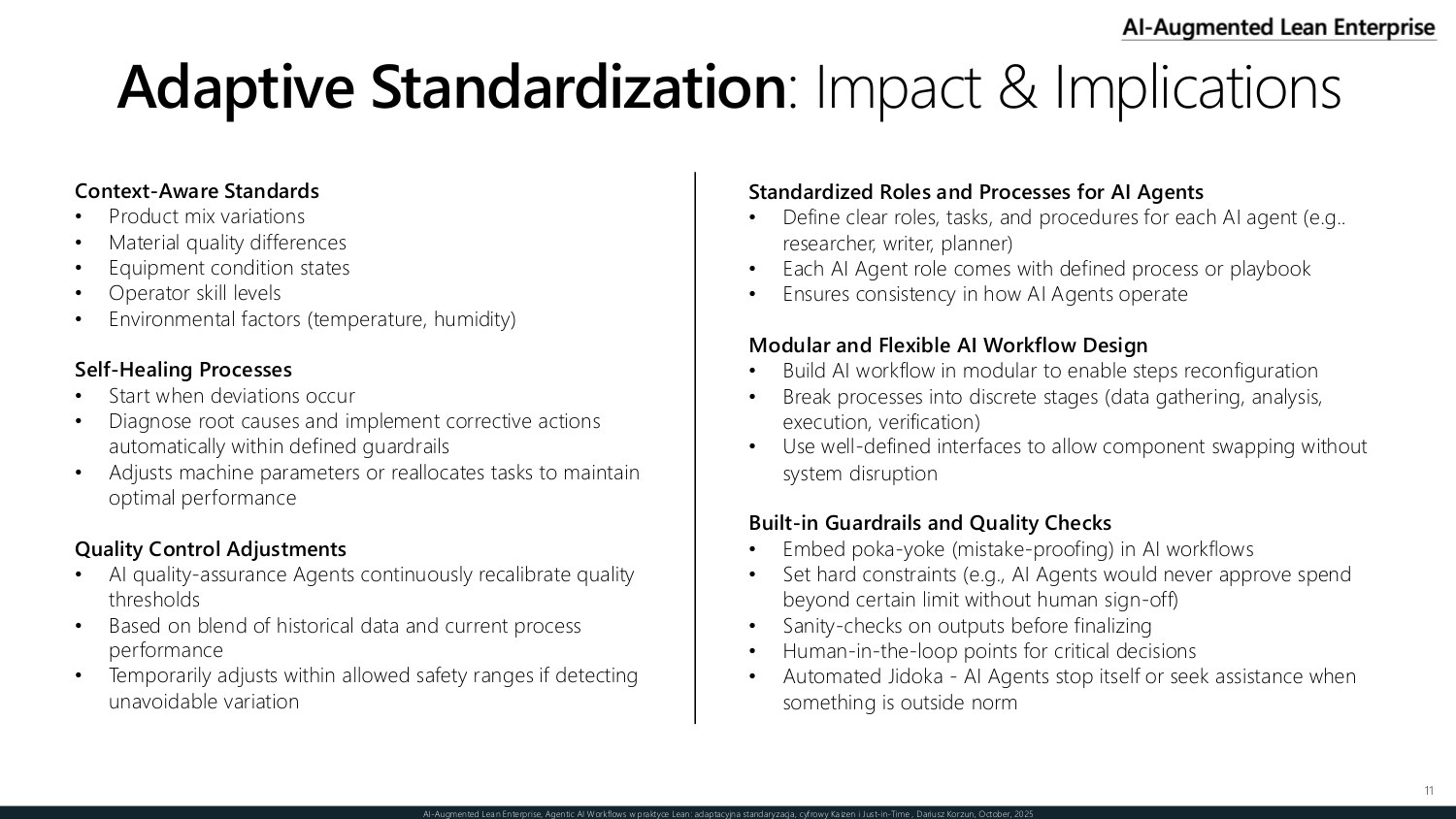
Adaptive standardization impact — context-aware standards, self-healing processes, modular workflow design, and built-in guardrails and quality checks for AI agents

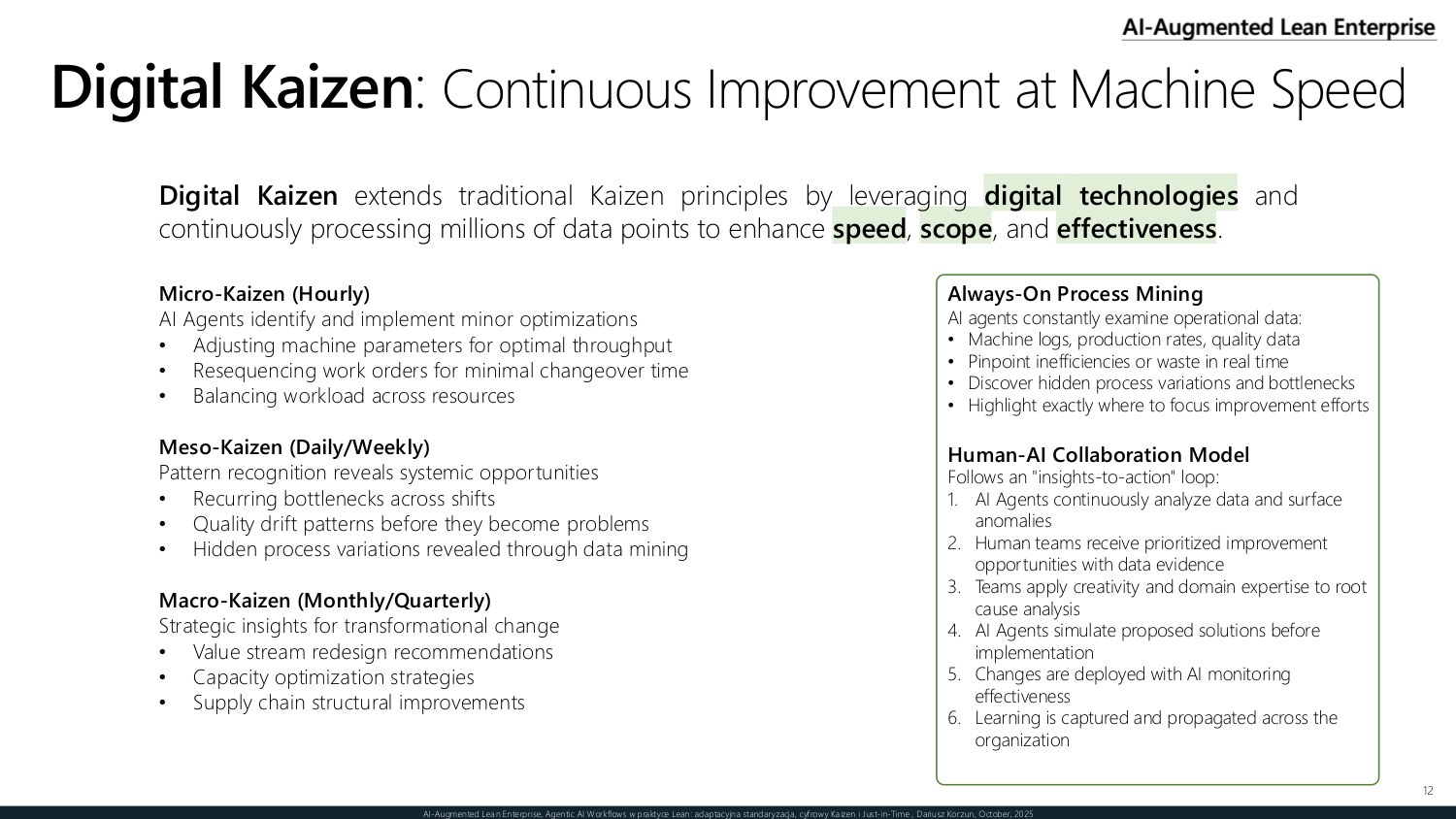
12. Digital Kaizen at machine speed

Digital Kaizen at machine speed — micro, meso, and macro Kaizen, always-on process mining, and a human-AI insights-to-action loop

13. Implementing digital Kaizen for AI systems
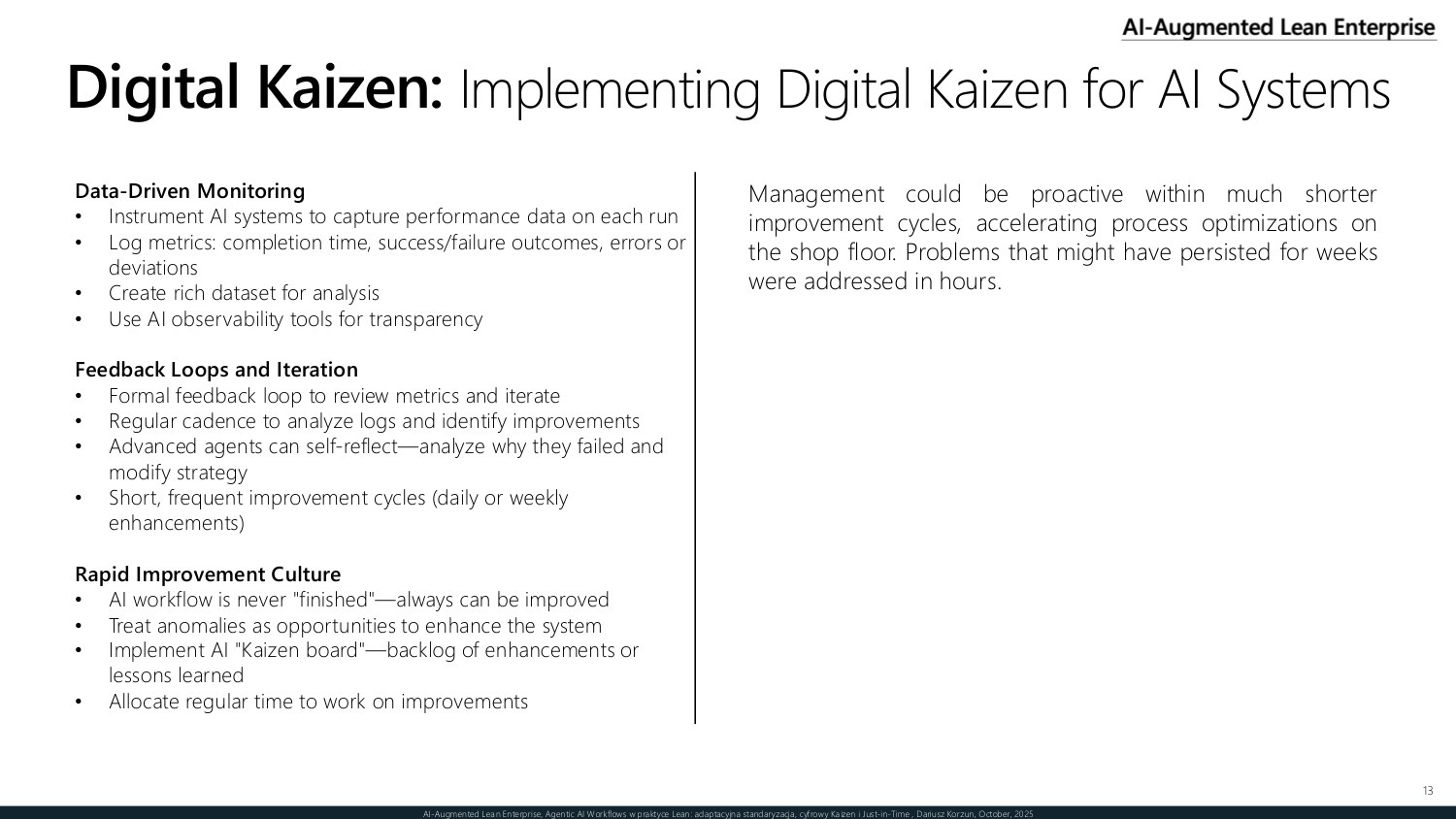
Implementing digital Kaizen for AI systems — data-driven monitoring, feedback loops and iteration, and a rapid improvement culture

14. Just-in-time intelligence: precision in time and space
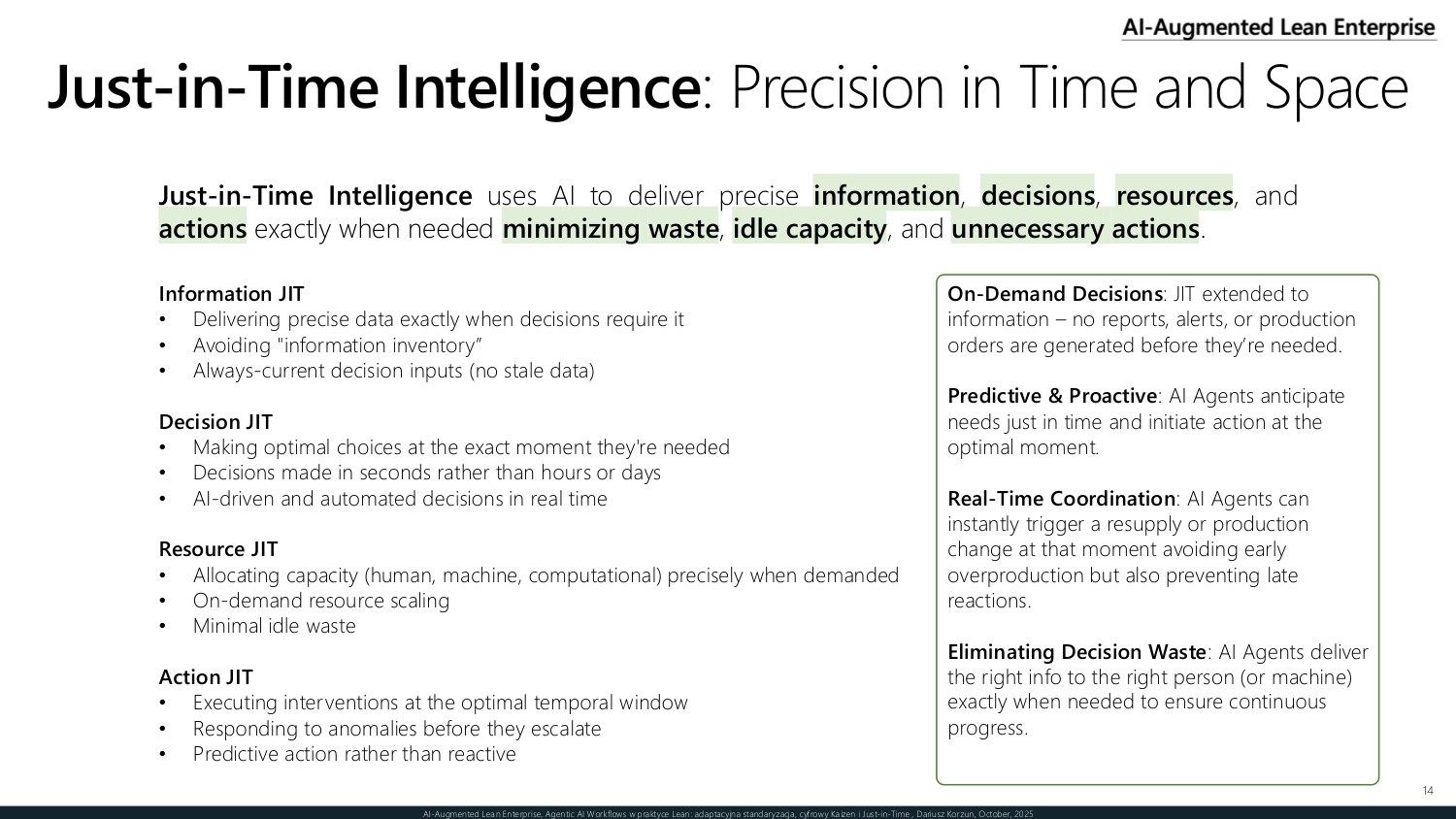
Just-in-time intelligence — delivering the right information, decision, and resource exactly when needed to minimize waste and idle capacity

15. Just-in-time intelligence: predictive and proactive
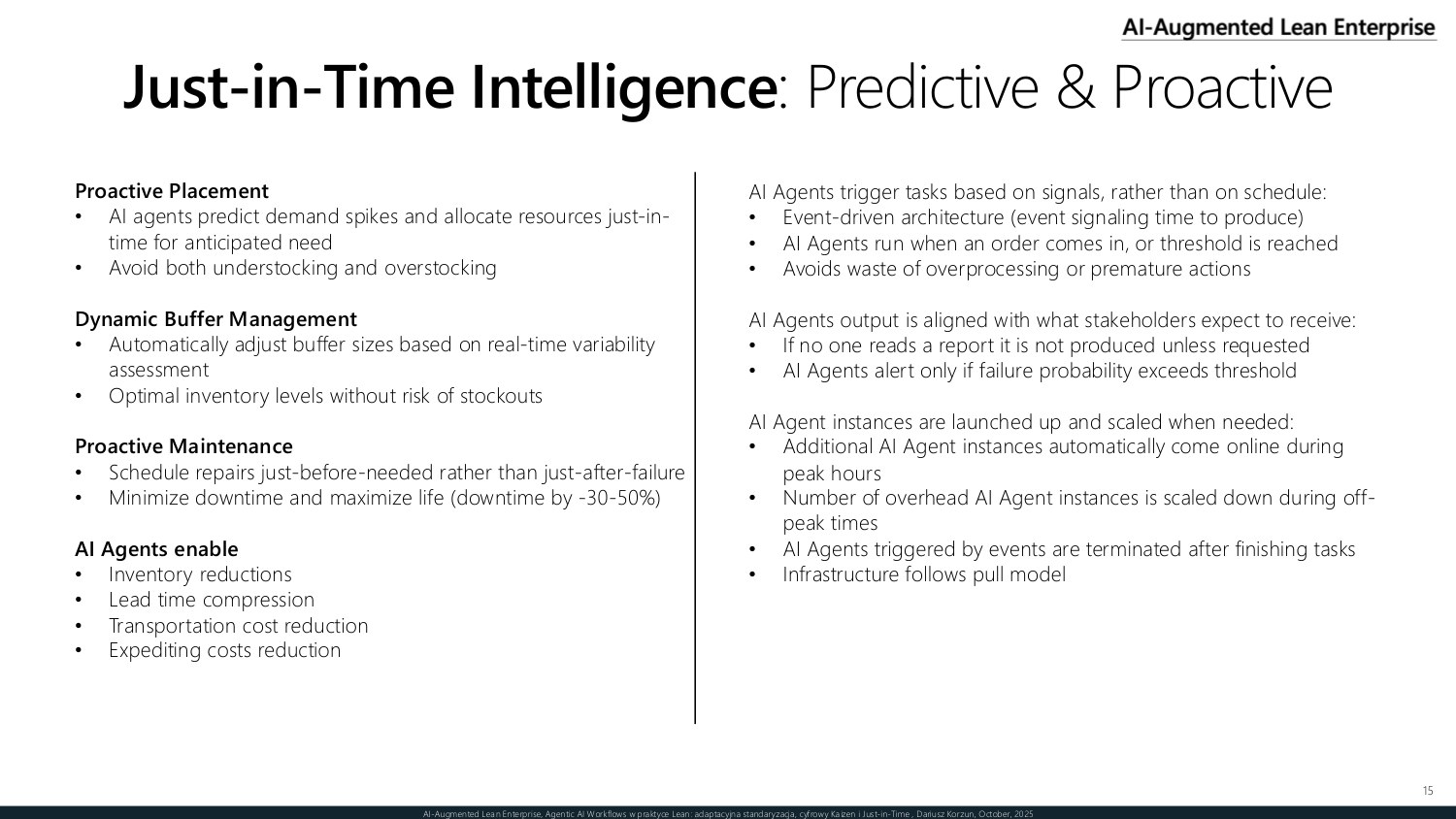
Just-in-time intelligence, predictive and proactive — proactive placement, dynamic buffer management, proactive maintenance, and event-driven action

16. Benefits and advantages

Section divider — benefits and advantages

17. Operational excellence advantages
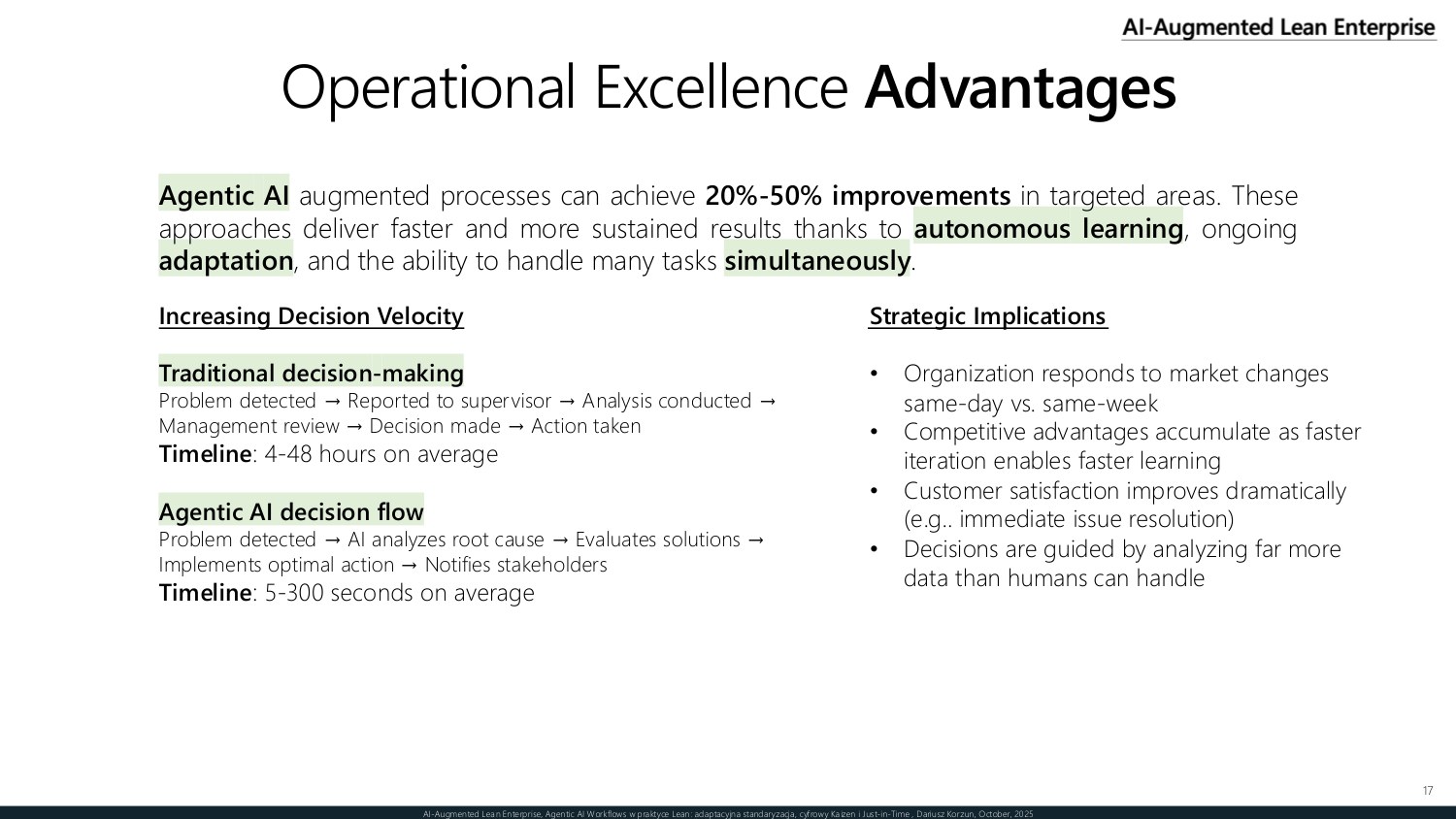
Operational excellence advantages — increasing decision velocity from hours to seconds and the strategic implications of faster iteration and learning

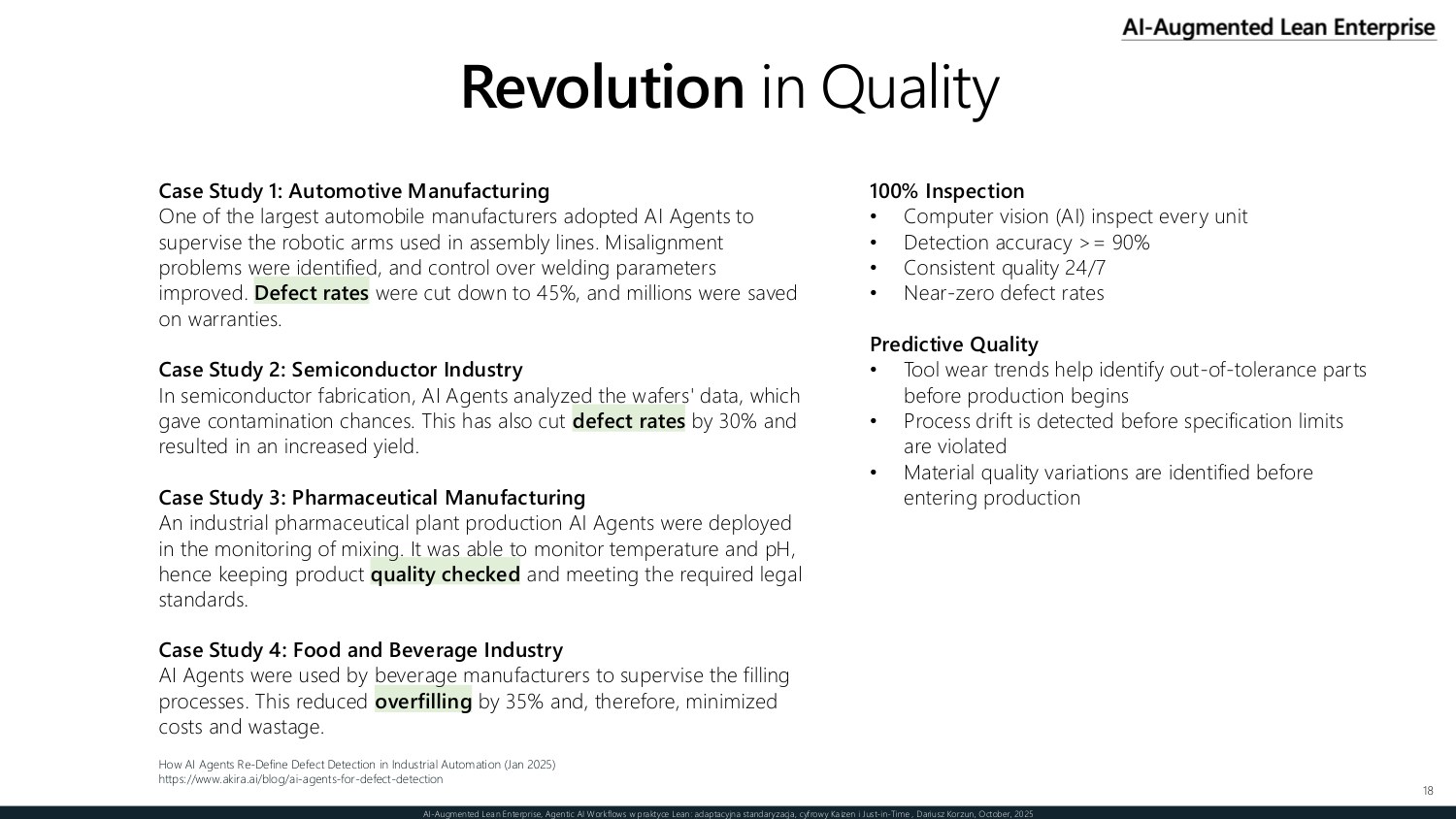
18. A revolution in quality

A revolution in quality — case studies in automotive, semiconductor, and pharmaceutical manufacturing, with 100 percent inspection and predictive quality

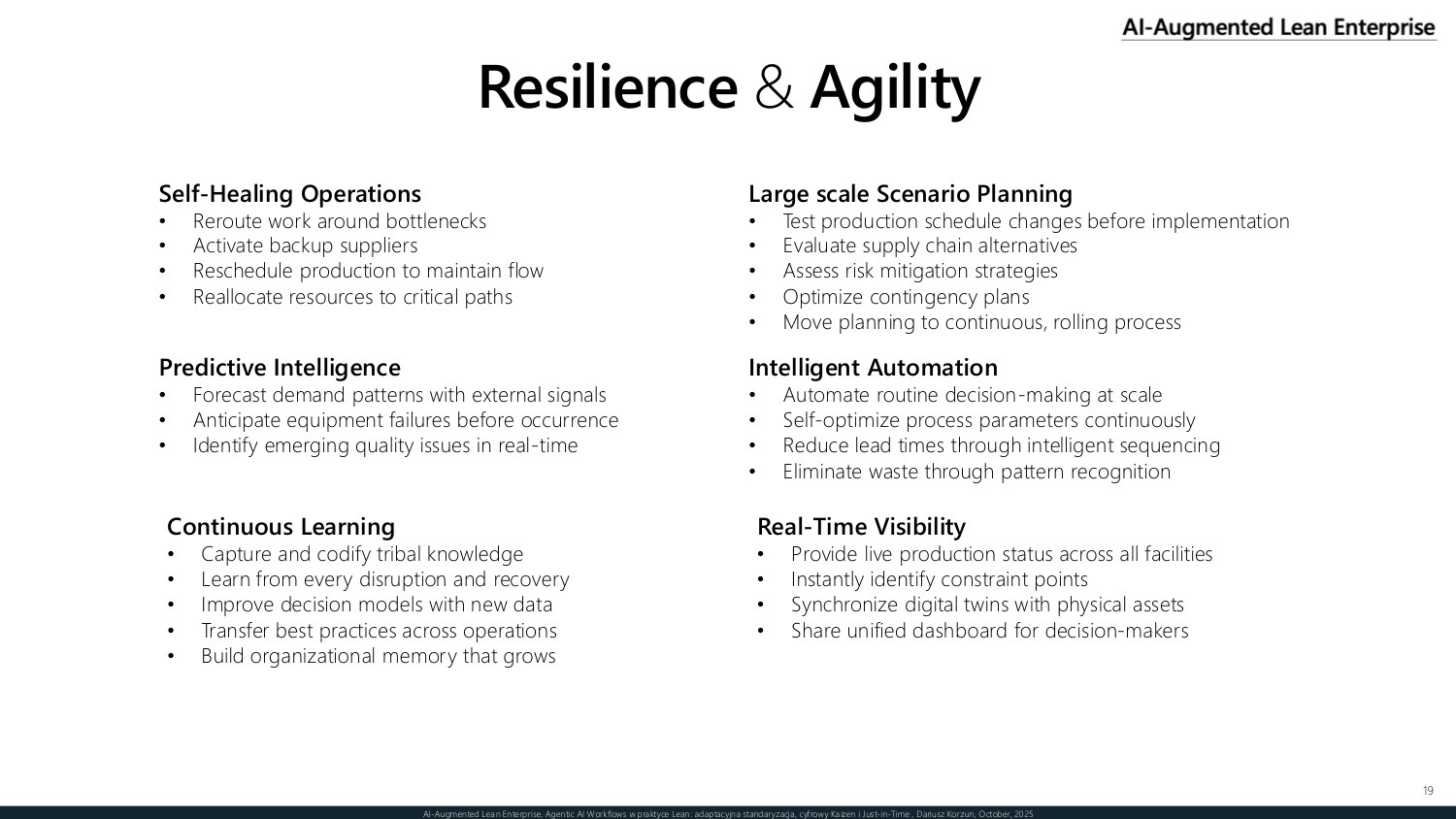
19. Resilience and agility

Resilience and agility — self-healing operations, large-scale scenario planning, predictive intelligence, intelligent automation, and real-time visibility

20. Workforce empowerment

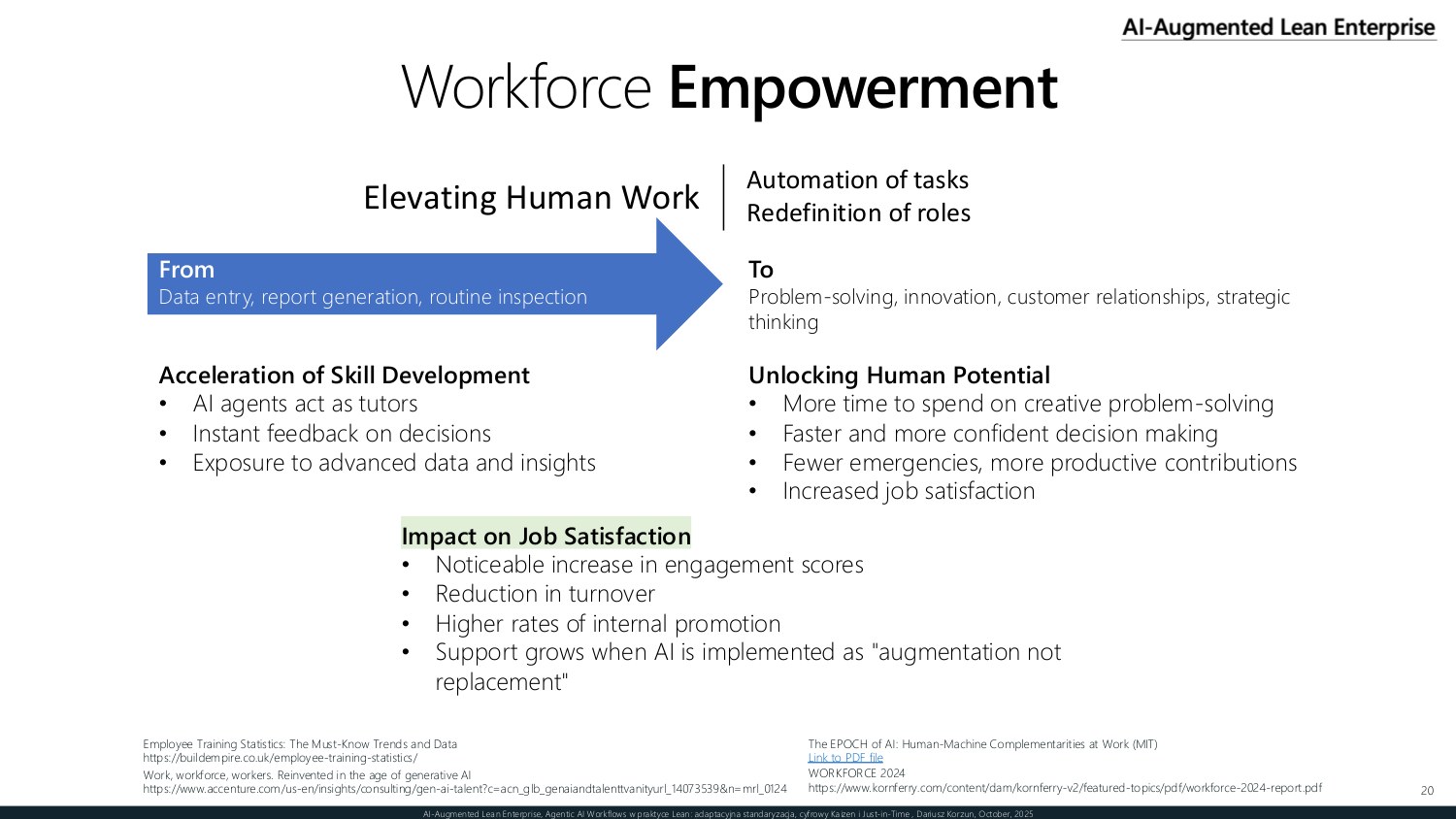
Workforce empowerment — elevating human work from routine tasks to problem-solving, accelerating skill development, and raising job satisfaction

21. Workforce empowerment: the future of jobs
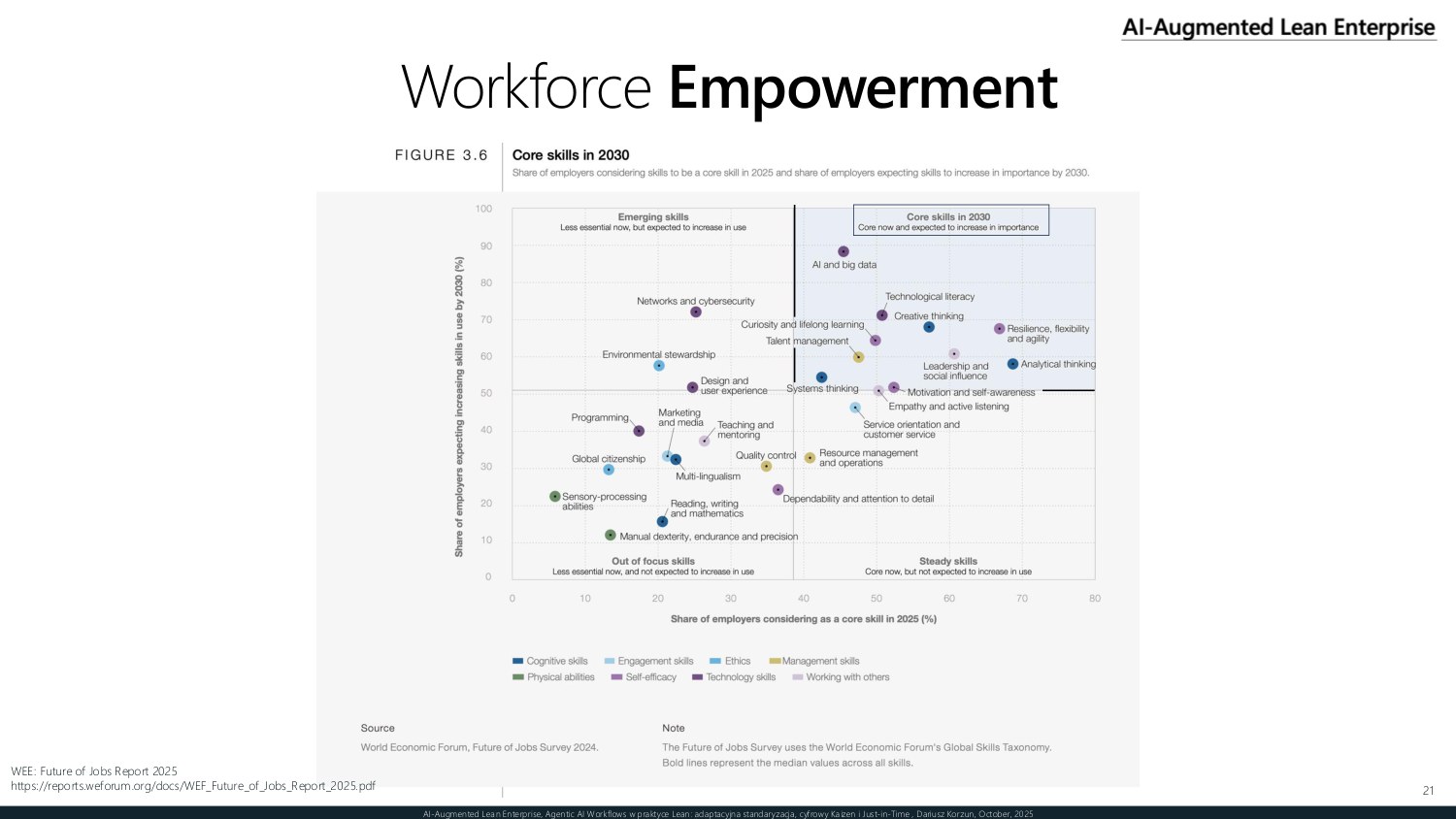
Workforce empowerment — referencing the World Economic Forum Future of Jobs Report 2025

22. Critical challenges and strategic risks
Section divider — critical challenges and strategic risks

23. Implementation challenges
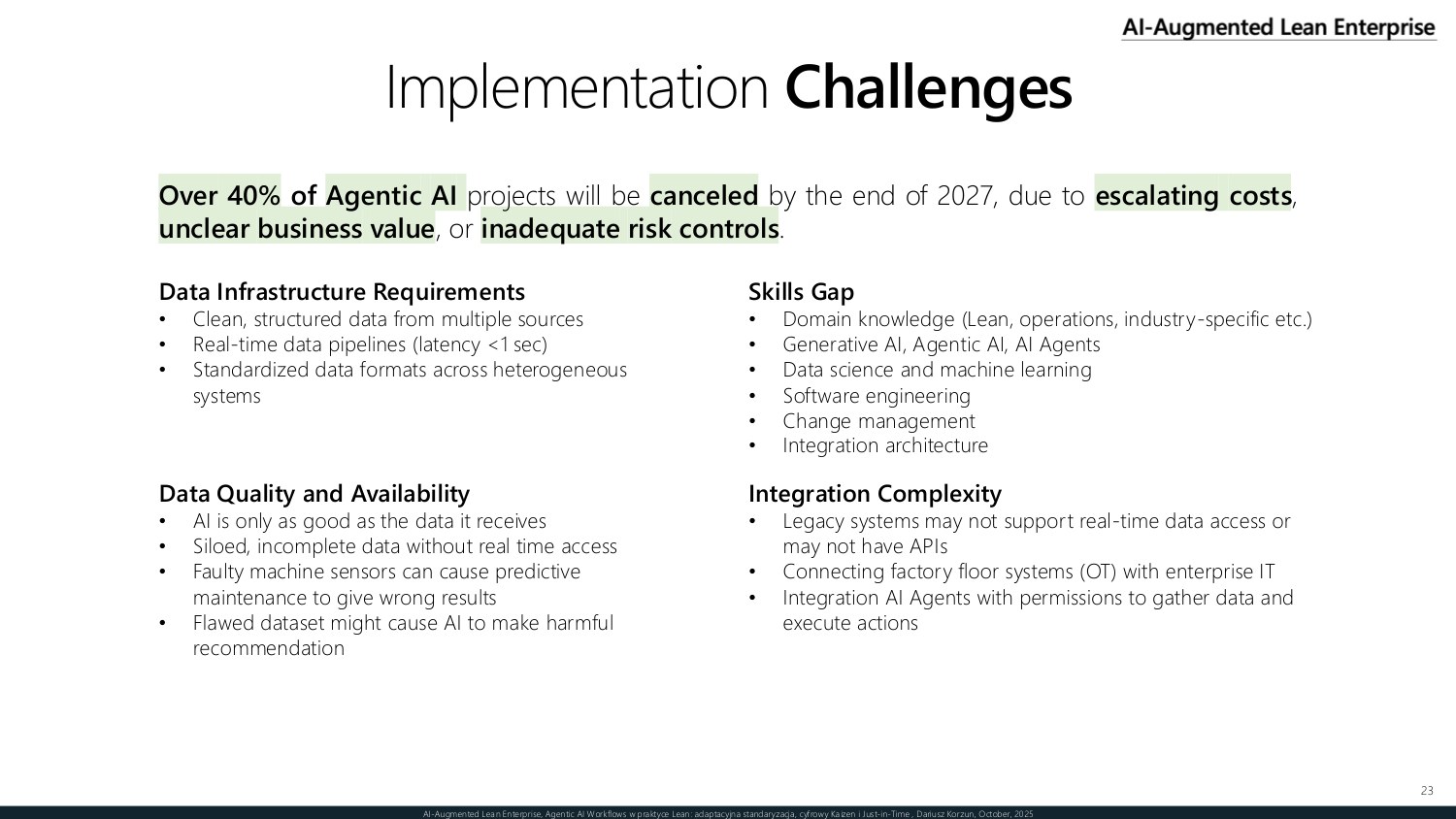
Implementation challenges — data infrastructure and quality requirements, the skills gap, and integration complexity, with over 40 percent of agentic AI projects at risk of cancellation by 2027

24. Cost considerations

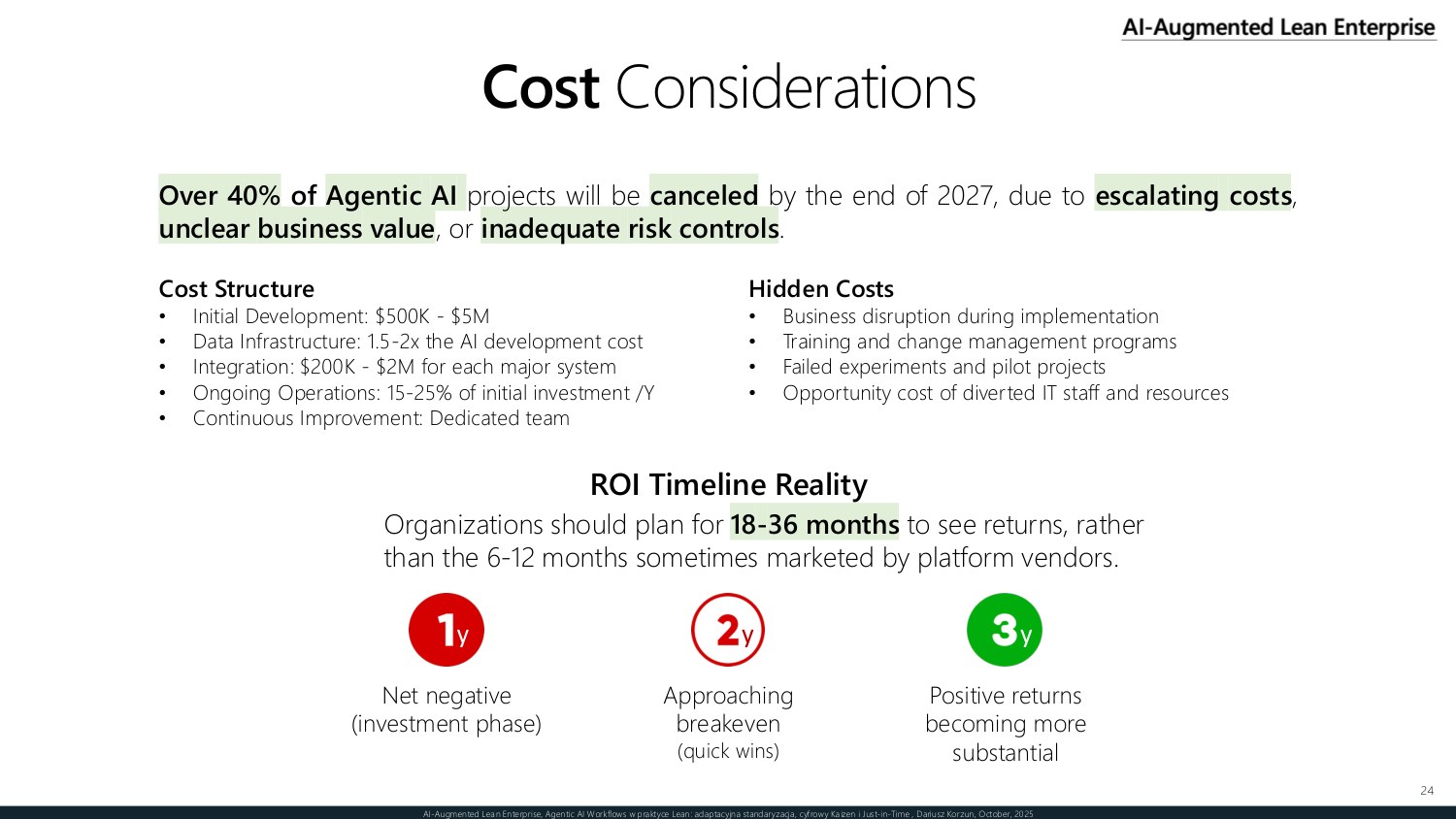
Cost considerations — development, infrastructure, integration, and operating cost structure, hidden costs, and an 18 to 36 month ROI timeline

25. Change management complexity

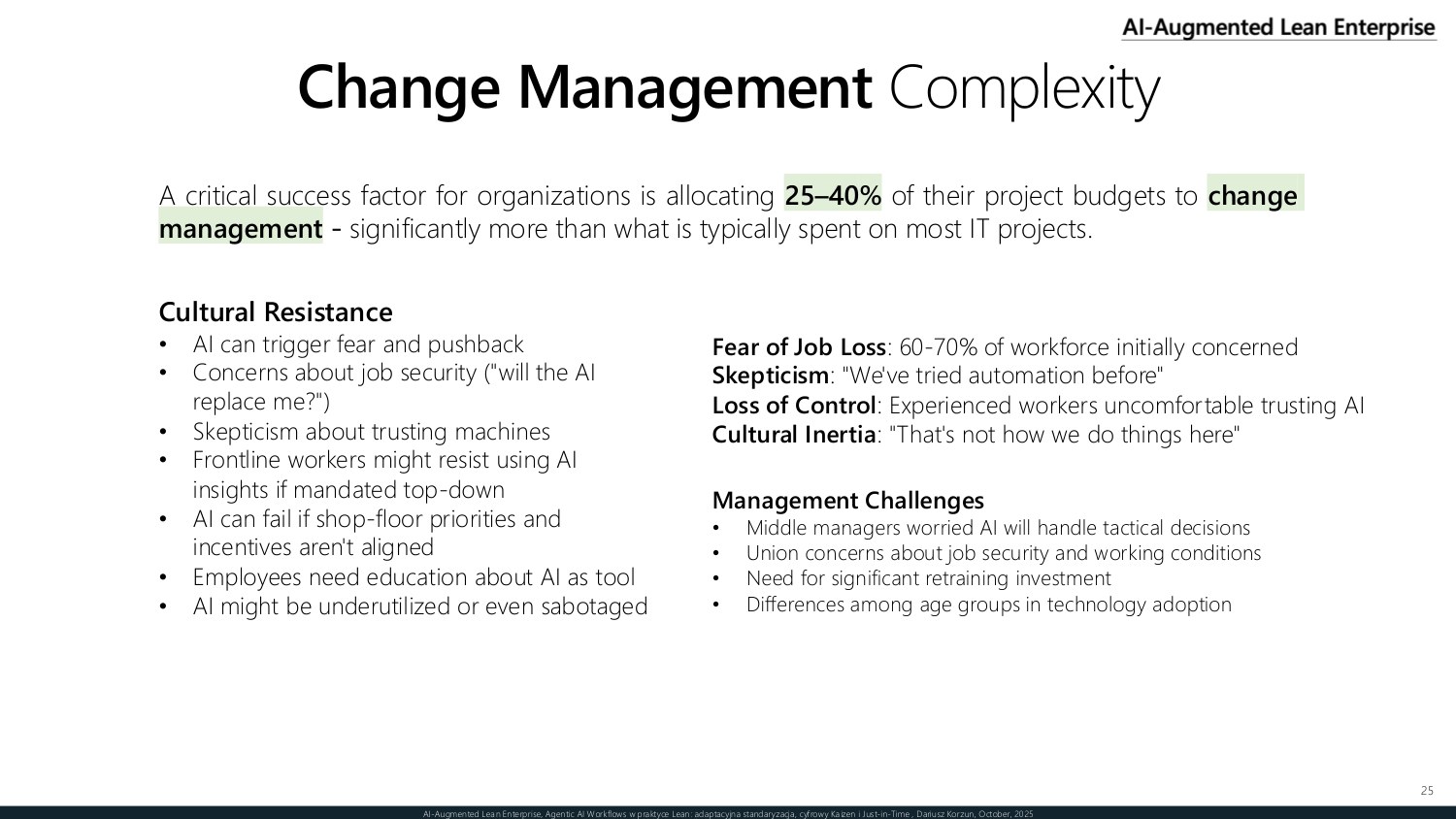
Change management complexity — cultural resistance and management challenges, and the case for allocating 25 to 40 percent of project budget to change management

26. Operational risks

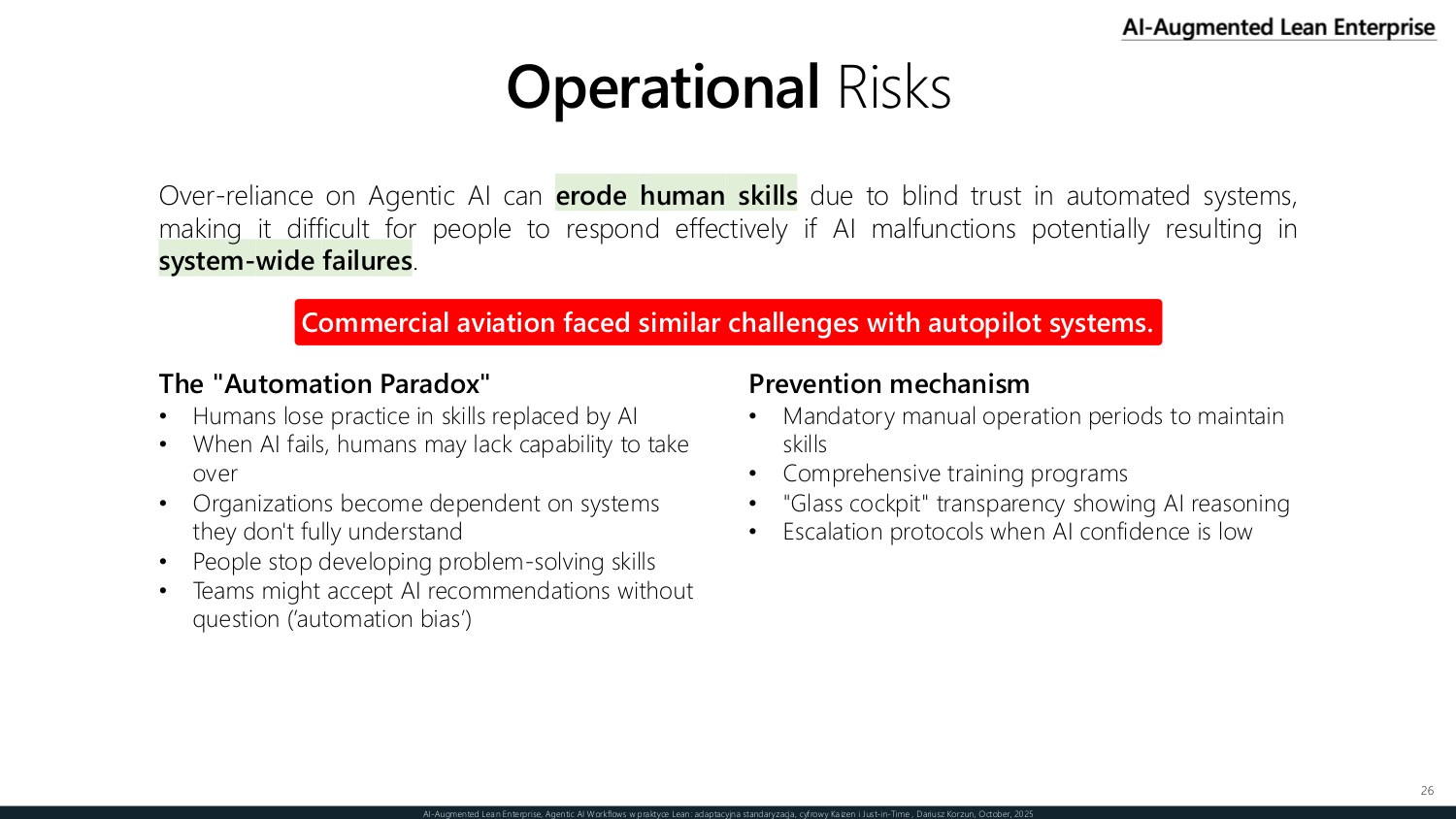
Operational risks — the automation paradox of eroded human skill, illustrated by commercial aviation autopilot, with prevention mechanisms

27. AI blind spots

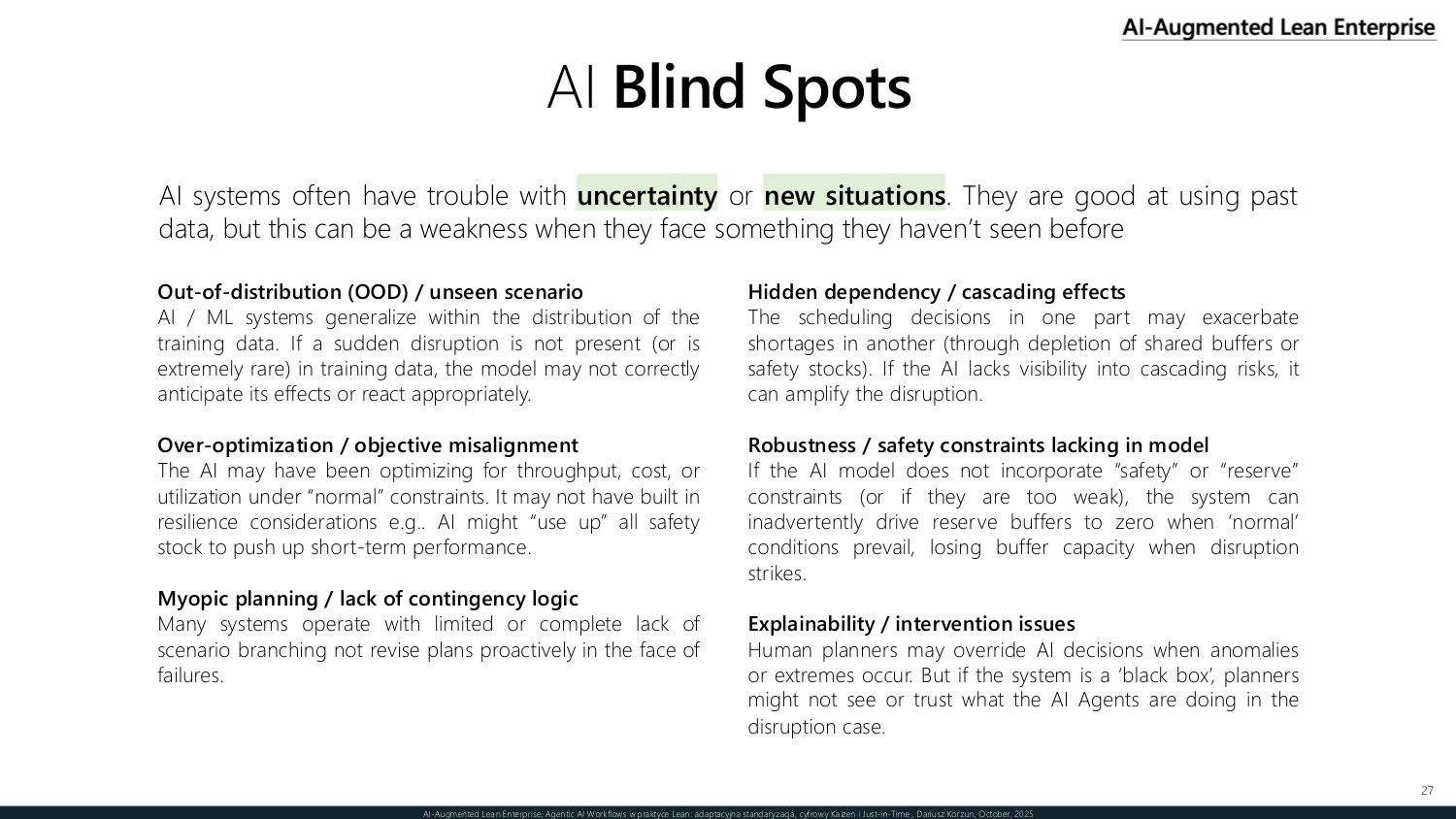
AI blind spots — out-of-distribution scenarios, hidden dependencies and cascading effects, over-optimization and objective misalignment, and missing safety constraints

28. Security and privacy

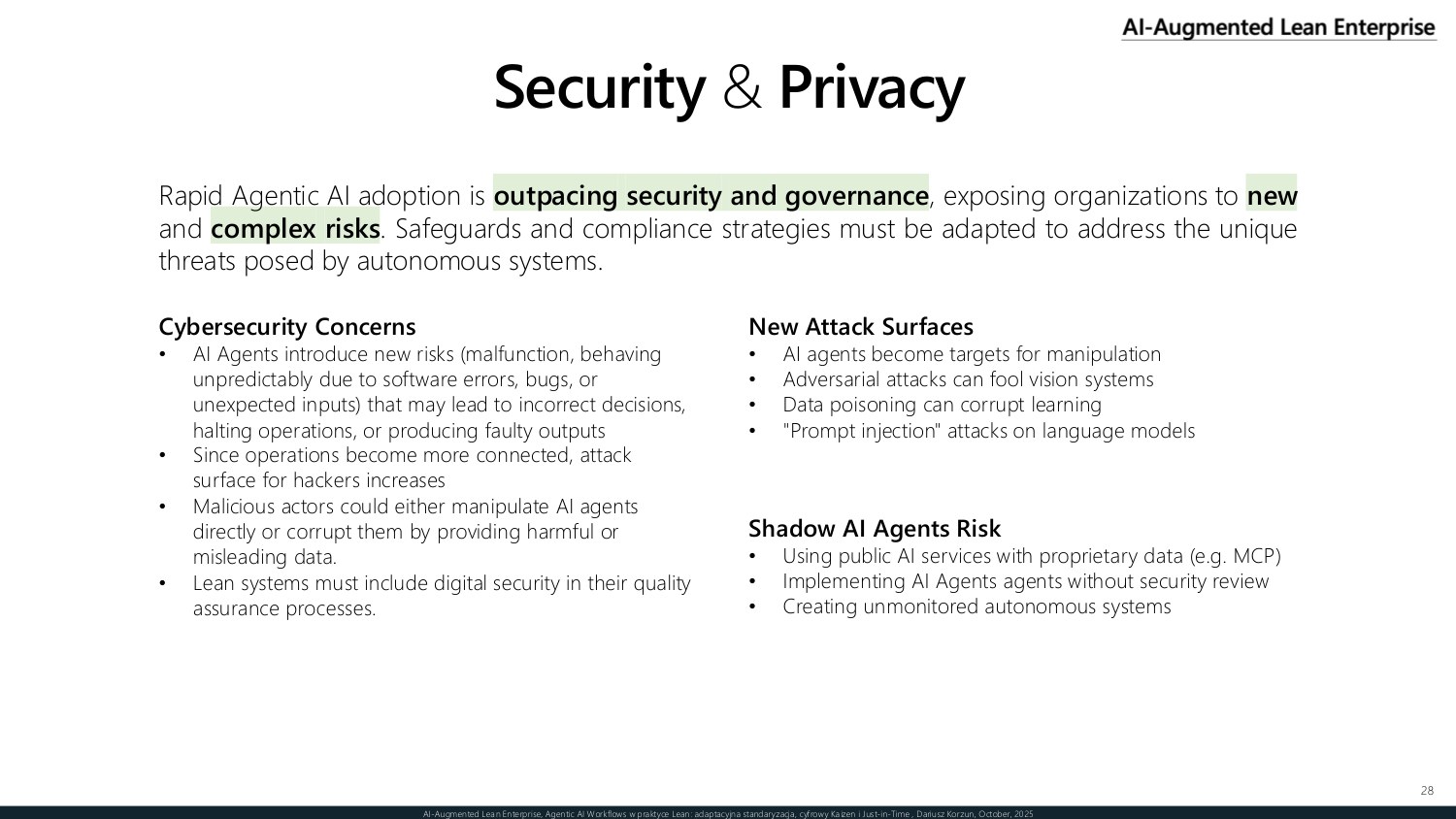
Security and privacy — cybersecurity concerns, new attack surfaces such as adversarial attacks and prompt injection, and shadow AI agent risk

29. Misalignment with business value

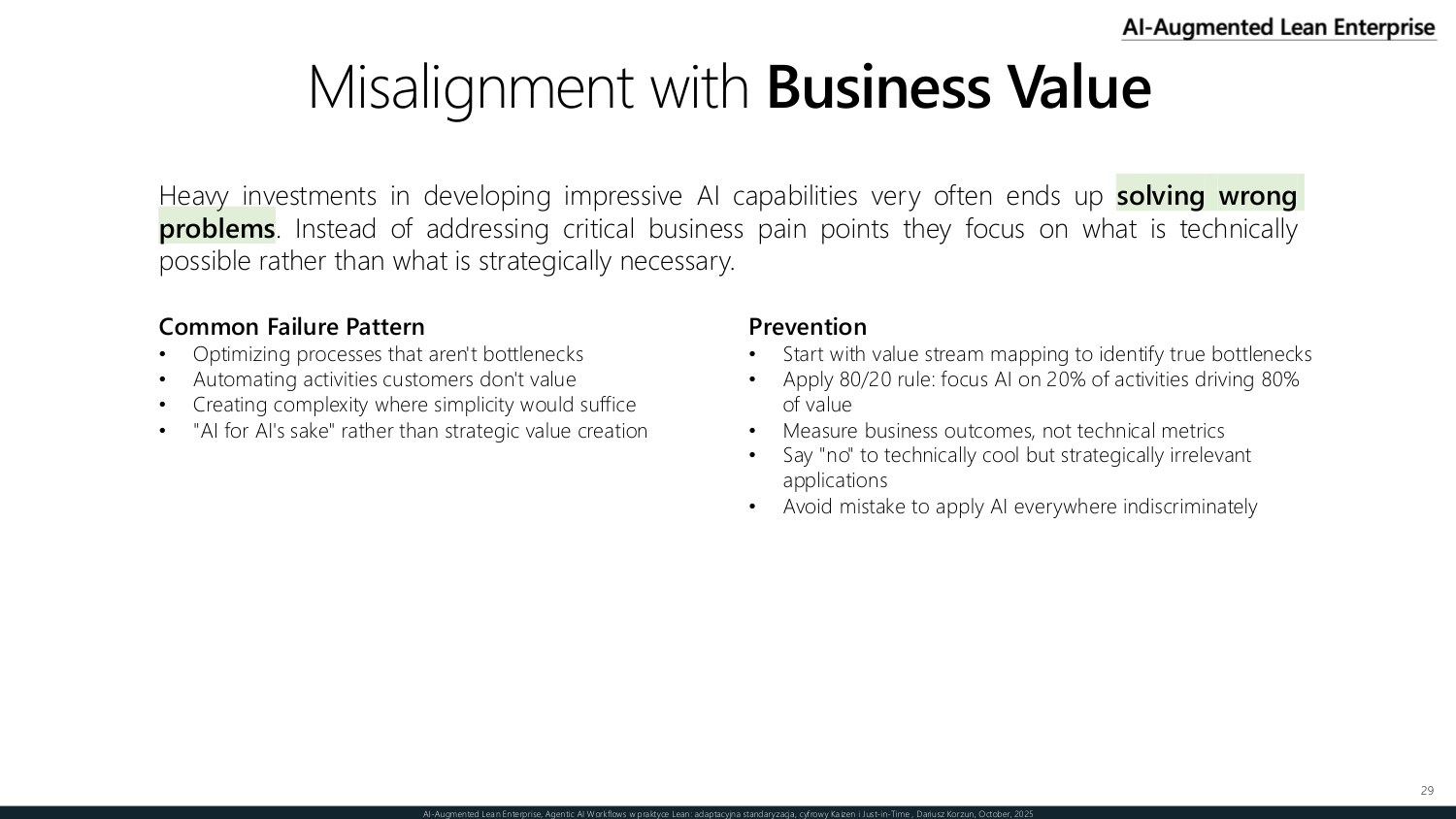
Misalignment with business value — the common failure pattern of automating the wrong things, and prevention through value stream mapping and the 80/20 rule

30. Implementation best practices

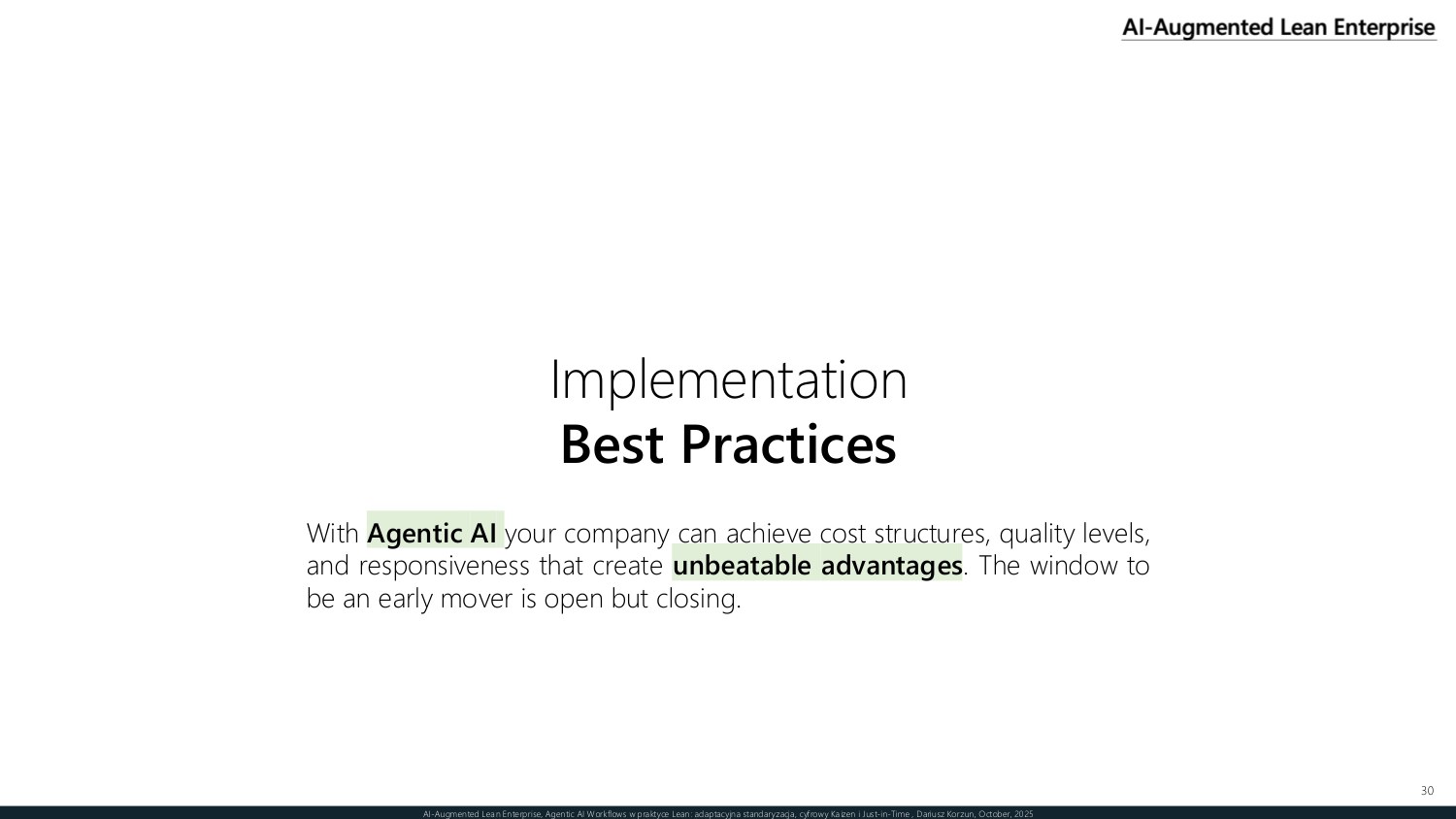
Section divider — implementation best practices, and the closing window to be an early mover

31. The decision autonomy model

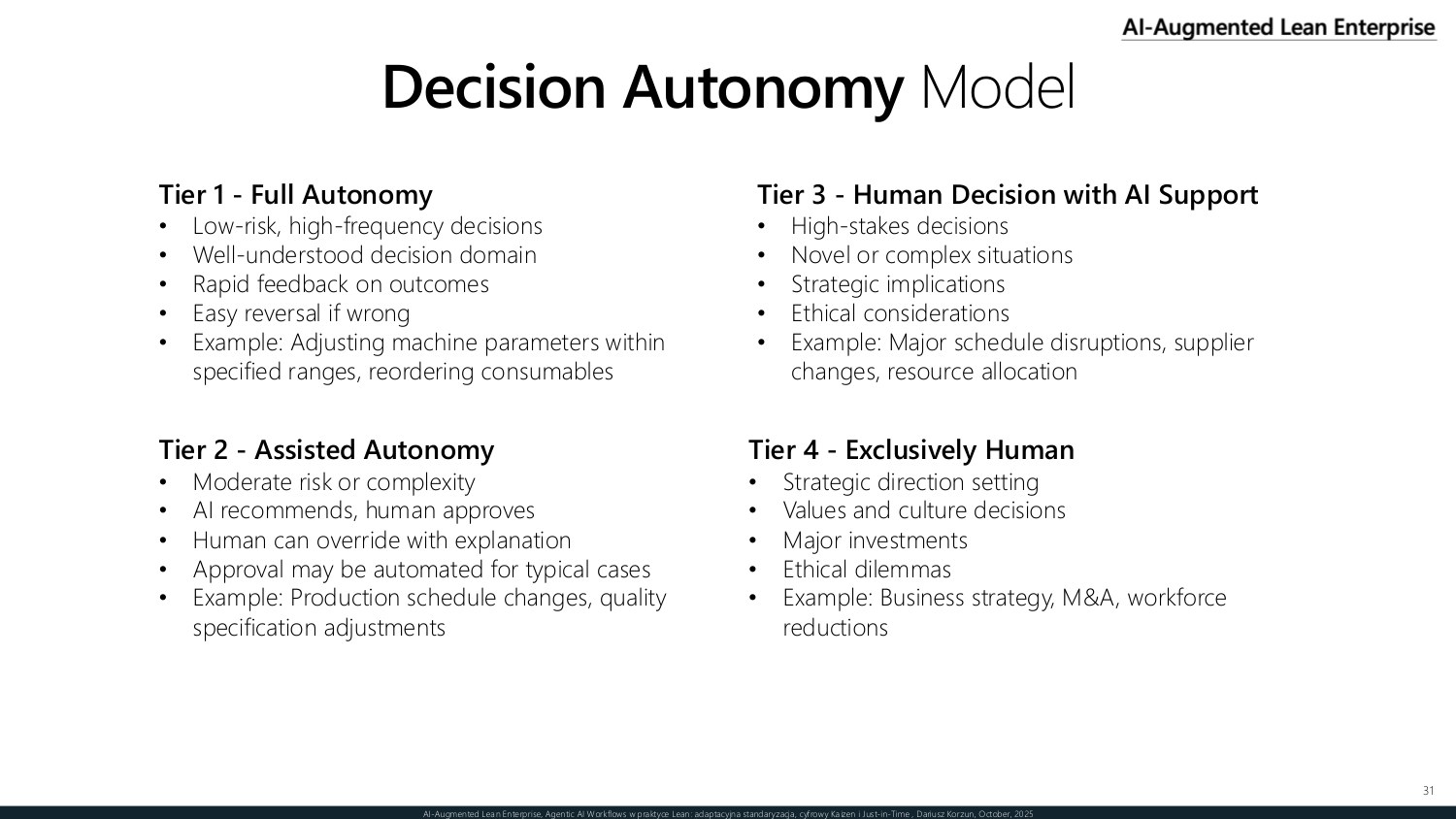
The decision autonomy model — four tiers from full autonomy to assisted autonomy, human decision with AI support, and exclusively human decisions

32. Strategic recommendations

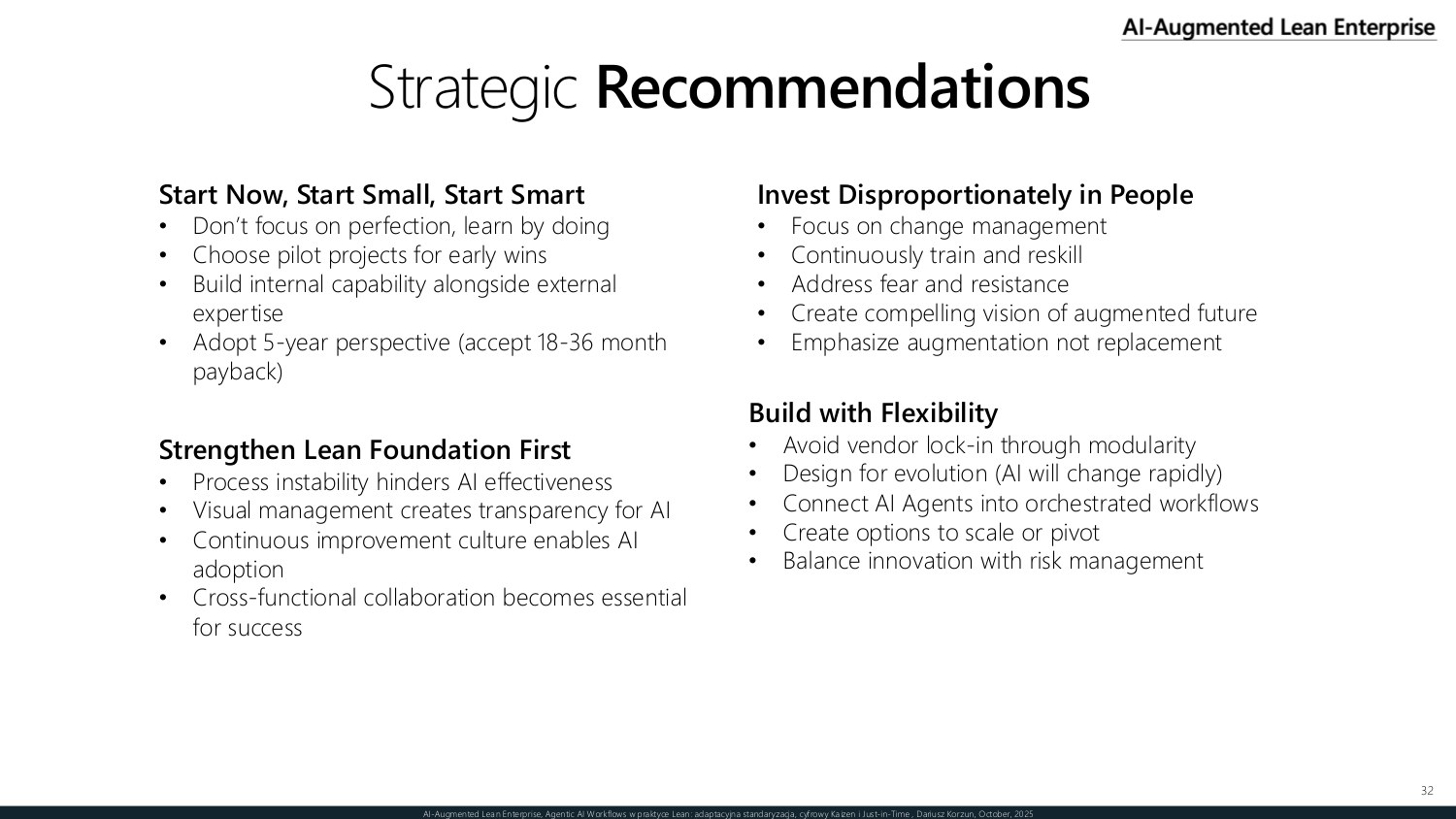
Strategic recommendations — start now, small, and smart, strengthen the Lean foundation first, invest disproportionately in people, and build with flexibility

33. The implementation roadmap

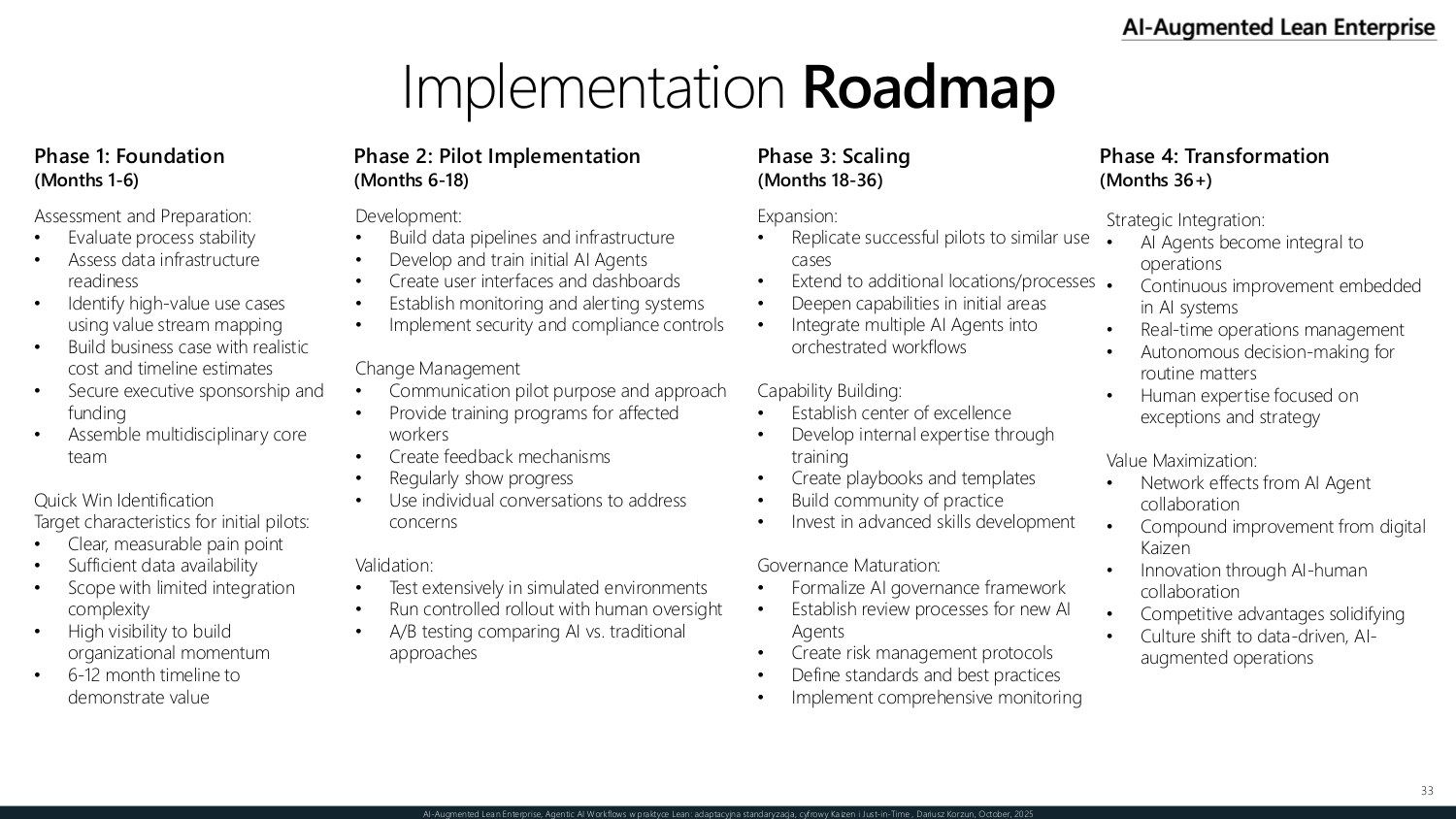
The implementation roadmap — four phases from foundation to pilot implementation, scaling, and transformation across roughly three years

34. Virtual employees at scale

Section divider — virtual employees at scale

35. Integrating AI agents as virtual employees
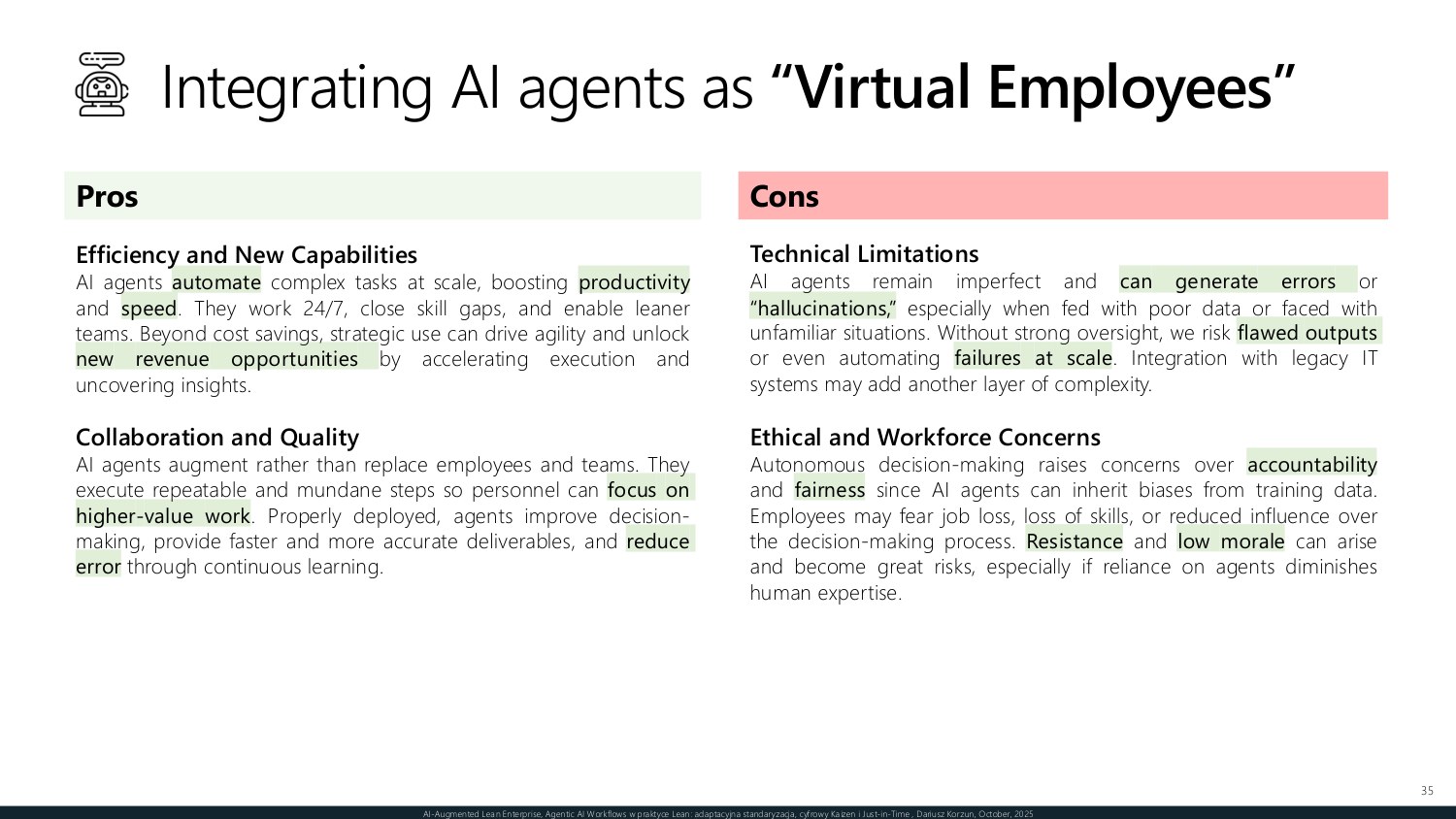
Integrating AI agents as virtual employees — pros of efficiency, new capabilities, and collaboration weighed against technical limits and ethical and workforce concerns

36. A new organizational design for human and AI
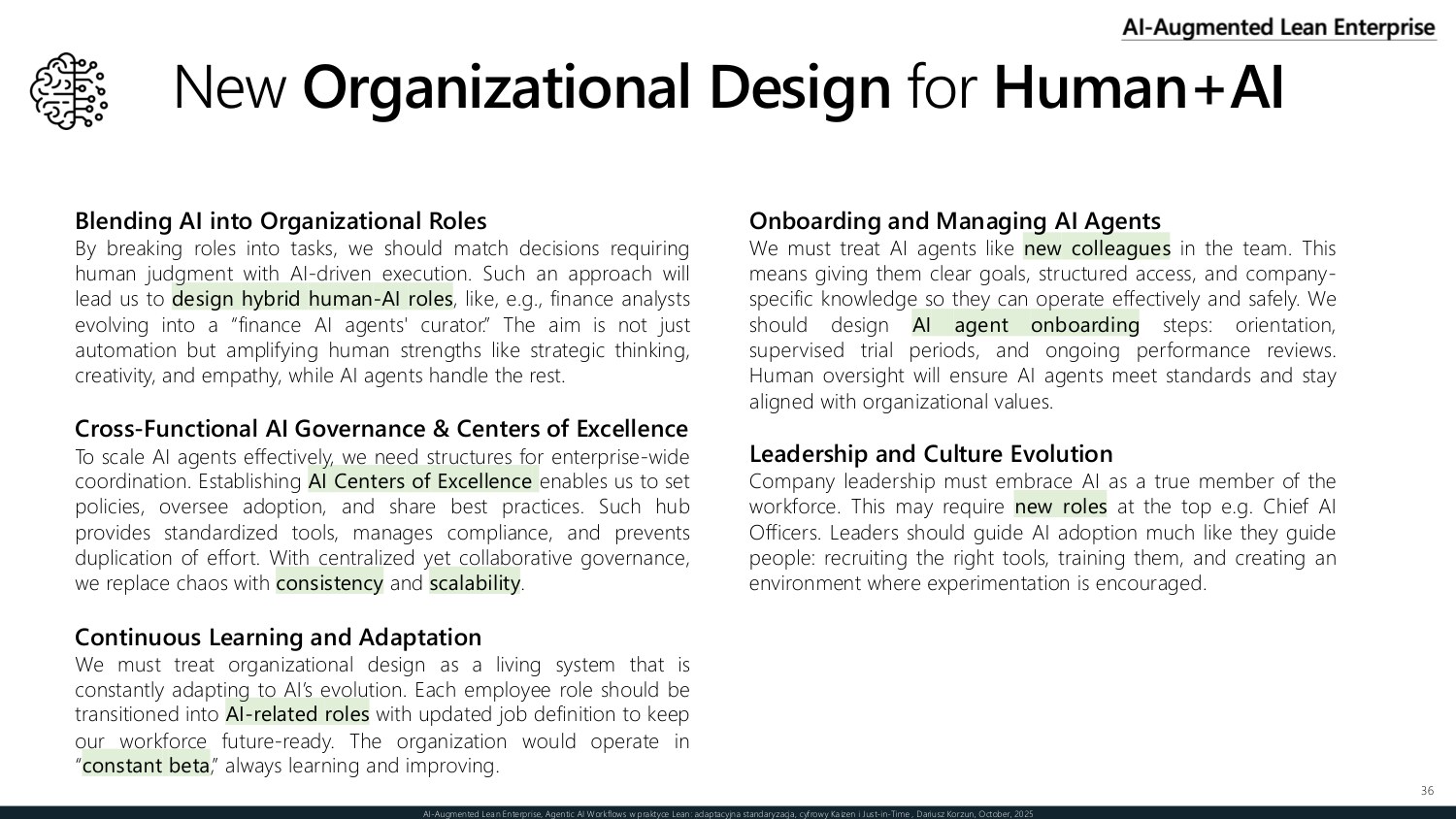
A new organizational design for human and AI — hybrid roles, onboarding and managing agents, cross-functional governance and centers of excellence, and leadership and culture evolution

37. Recommendations and next steps

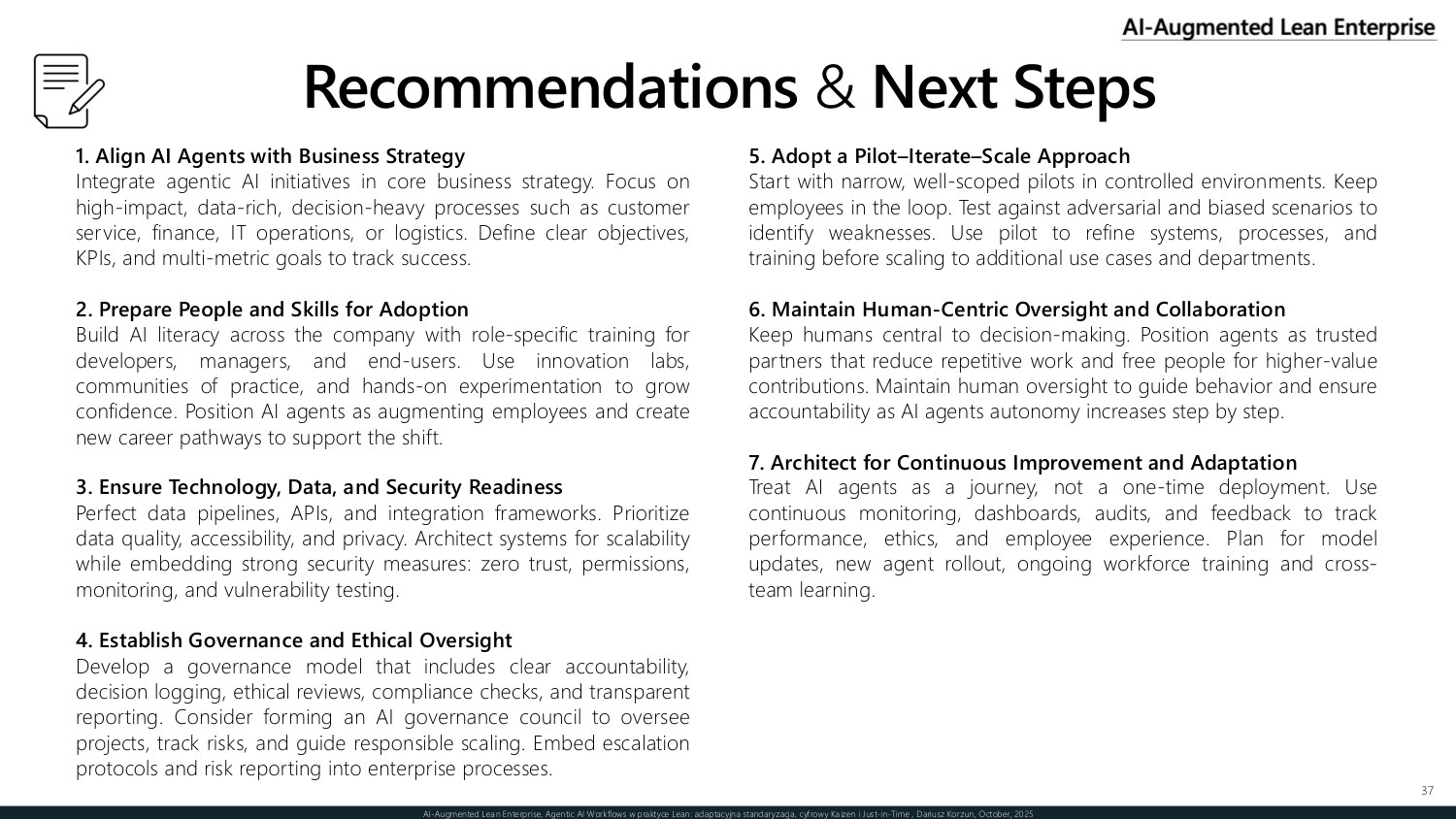
Recommendations and next steps — aligning agents with business strategy, preparing people and skills, adopting a pilot-iterate-scale approach, and maintaining human-centric oversight

38. Closing: AI-Augmented Lean Enterprise
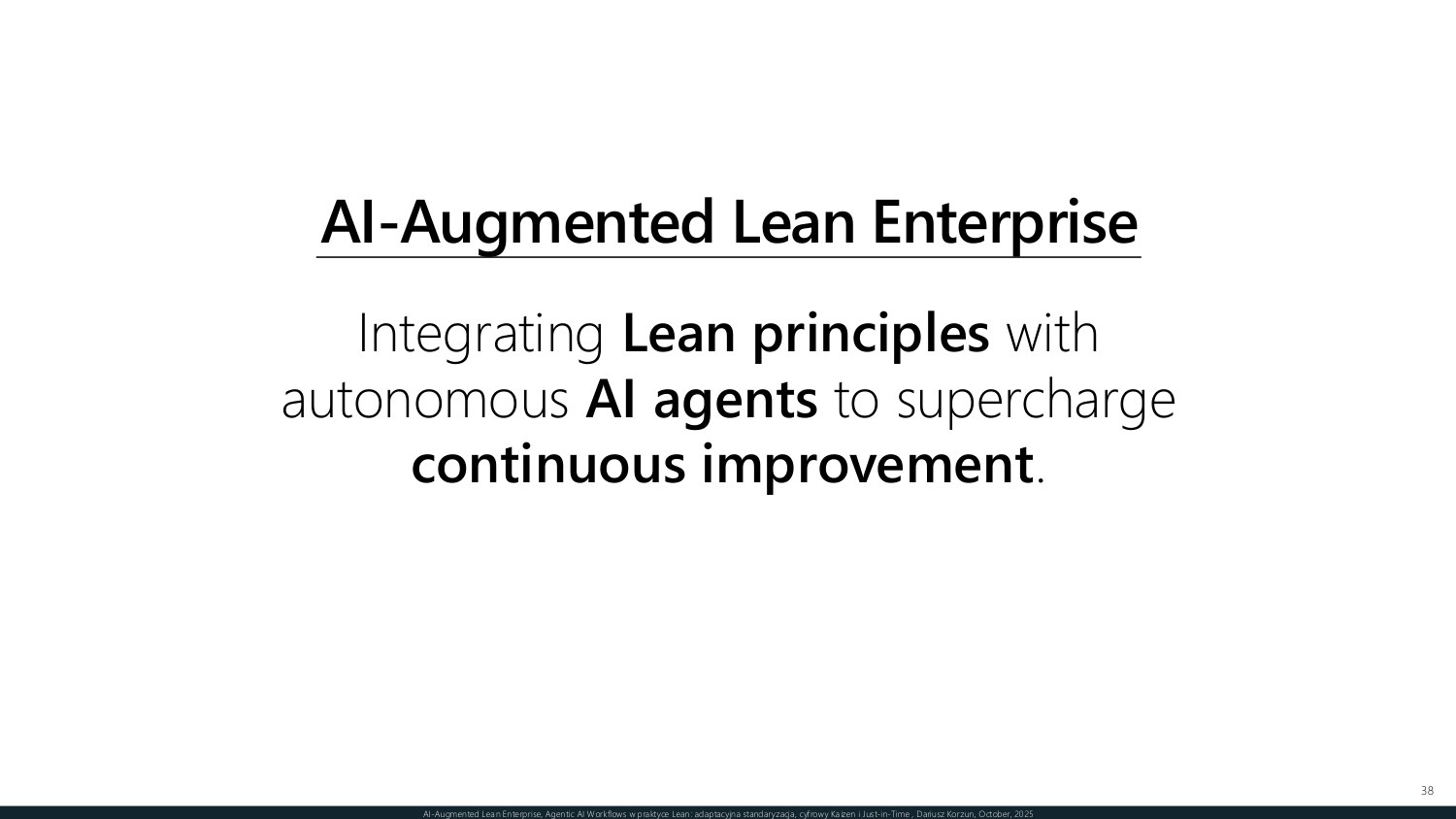
Closing slide — AI-Augmented Lean Enterprise: integrating Lean principles with autonomous AI agents to supercharge continuous improvement

39. Closing: agentic AI elevates Lean
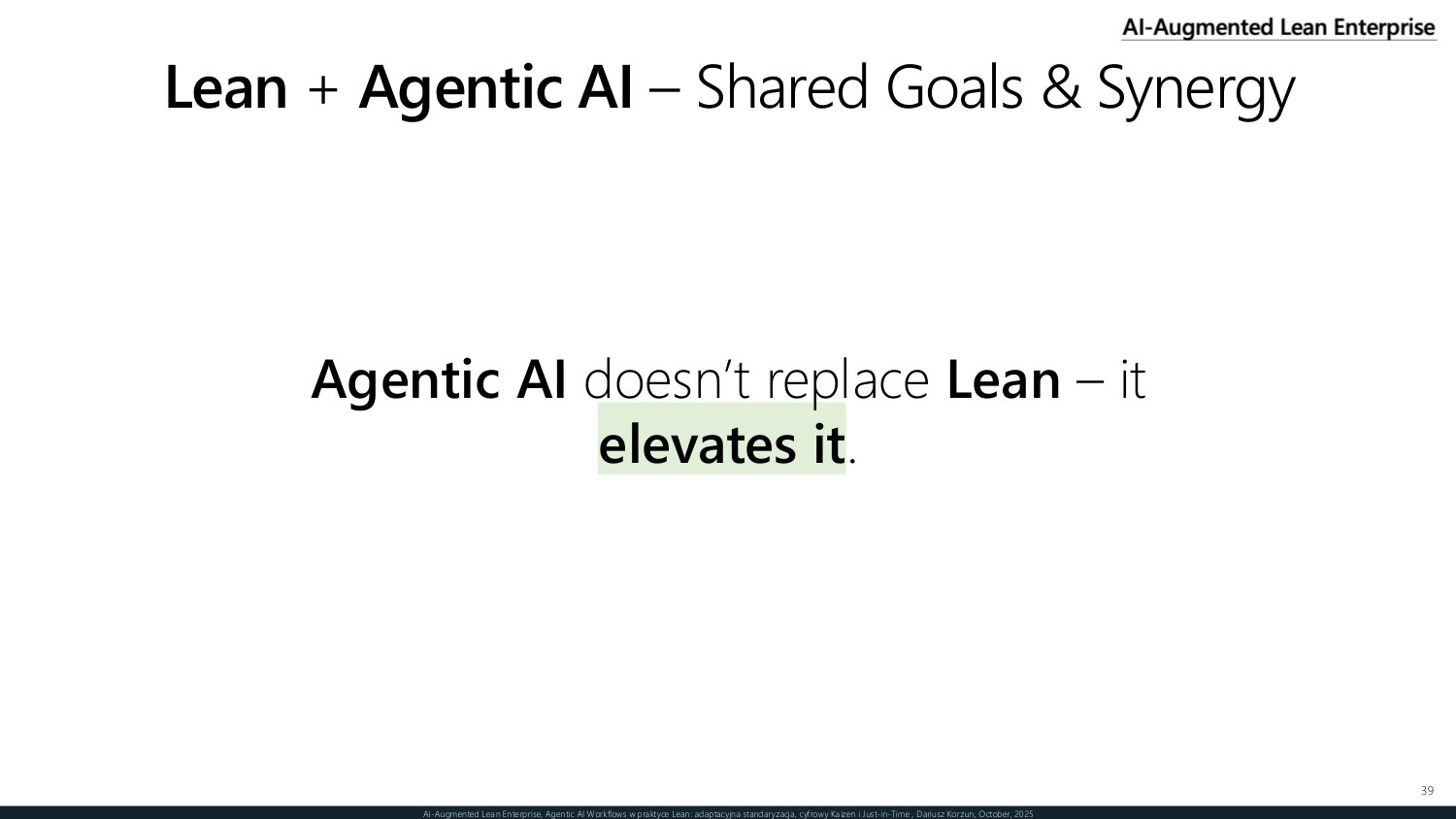
Closing slide — agentic AI does not replace Lean, it elevates it

40. Closing: the paradigm shift

Closing slide — the paradigm shift, Lean plus agentic AI as a multiplier effect
← All presentations