Presentations

Agentic AI and agentic workflows

A practitioner's walk through agentic AI — what makes a system an agent, how to analyze whether you need one, and how to design workflows, memory, tooling, evaluation, observability, safety, and security for agents in the enterprise.

Most teams reach for an agent before they have decided whether they need one. In this CIONet AI Masterclass we work the problem from the need backward. We start with what actually qualifies a system as an agent and how it differs from a chatbot, a retrieval-augmented assistant, or plain automation, then we make the reasoning patterns explicit so behavior is interpretable, controllable, and debuggable. From there we move to the decisions that matter on the job: a five-question framework for analyzing the need, a decision tree for choosing between non-AI automation, RAG, a single agent, or a multi-agent system, and the workflow patterns that compose into real solutions. We close on the operational backbone every deployed agent depends on — memory and knowledge design, the tooling landscape, evaluation, observability, safety, and enterprise security. The throughline is restraint: the goal is not the fanciest pattern, but the simplest one that delivers reliable, efficient, and safe behavior.

1. Opening
Title slide — Agentic AI and agentic workflows: how to analyze the need, design workflows, and build specialized agents

2. AI agent definition and key characteristics
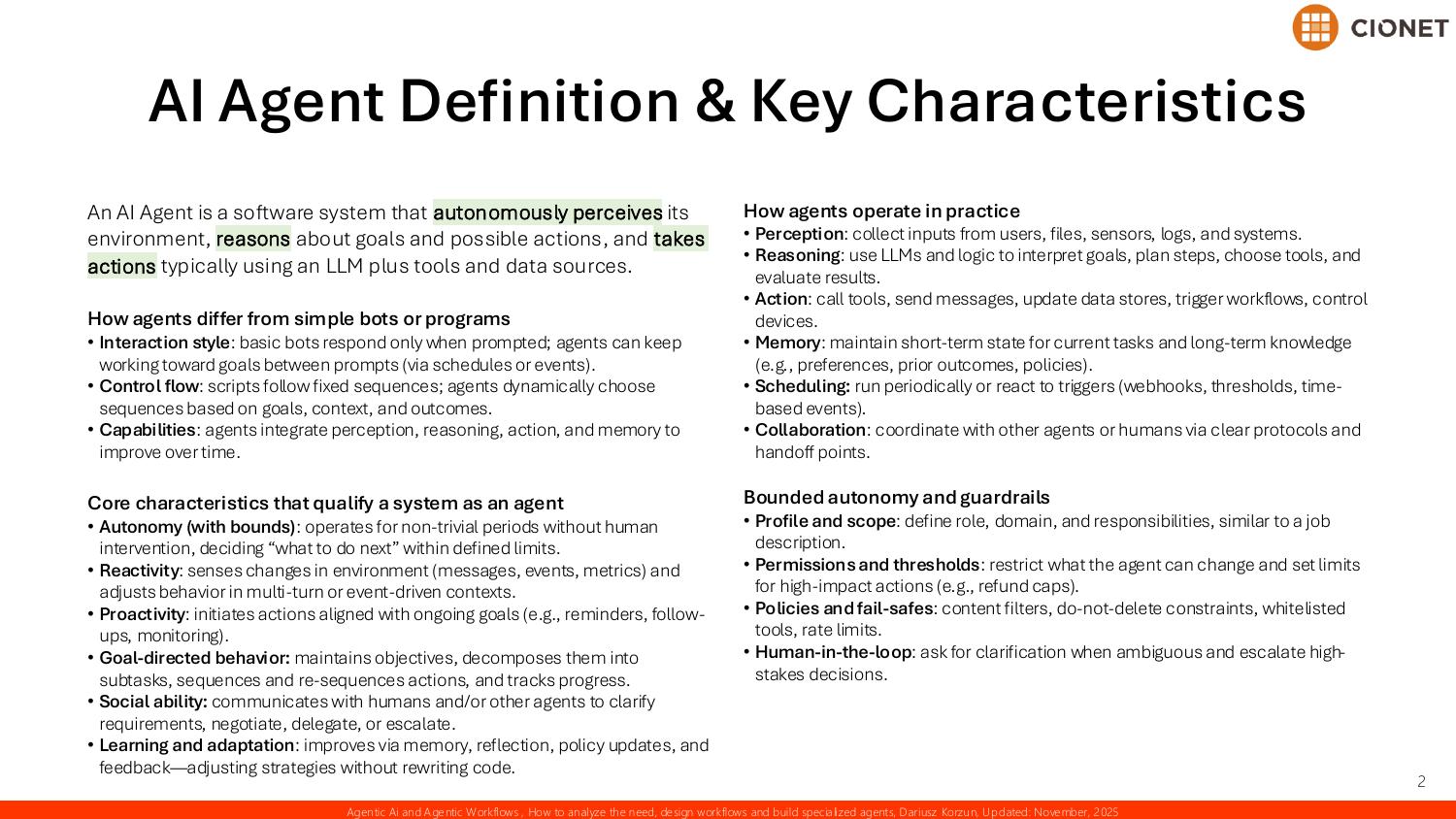
AI agent definition and key characteristics — a software system that autonomously perceives, reasons, and acts using an LLM plus tools, how agents differ from simple bots, the core traits of autonomy, reactivity, proactivity, goal-directed behavior, social ability, and learning, and how bounded autonomy and guardrails keep it in scope

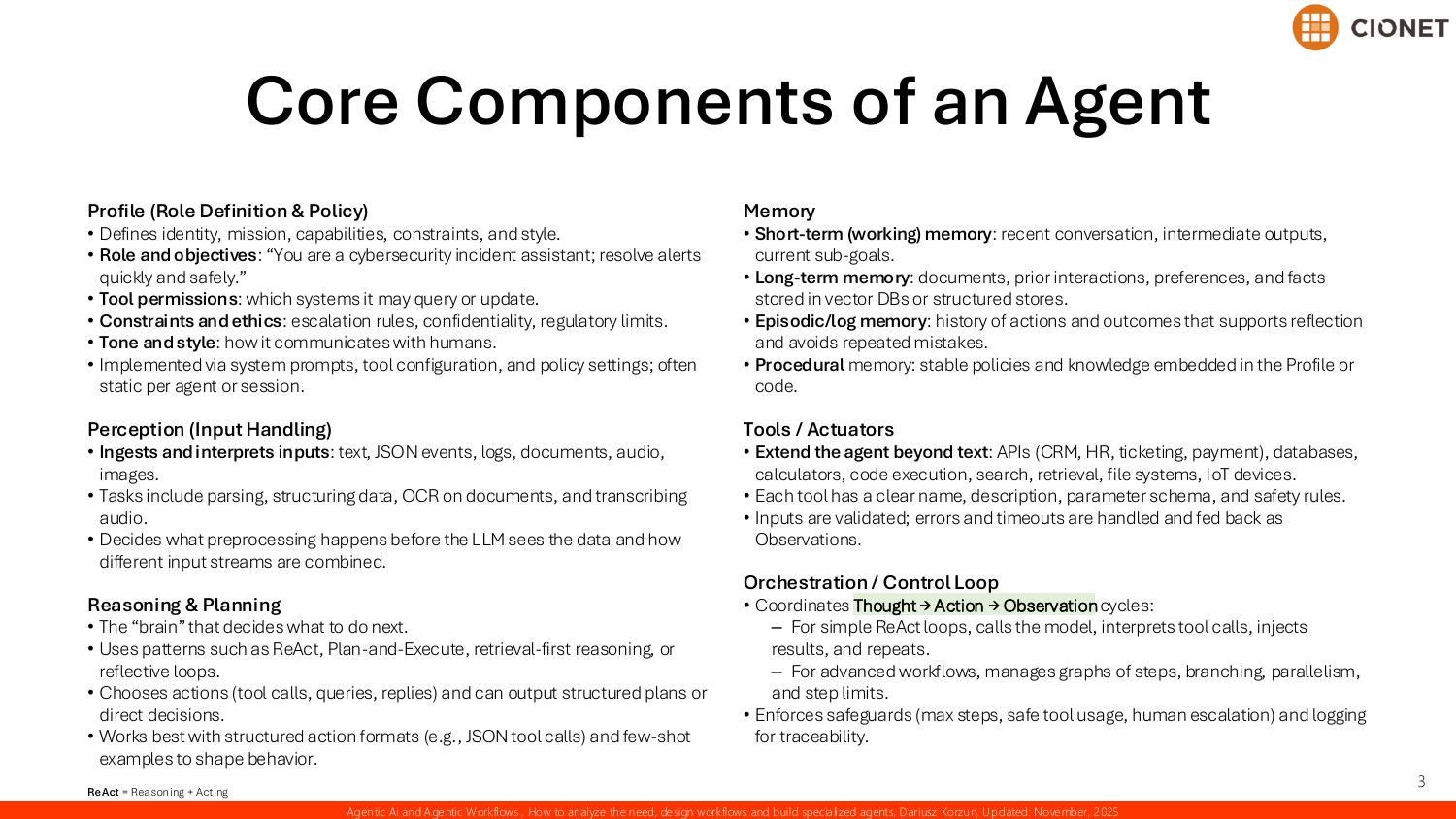
3. Core components of an agent

Core components of an agent — profile and role definition, perception and input handling, reasoning and planning, memory across short-term, long-term, episodic, and procedural layers, tools and actuators, and an orchestration control loop running thought, action, and observation cycles

4. AI agents vs chatbots, RAG systems, and classic automation
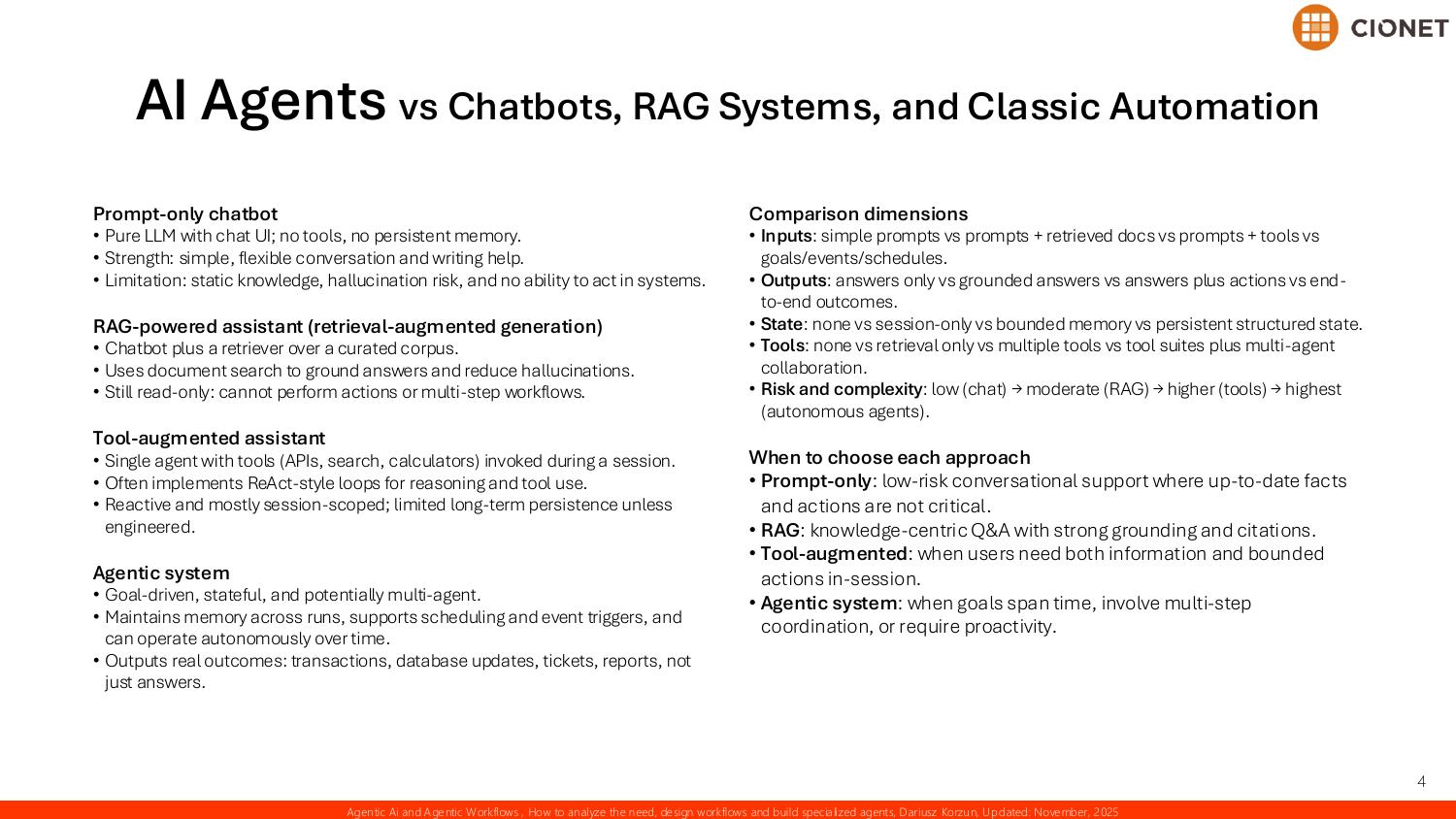
AI agents versus prompt-only chatbots, RAG-powered assistants, tool-augmented assistants, and full agentic systems — compared across inputs, outputs, state, tools, and risk, with guidance on when to choose each approach

5. Reasoning methodologies for agents
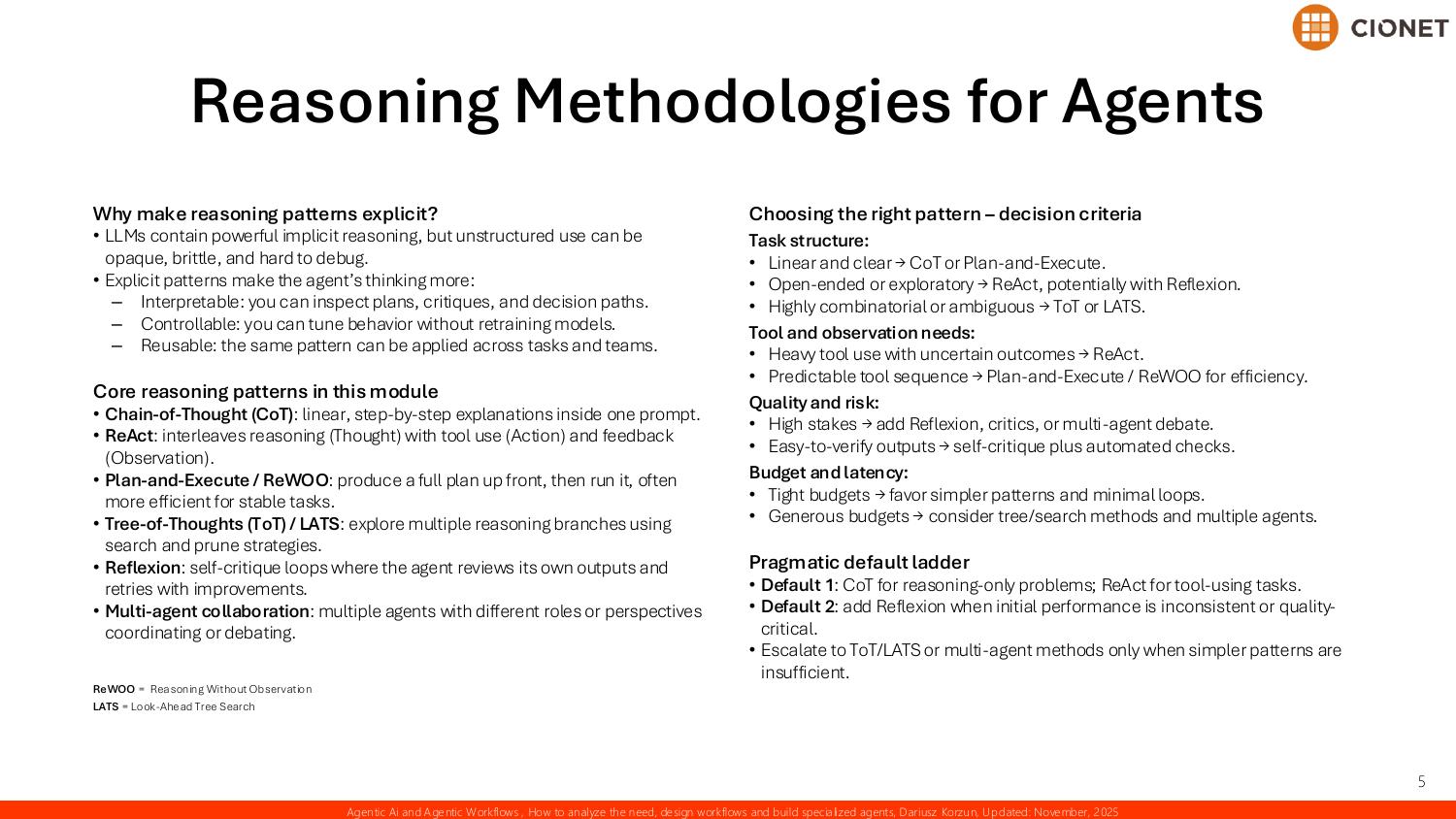
Reasoning methodologies for agents — why to make reasoning explicit for interpretability, control, and reuse, the core patterns of Chain-of-Thought, ReAct, Plan-and-Execute or ReWOO, Tree-of-Thoughts or LATS, Reflexion, and multi-agent collaboration, with decision criteria and a pragmatic default ladder

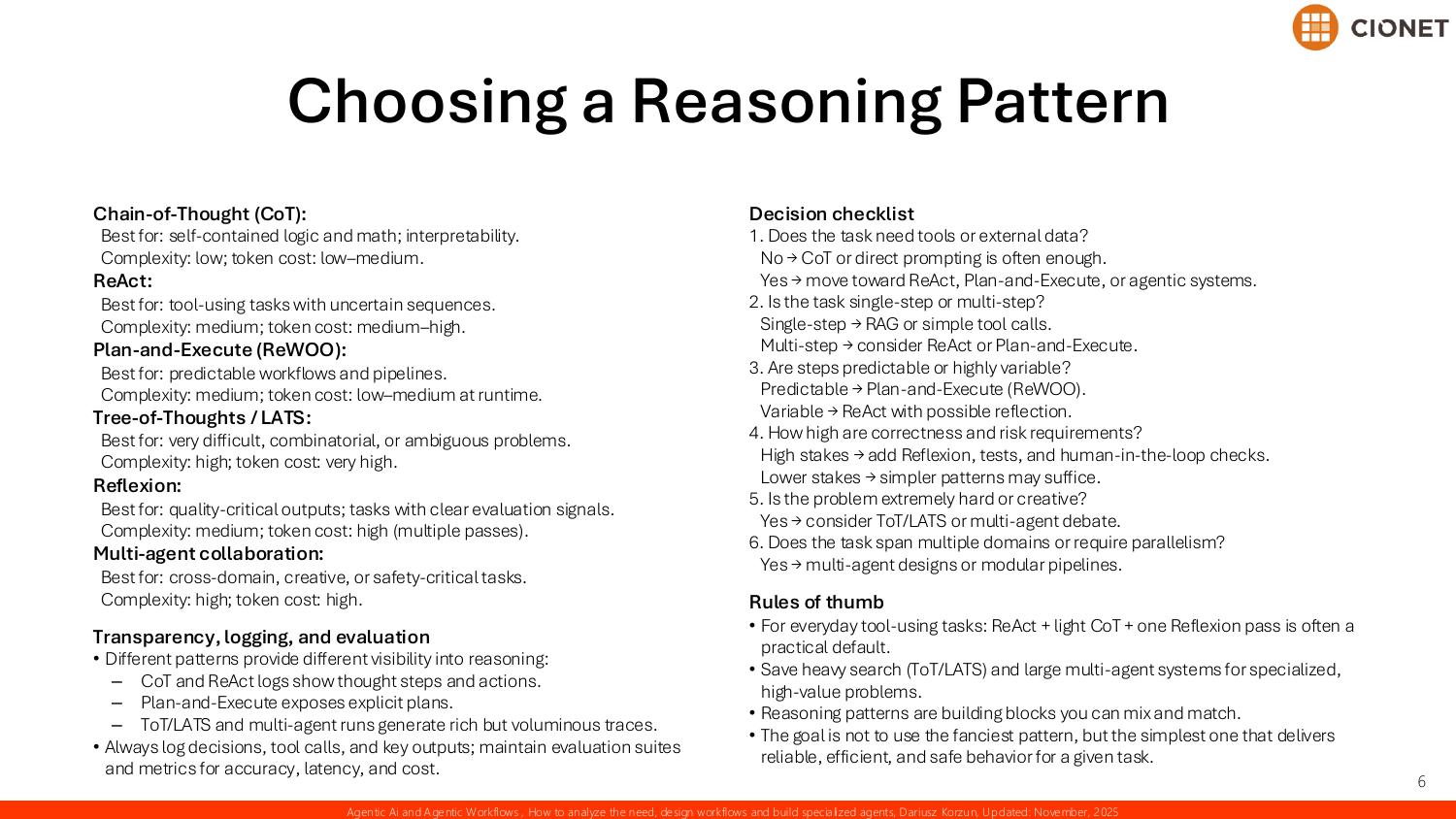
6. Choosing a reasoning pattern

Choosing a reasoning pattern — the strengths, complexity, and token cost of each pattern, a six-step decision checklist, transparency and logging considerations, and rules of thumb favoring the simplest pattern that delivers reliable, efficient, and safe behavior

7. The five-question framework for need analysis
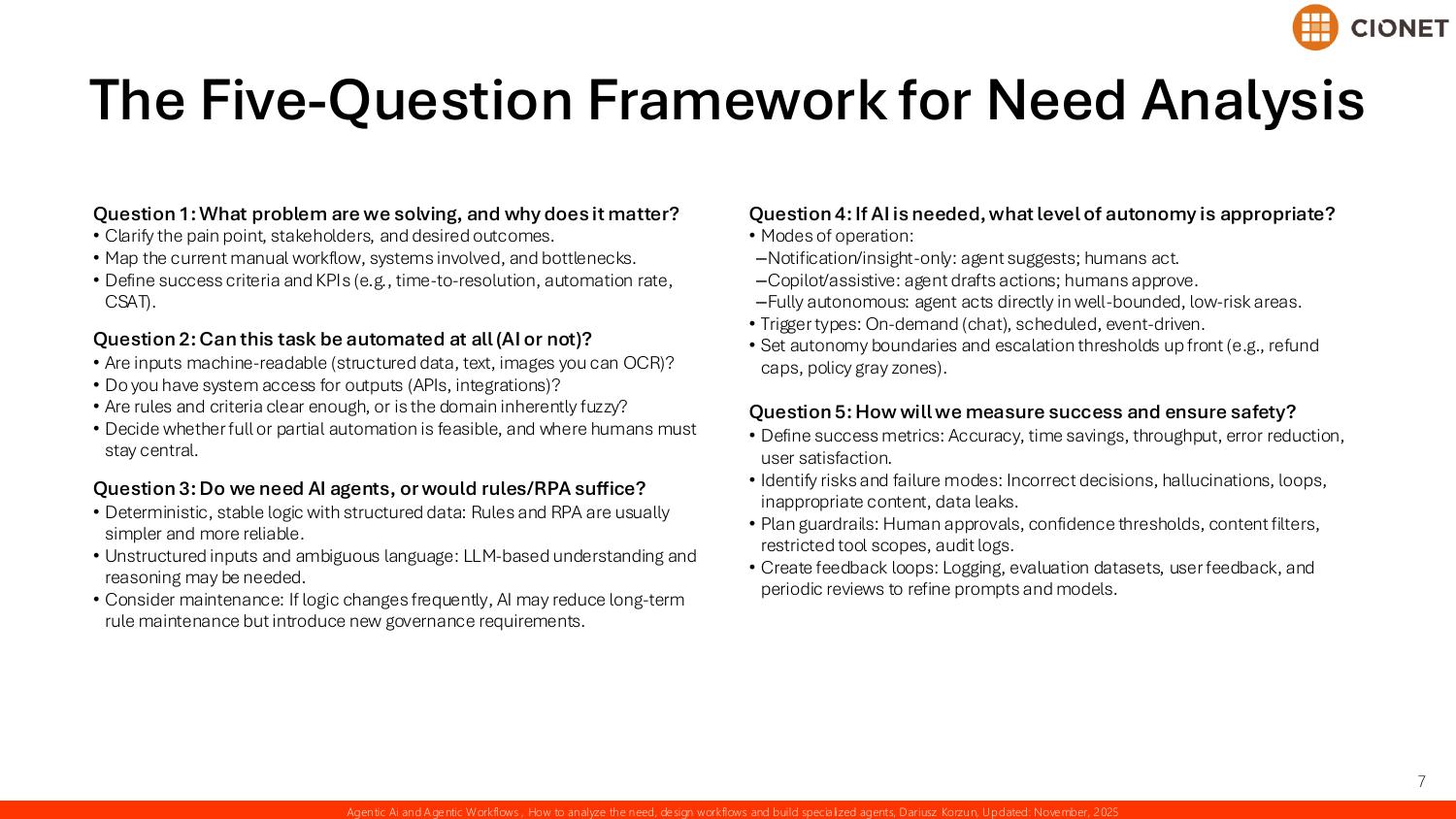
The five-question framework for need analysis — what problem are we solving and why, can the task be automated at all, do we need agents or would rules and RPA suffice, what level of autonomy is appropriate, and how we will measure success and ensure safety

8. RAG vs single agent vs multi-agent vs non-AI
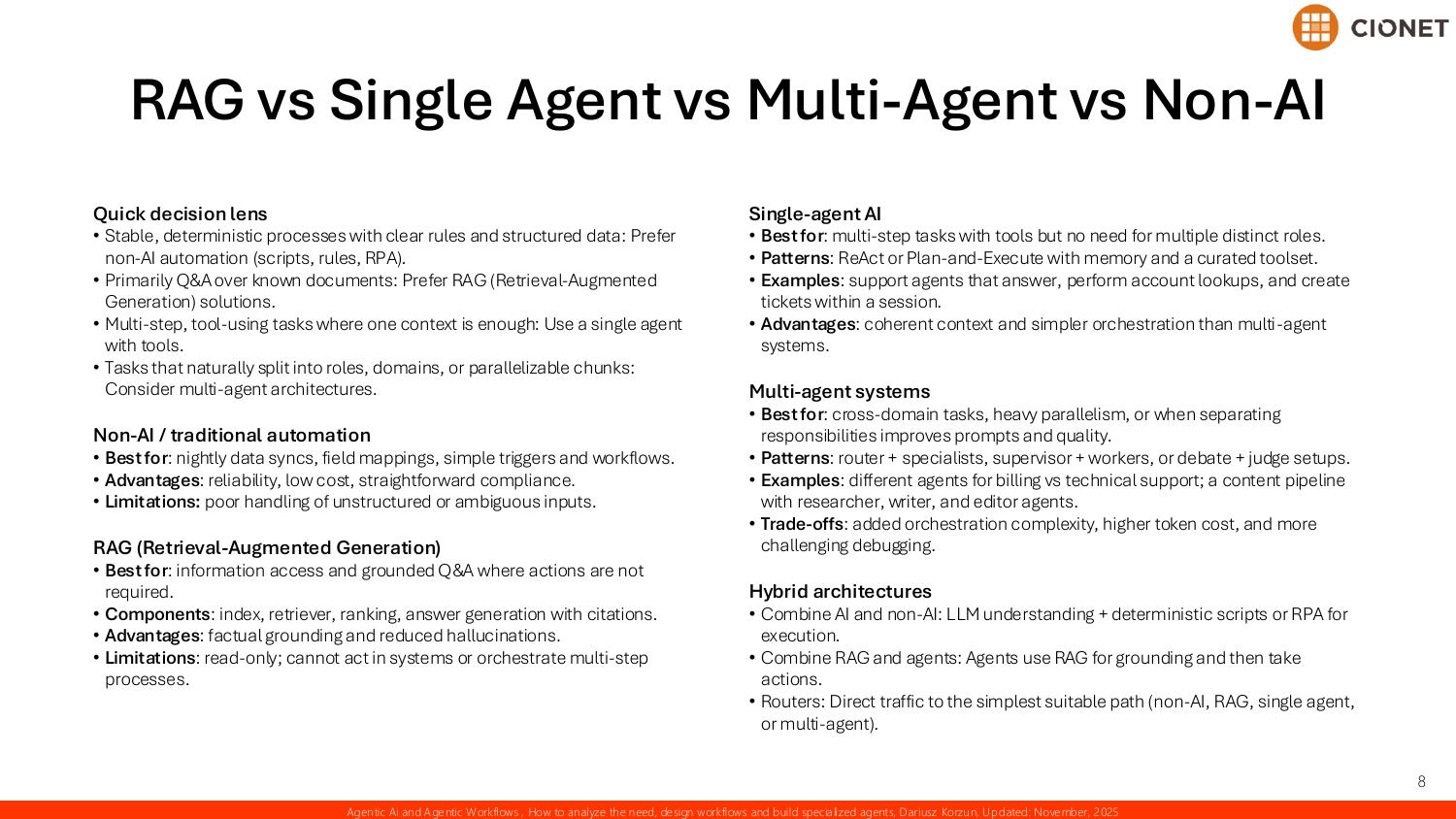
RAG versus single agent versus multi-agent versus non-AI — a quick decision lens, when traditional automation, retrieval-augmented generation, a single agent, or a multi-agent system fits best, and hybrid architectures that combine them with routers

9. Decision tree for architecture choice
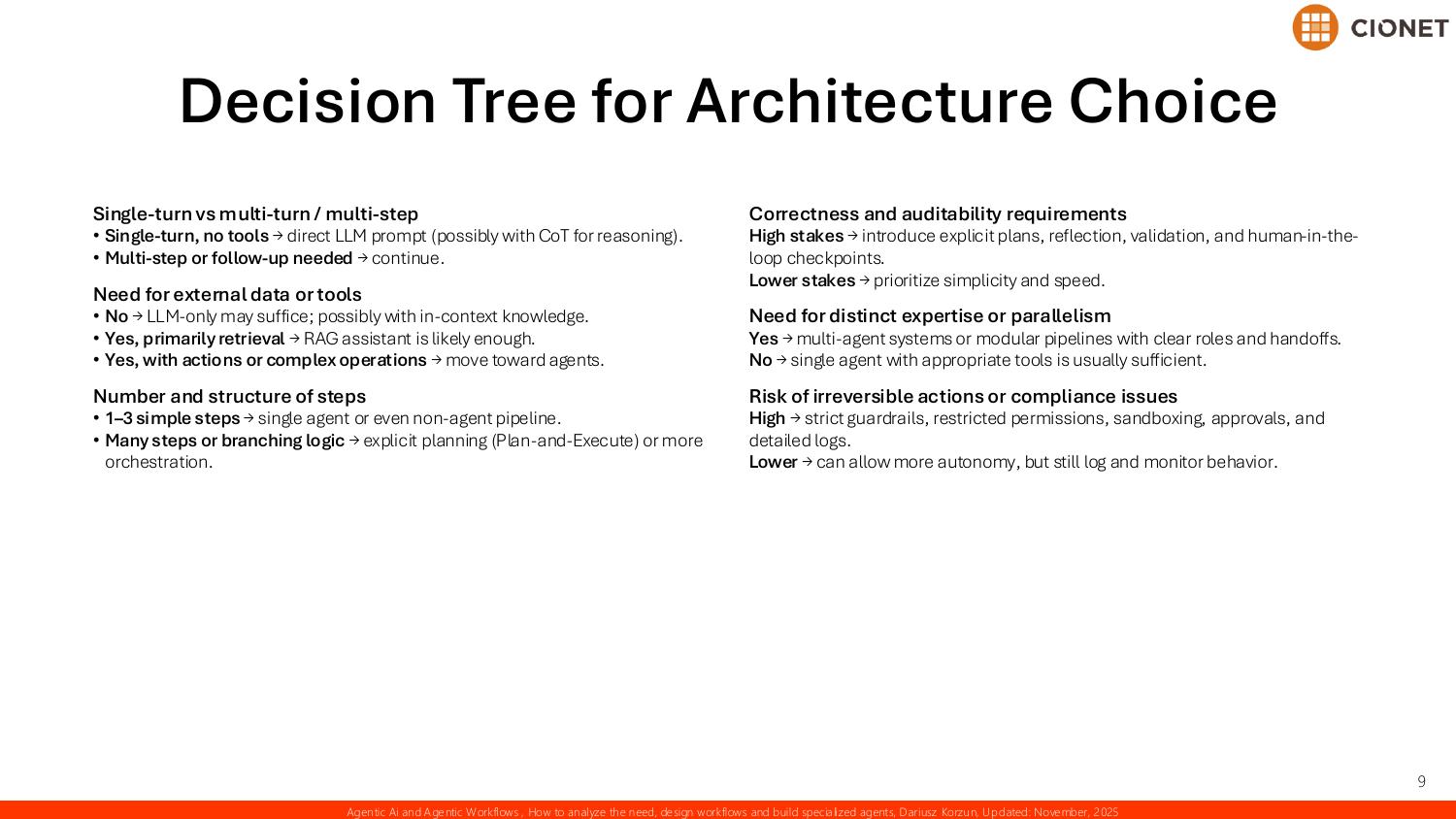
Decision tree for architecture choice — single-turn versus multi-step, the need for external data or tools, the number and structure of steps, correctness and auditability requirements, the need for distinct expertise or parallelism, and the risk of irreversible or compliance-sensitive actions

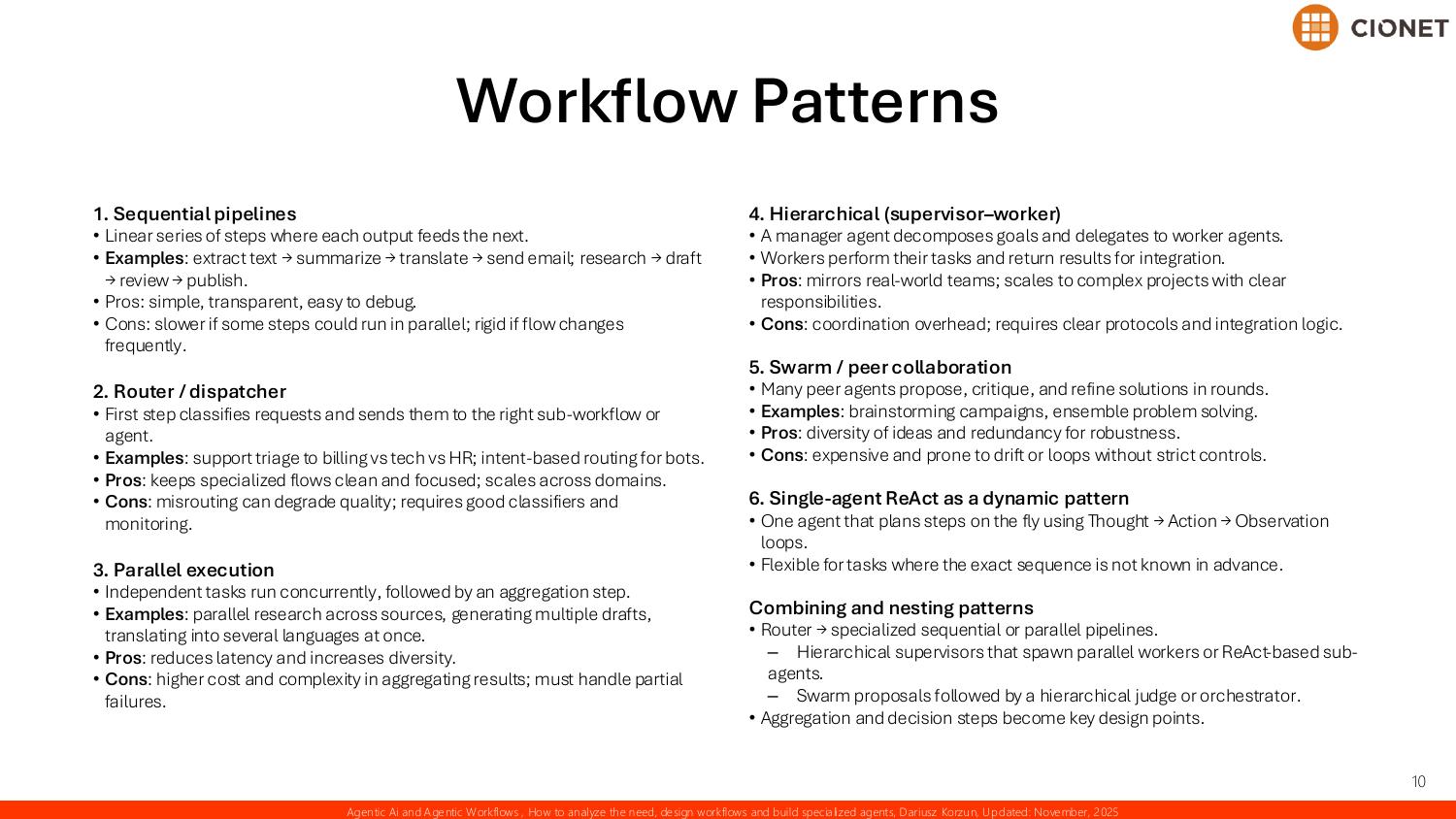
10. Workflow patterns

Workflow patterns — sequential pipelines, router and dispatcher, parallel execution, hierarchical supervisor and worker, swarm and peer collaboration, and single-agent ReAct as a dynamic pattern, plus how to combine and nest them around aggregation and decision points

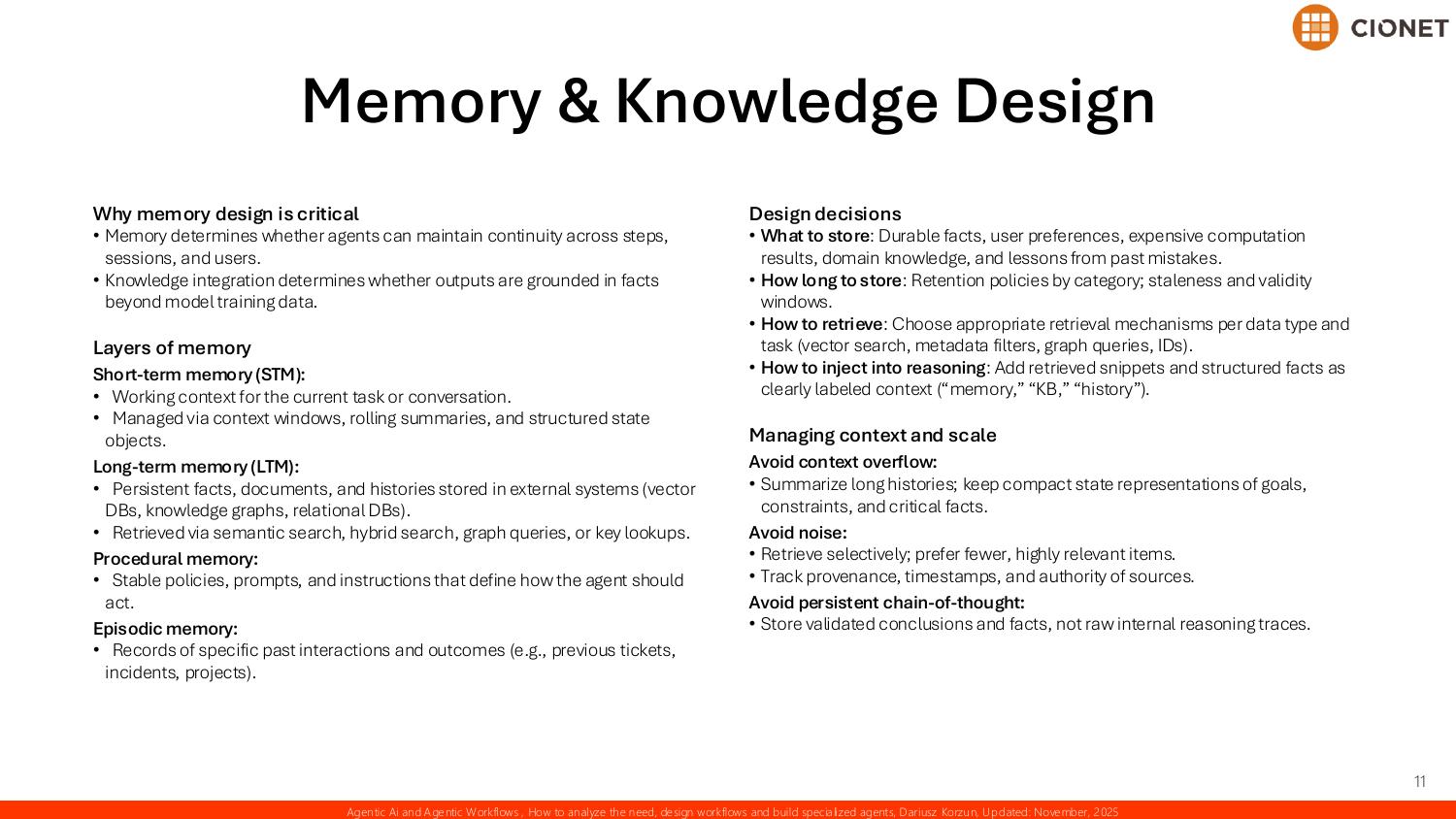
11. Memory and knowledge design

Memory and knowledge design — why memory is critical for continuity, the layers of short-term, long-term, procedural, and episodic memory, key design decisions on what to store, how long, and how to retrieve and inject it, and how to manage context and scale without overflow or noise

12. Memory and knowledge design, continued
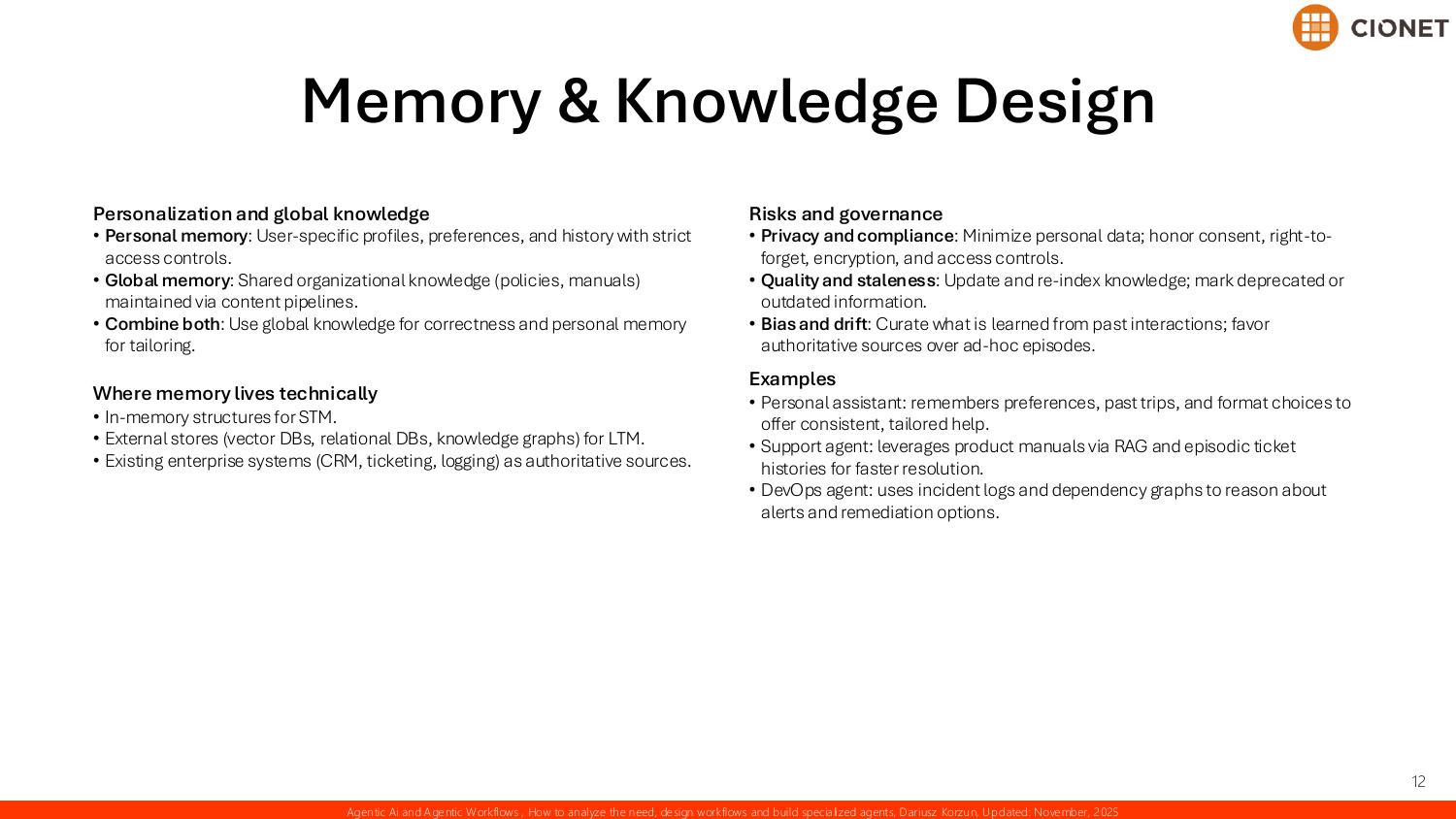
Memory and knowledge design continued — balancing personal and global knowledge, where memory lives technically across in-memory structures, vector and relational stores, and enterprise systems, the risks and governance of privacy, staleness, and drift, and examples for personal, support, and DevOps agents

13. What breaks when analysis is skipped
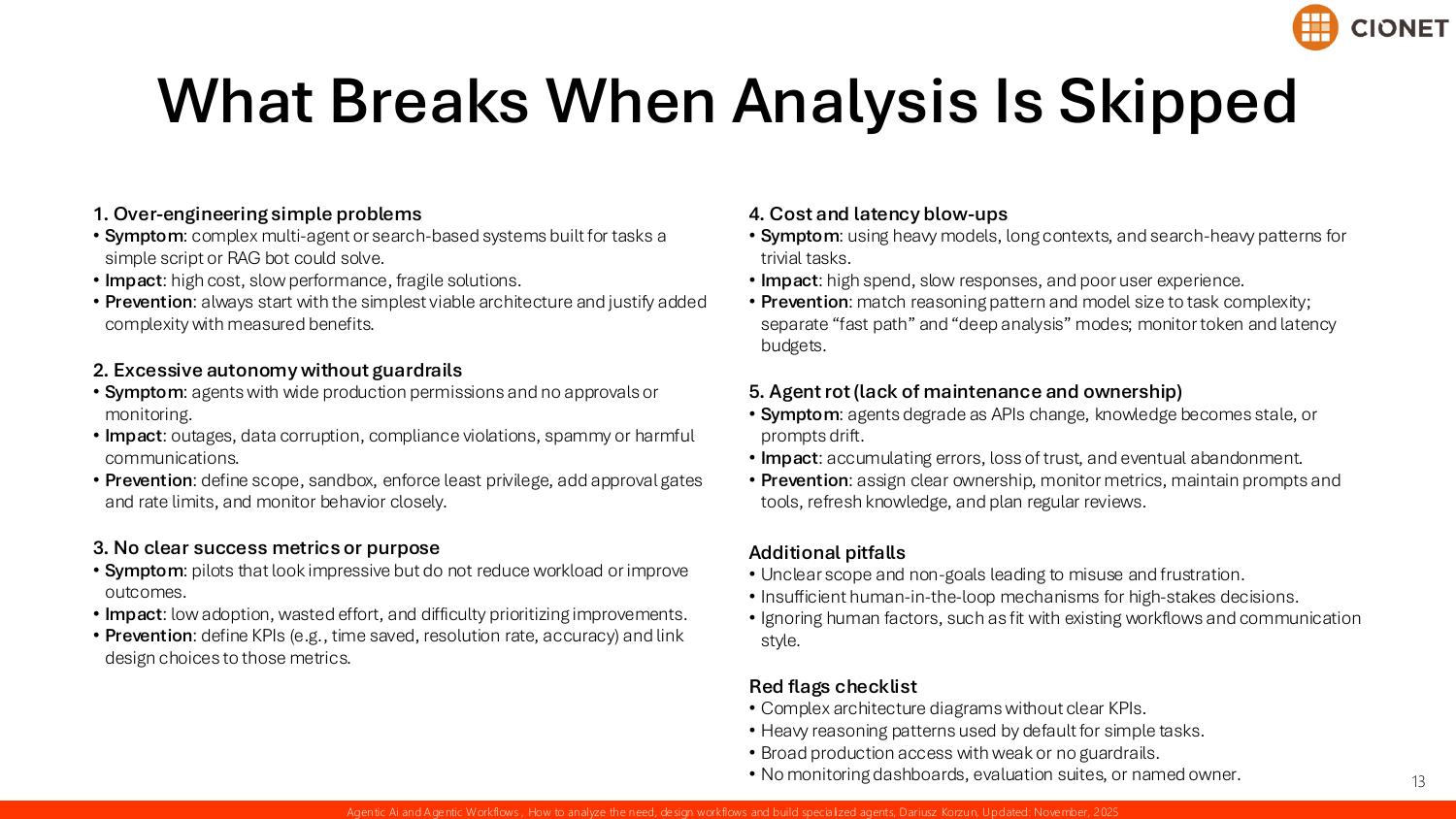
What breaks when analysis is skipped — over-engineering simple problems, excessive autonomy without guardrails, no clear success metrics, cost and latency blow-ups, and agent rot from lack of maintenance and ownership, with prevention measures and a red-flags checklist

14. Tooling landscape

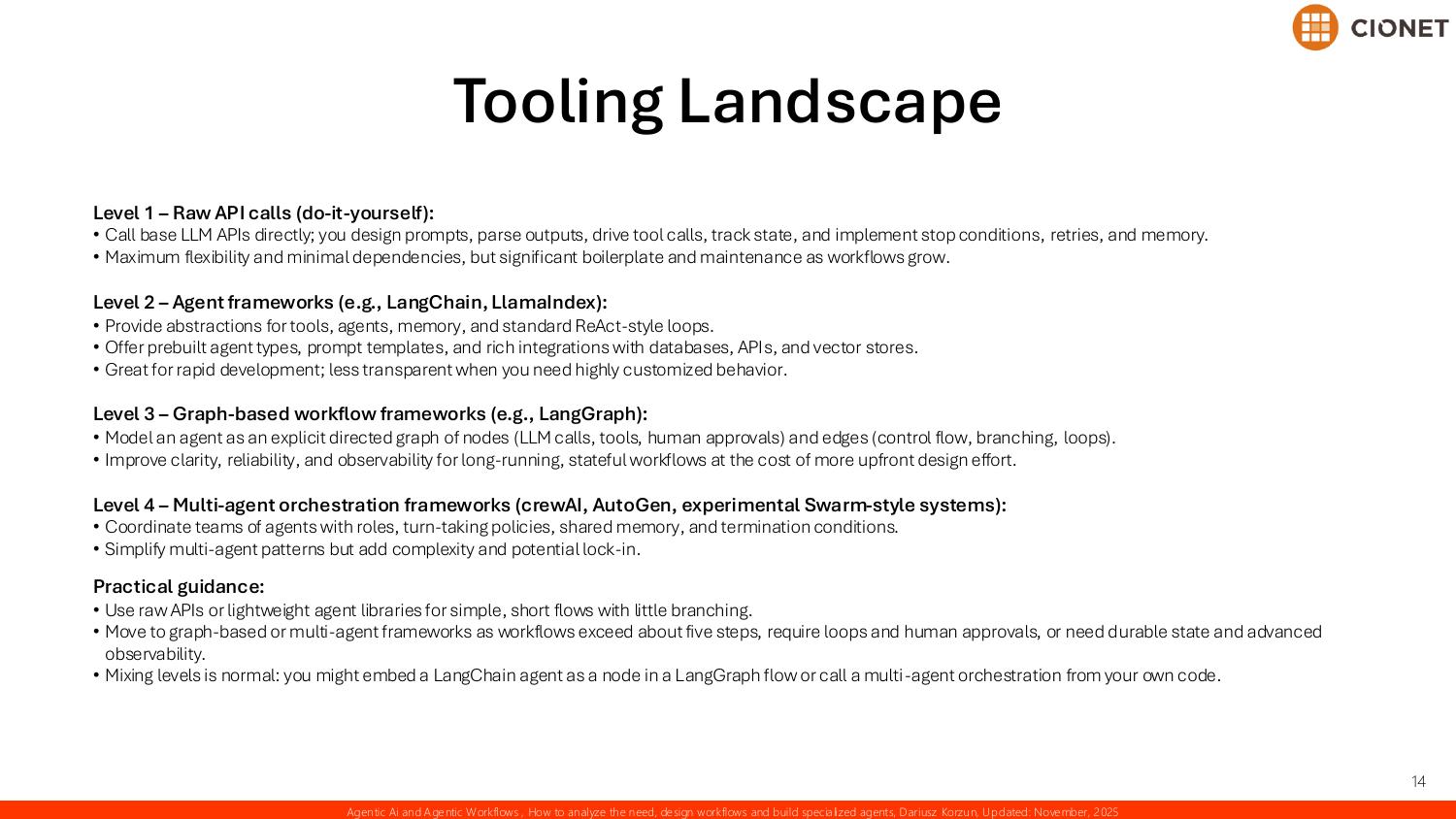
Tooling landscape across four levels — raw API calls, agent frameworks such as LangChain and LlamaIndex, graph-based workflow frameworks such as LangGraph, and multi-agent orchestration frameworks such as crewAI and AutoGen, with practical guidance on when to move up and how to mix levels

15. Selection matrix

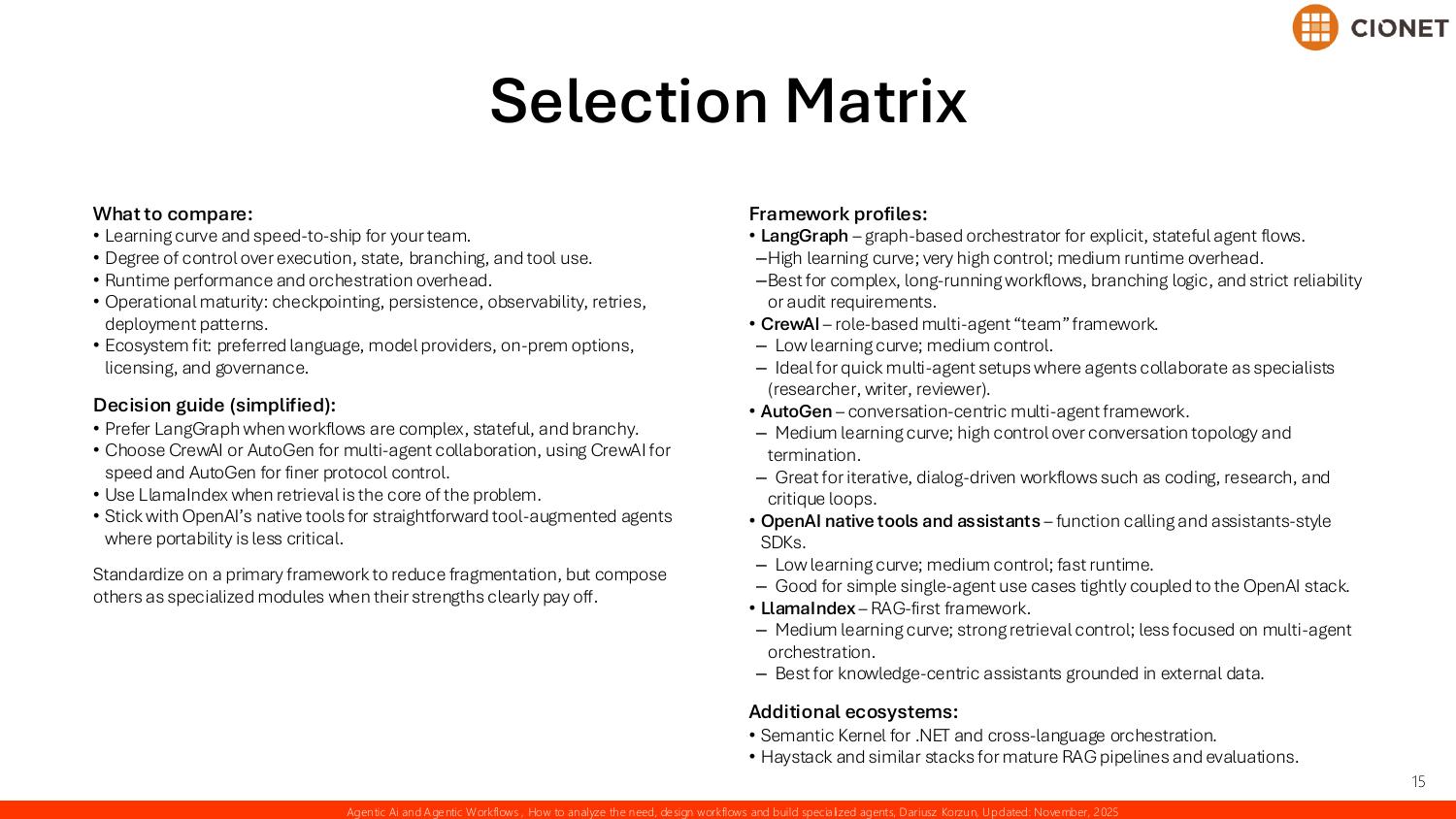
Framework selection matrix — what to compare across learning curve, control, performance, operational maturity, and ecosystem fit, with profiles of LangGraph, CrewAI, AutoGen, OpenAI native tools, and LlamaIndex, plus Semantic Kernel and Haystack as additional ecosystems

16. Evaluation: what and how to measure
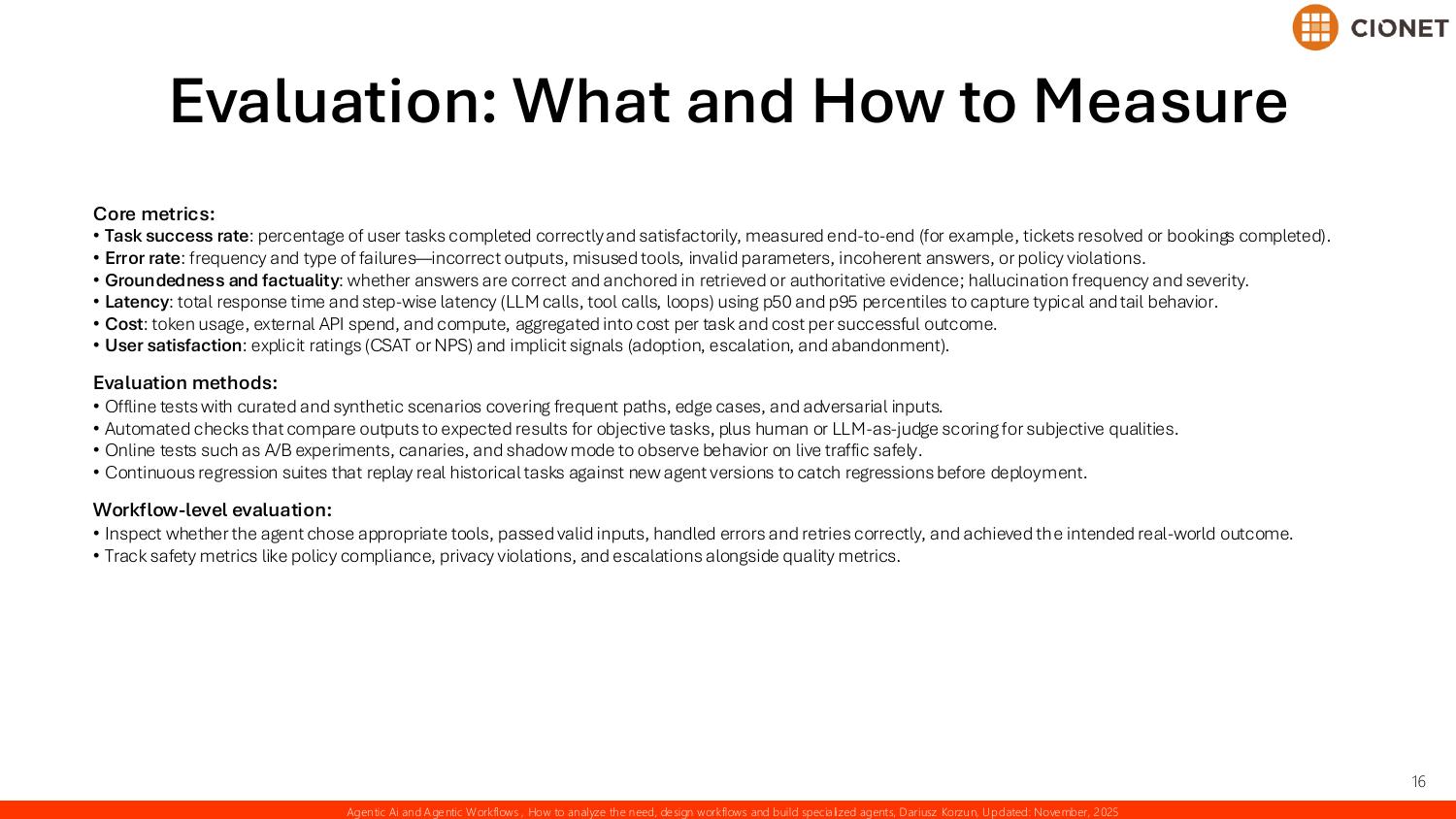
Evaluation of agentic systems — core metrics of task success rate, error rate, groundedness, latency, cost, and user satisfaction, evaluation methods spanning offline tests, automated and LLM-as-judge checks, online experiments, and regression suites, and workflow-level evaluation of tool choice and outcomes

17. Observability and monitoring for agentic systems
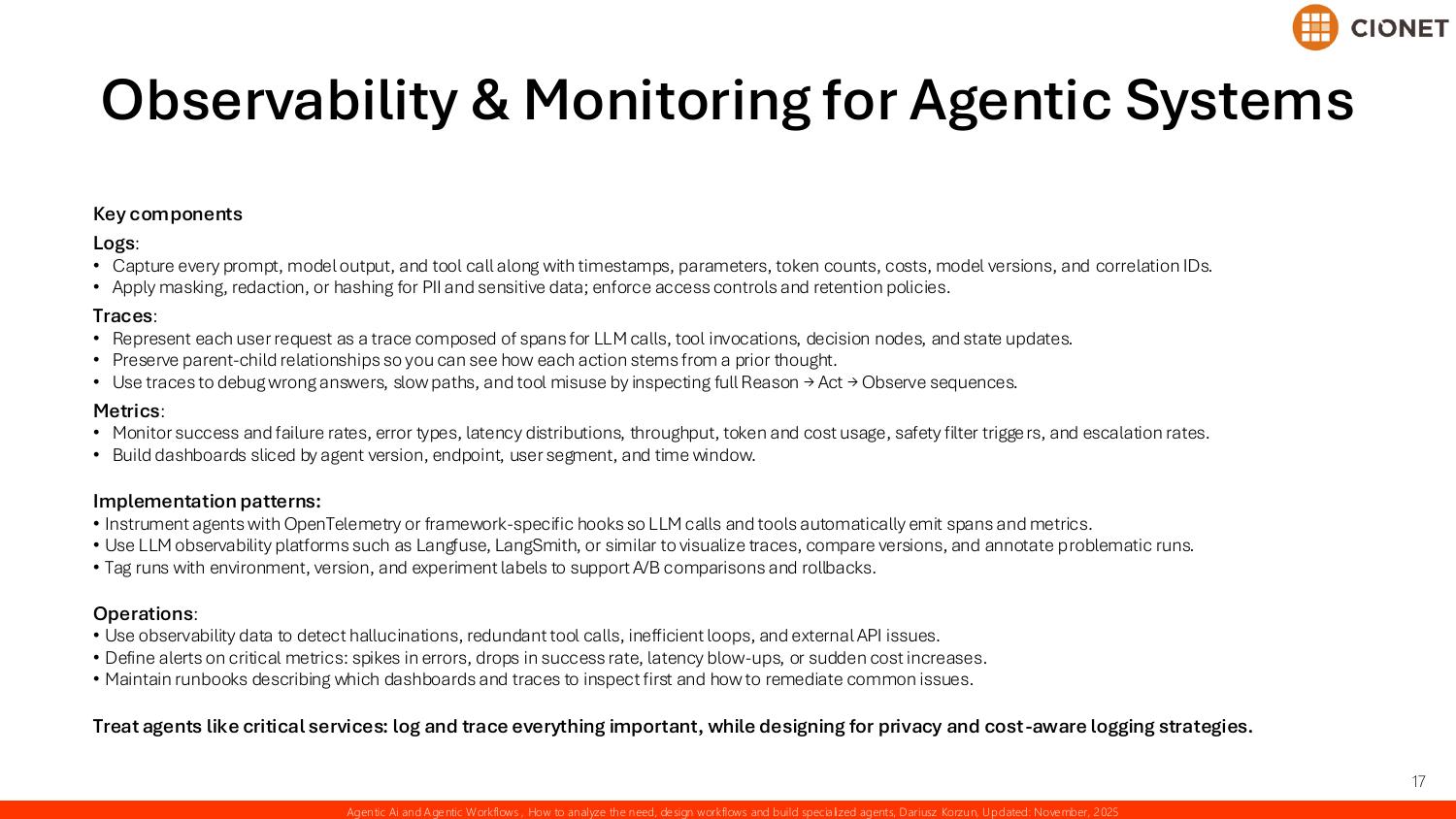
Observability and monitoring for agentic systems — logs, traces, and metrics as key components, implementation with OpenTelemetry and platforms such as Langfuse and LangSmith, and operations covering hallucination detection, alerting, and runbooks, treating agents like critical services

18. Safety fundamentals

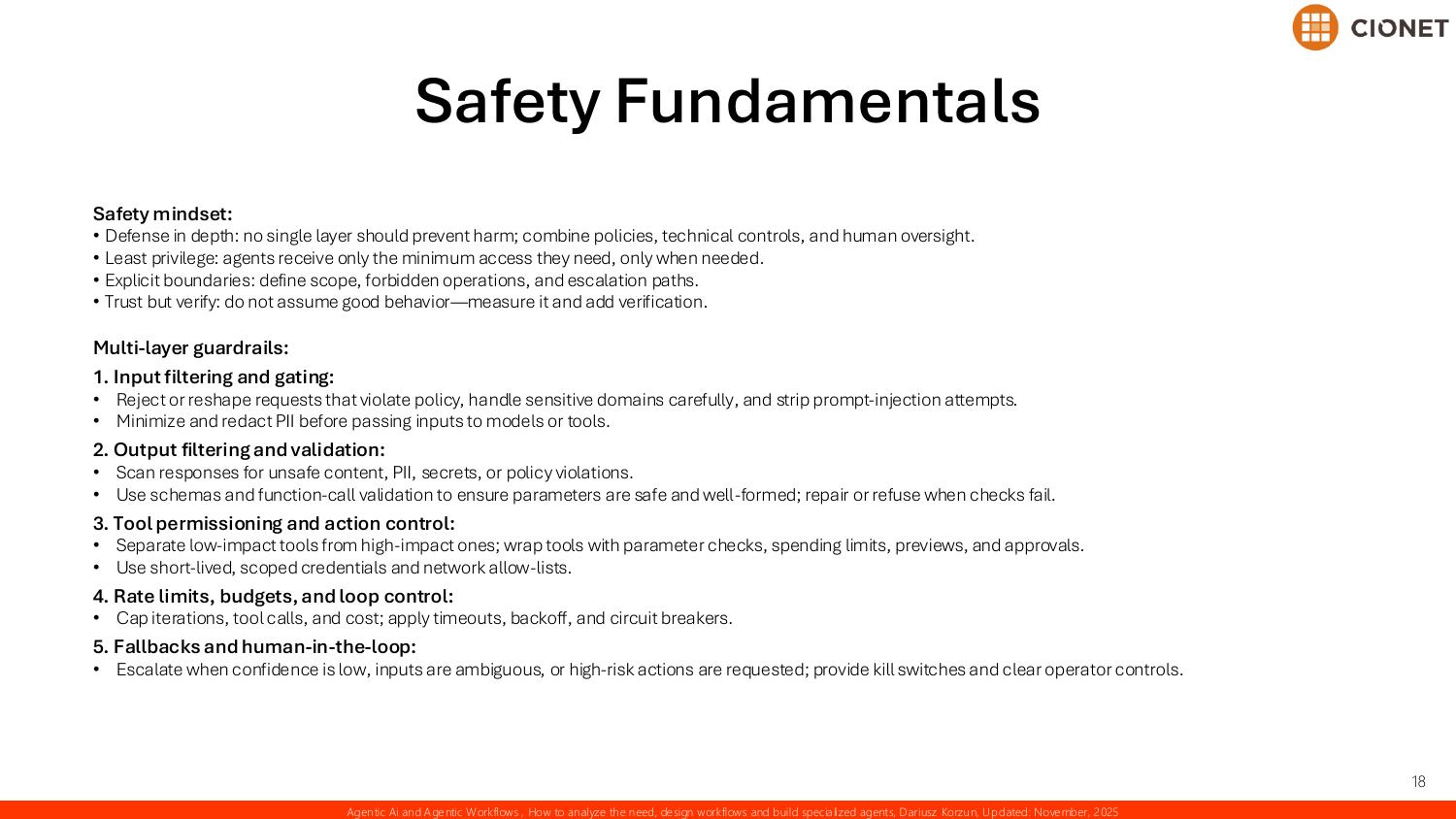
Safety fundamentals — a safety mindset of defense in depth, least privilege, explicit boundaries, and trust but verify, and multi-layer guardrails spanning input filtering, output validation, tool permissioning, rate limits and loop control, and fallbacks with human-in-the-loop escalation

19. Security for enterprise agents

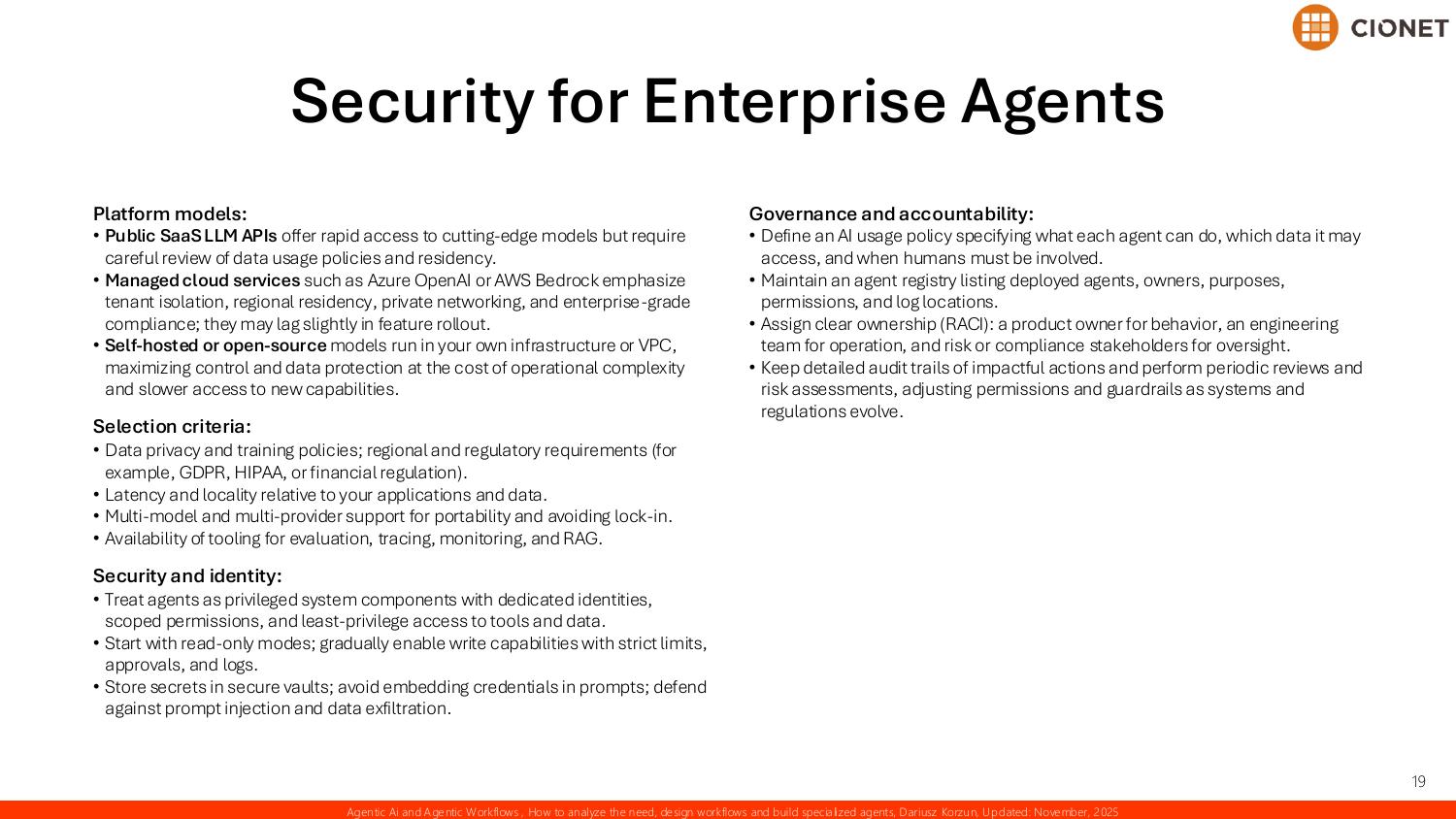
Security for enterprise agents — platform models from public SaaS APIs to managed cloud and self-hosted, selection criteria for privacy, locality, and portability, treating agents as privileged identities with least-privilege access, and governance through usage policies, an agent registry, RACI ownership, and audit trails

20. Closing

Closing slide — thank you for reading, Agentic AI and agentic workflows
← All presentations