
Google's Open Knowledge Format
A vendor-neutral way for agents to share knowledge: plain markdown files with YAML frontmatter, no SDK or backend required. OKF is to knowledge what MCP is to APIs.
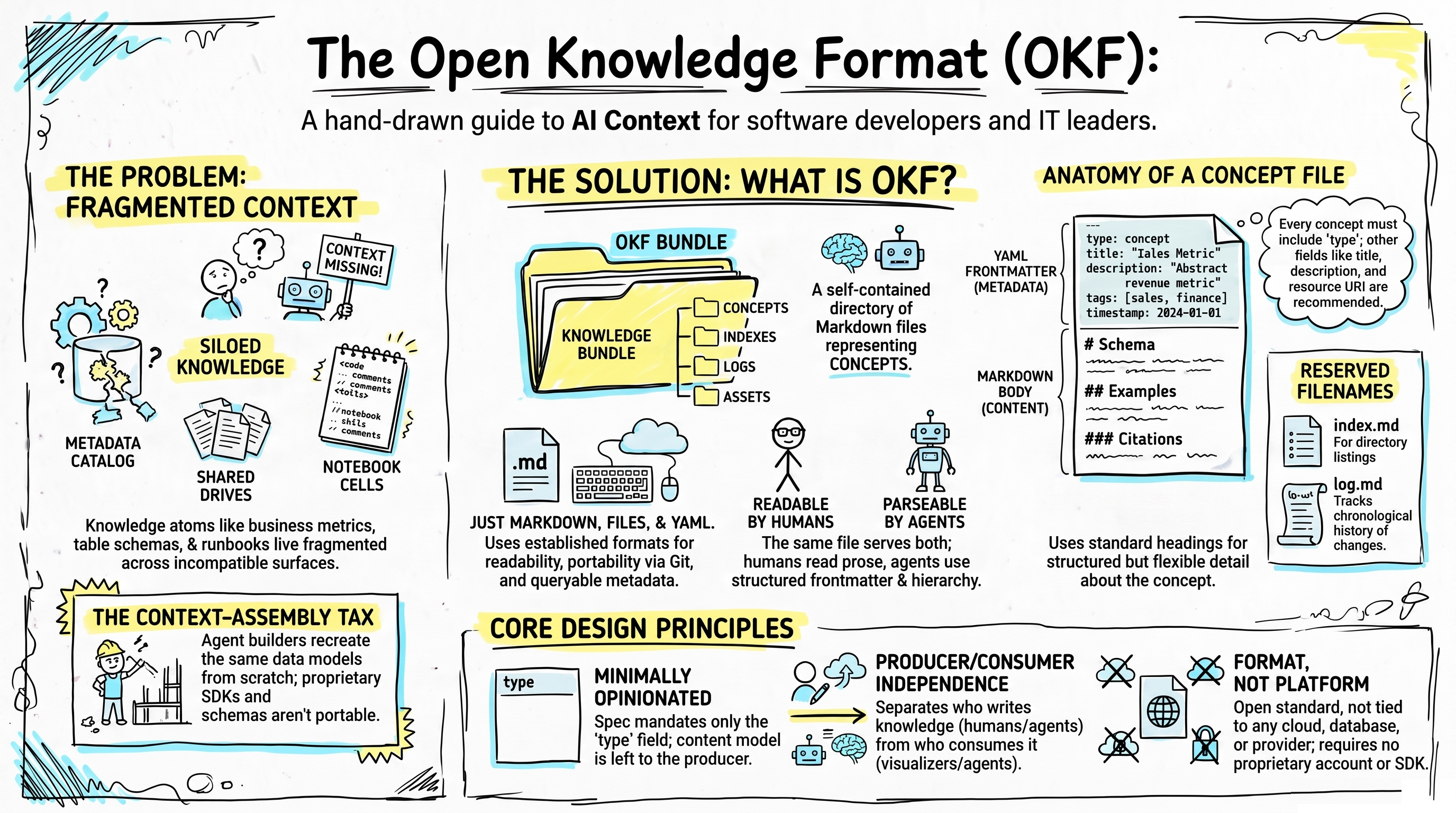
The bottleneck for today’s AI agents is getting the right information to them, not the reasoning itself. Google’s Open Knowledge Format (OKF) addresses this by giving agents a shared way to represent knowledge. The analogy is the Model Context Protocol (MCP): where MCP defines how a model connects to tools and APIs, OKF defines how knowledge is shared. We don’t have to build a bespoke data integration for every new agent.
How it works
- Structure. A folder of plain markdown files, where each file describes a single idea, such as a table, a dataset, or a metric.
- Metadata. Standard YAML frontmatter, with
typethe only required field. Other fields like title, description, and a resource URI are recommended. - Interoperability. No proprietary tooling, runtime, or backend is needed to produce or consume a bundle. It is just markdown, files, and YAML.
- Version control. Because a bundle is just files, it lives in git alongside code, with diffs, reviews, and history.
The format is deliberately minimal. It mandates only the type field and leaves the rest of the content model to whoever produces the knowledge, which keeps producers and consumers independent. That is what makes it a format rather than a platform.